Flatbed vs wheel-lift towing: which is safer?
Both methods are used in Orlando. The owner's manual, plus what the operator sees on scene, decide which one is allowed. This page is a referral guide, not a company equipment policy.
What you'll learn
- How a flatbed differs from a wheel-lift
- Why many manuals want every tire off the ground
- Why Tesla and some other EVs are not a blanket "flatbed only, always" rule
- When wheel-lift plus dollies can keep all four tires off the pavement
- What to tell the operator so they can match equipment to your vehicle
Step by step
- Read the towing section of the owner's manual for that year, make, and model. That is the rule that matters.
- Tell the operator if the vehicle is AWD, 4WD, hybrid, or electric, and whether it is lowered or damaged.
- If the manual wants all four tires off the ground, ask for a flatbed, or a wheel-lift plus dollies if the manual allows that within its distance and speed limits.
- Do not let drive wheels roll on the pavement if the manual forbids it. That is the damage risk, not "wheel-lift" as a word.
- A standard FWD or RWD car with two rolling tires can be a fit for a drive-wheels-up wheel-lift on a short move, if the manual allows it and the unlifted wheels can roll.
- If the operator cannot match the manual, ask them to send different equipment or call another operator.
Tesla's Model Y owner's manual (Tesla, retrieved 2026-09-13) says all four tires must remain off the ground. It recommends a flatbed. It also permits a wheel-lift plus dollies for a bounded distance when all four tires stay off the ground. It does not allow transport with wheels rolling on the pavement. Other EVs, AWD cars, and hybrids have their own manuals. Quick Tow Orlando is a referral line; the operator on scene chooses equipment after reviewing the vehicle.
The short answer
A flatbed keeps all four tires off the road. A wheel-lift lifts two tires and lets the other two roll, unless the operator also uses dollies under the rolling axle. The owner's manual for that vehicle is the instruction that counts. Quick Tow Orlando refers the call to a local operator. It does not set a house rule that every EV or AWD vehicle must always go flatbed, and it does not guarantee that a given method will prevent damage.
How each method actually works
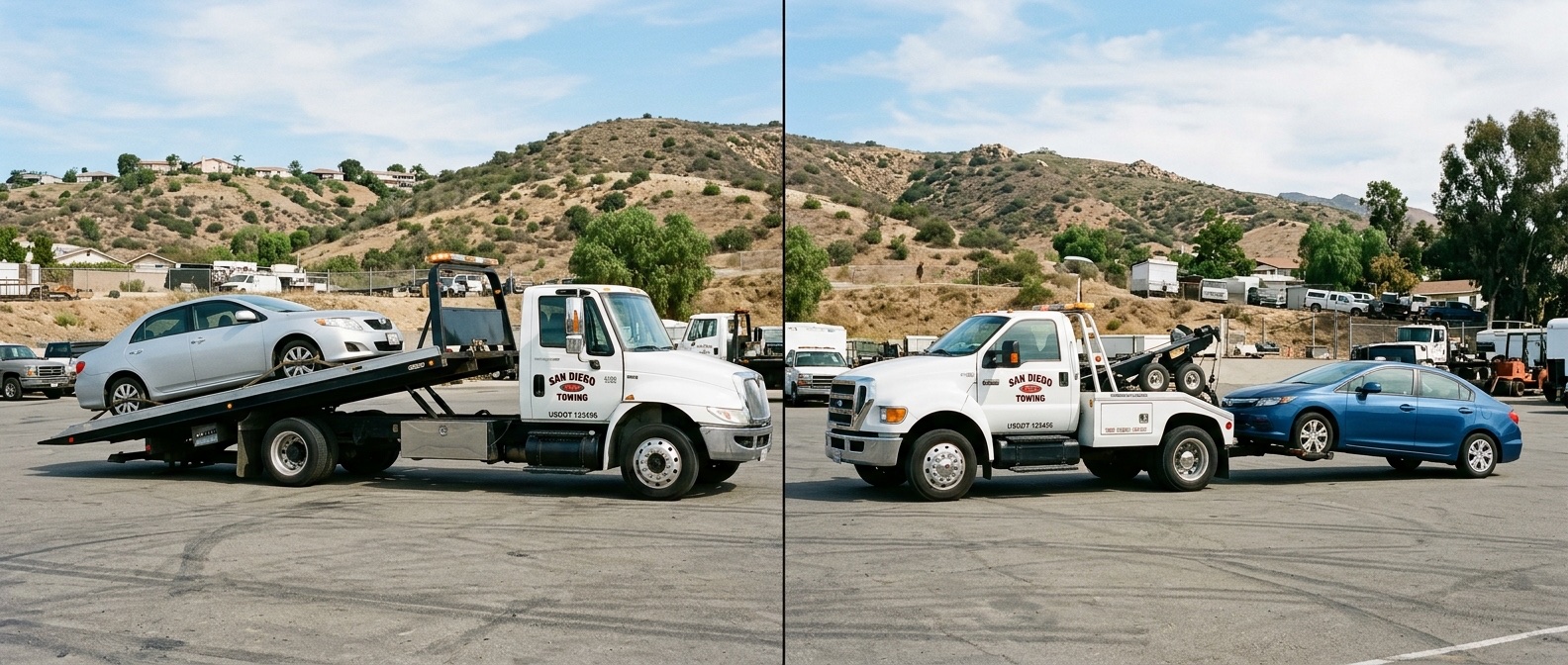
Flatbed (rollback) towing uses a hydraulic-tilt deck that lowers to ground level. The disabled vehicle is winched up the ramp and secured, often with four soft-strap tie-downs at the wheels. All four wheels leave the road. Nothing drags. No part of the drivetrain has to spin on the pavement.
Wheel-lift towing uses a hydraulic yoke that slides under two of the vehicle's wheels (front or rear) and lifts them off the ground. The other two wheels stay on the road unless dollies go under them. If the drive wheels stay on the pavement, many manuals treat that as a damage risk.
What to ask the operator, by vehicle type
| Vehicle type | What to verify | Why |
|---|---|---|
| Front-wheel-drive sedan | Manual plus drive-wheels-up wheel-lift, or flatbed | Two rolling tires can be acceptable on a short move if those tires can roll and the manual allows it |
| Rear-wheel-drive sedan | Manual plus rear wheels up, or flatbed | Same idea: drive wheels off the pavement |
| All-wheel-drive | Usually all four tires off the ground | A rolling axle can load a center differential or transfer case. Confirm the manual, then ask for a flatbed or wheel-lift plus dollies |
| 4WD truck/SUV | Manual; some allow wheel-lift only with axles disconnected | Transfer-case risk if an axle stays driven on the pavement |
| Tesla and many other EVs | All four tires off the ground. Flatbed is common. Wheel-lift plus dollies may be allowed inside the manual's limits | Tesla's Model Y manual recommends a flatbed and also permits wheel-lift plus dollies for a bounded distance when every tire stays off the ground. It does not allow wheels on the pavement. Check your year and model |
| Plug-in hybrid | Read that model's towing section | Some share EV transport limits; some do not. Do not copy a Tesla sentence onto every hybrid |
| Lowered or damaged vehicle | Operator has to see approach angle and whether an unlifted wheel can roll | A wheel-lift can scrape a lip. A damaged wheel should not roll behind a truck |
Manufacturer instructions, not a house policy
- Tesla Model Y (owner's manual transport instructions, Tesla, checked 2026-09-13): all four tires off the ground. Flatbed recommended. Wheel-lift plus dollies permitted within the manual's distance limit when all four tires stay off the ground. Not "flatbed only, always, no exceptions."
- Other EVs and AWD vehicles: open the towing chapter for that year. Many want every tire off the ground. That can be a flatbed or a wheel-lift with dollies. Do not treat a list of brand names as a substitute for the book in the glovebox.
If an operator wants to roll drive wheels on the pavement against the manual, you can refuse that method and ask for different equipment or another operator. Quick Tow Orlando cannot promise how any operator's paperwork assigns damage liability.
Common method mistakes
- Letting drive wheels roll on an AWD or EV because "it is only a few miles." Distance does not rewrite the manual.
- Treating "wheel-lift" as automatically illegal on a Tesla. Wheel-lift plus dollies can keep all four tires off the ground when the Tesla manual allows that. Wheel-lift with two tires on the pavement is the problem Tesla describes.
- Wheel-lift on a lowered car without checking clearance. The yoke can scrape a lip or undertray.
- Rolling a damaged wheel behind the truck. If a tire or hub cannot roll, those wheels need to be off the ground.
- Skipping the manual because a dispatcher sounded sure. The manual is the instruction that the manufacturer published for that vehicle.
How the two methods compare
| Factor | Wheel-lift | Flatbed | What this referral line can say |
|---|---|---|---|
| Local hook | Often faster if two wheels can roll | All four tires off the ground | The operator quotes the job before they roll, when you arrange the tow |
| Long-distance | Ask the manual and the operator | Common when every tire must stay off the ground | Get the method and the total in the same conversation |
| EV / AWD | Only if the manual allows it, including dollies when required | Often the simplest way to keep every tire off the ground | We do not refuse wheel-lift as a brand policy. The operator matches equipment to the vehicle |
Florida and Orange County, kept in their actual scope
Florida does not mandate flatbed versus wheel-lift by vehicle type in a statewide towing statute. Orange County Code Chapter 35, Division III, is the county's trespass, nonconsensual, and immobilization article. Section 35-55 exempts towing done with the consent of the vehicle owner or operator from that article. Insurance minimums, Sheriff filings, and related duties in that Division apply to the regulated nonconsensual work the ordinance covers. They are not a blanket rule for every consensual private dispatch in the metro.
When a wheel-lift can be the right call
- The manual allows two rolling tires, and those tires can actually roll
- A tight parking structure where a flatbed cannot enter, if the operator can still keep the drivetrain inside the manual (including dollies)
- A short move of a conventional FWD or RWD car with no AWD coupling and no EV motor that the manual wants kept off the pavement
What to tell the dispatcher
When you call this line or any operator, give these four data points:
- Year, make, model, and trim (trim often tells AWD versus FWD).
- Whether it is hybrid or electric.
- What happened: mechanical failure, flat, collision, empty tank, dead battery.
- Pickup and drop-off.
A competent operator should say which equipment they are sending and why it matches the manual. If they cannot, ask for different equipment or another operator. Quick Tow Orlando connects the request. It does not operate the truck.
Rather have a pro handle it?
Towing and roadside service across Orlando Metro. One local number, open any hour.
Keep learning.
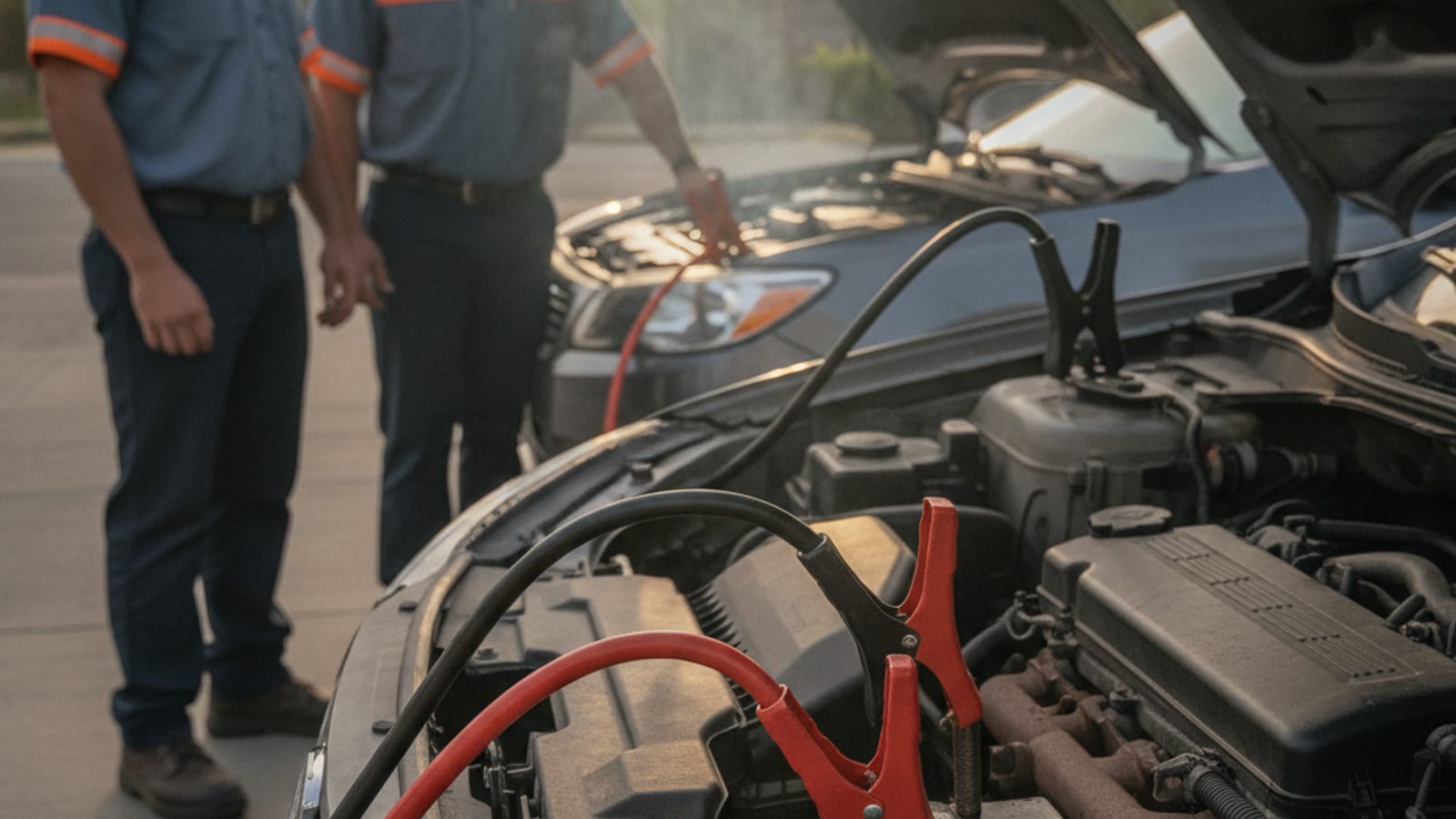
Jump-start a dead battery safely
Jumper cables are simple until you hook them wrong. Do it right and you'll avoid sparks, ruined electronics, and a tow you didn't need.
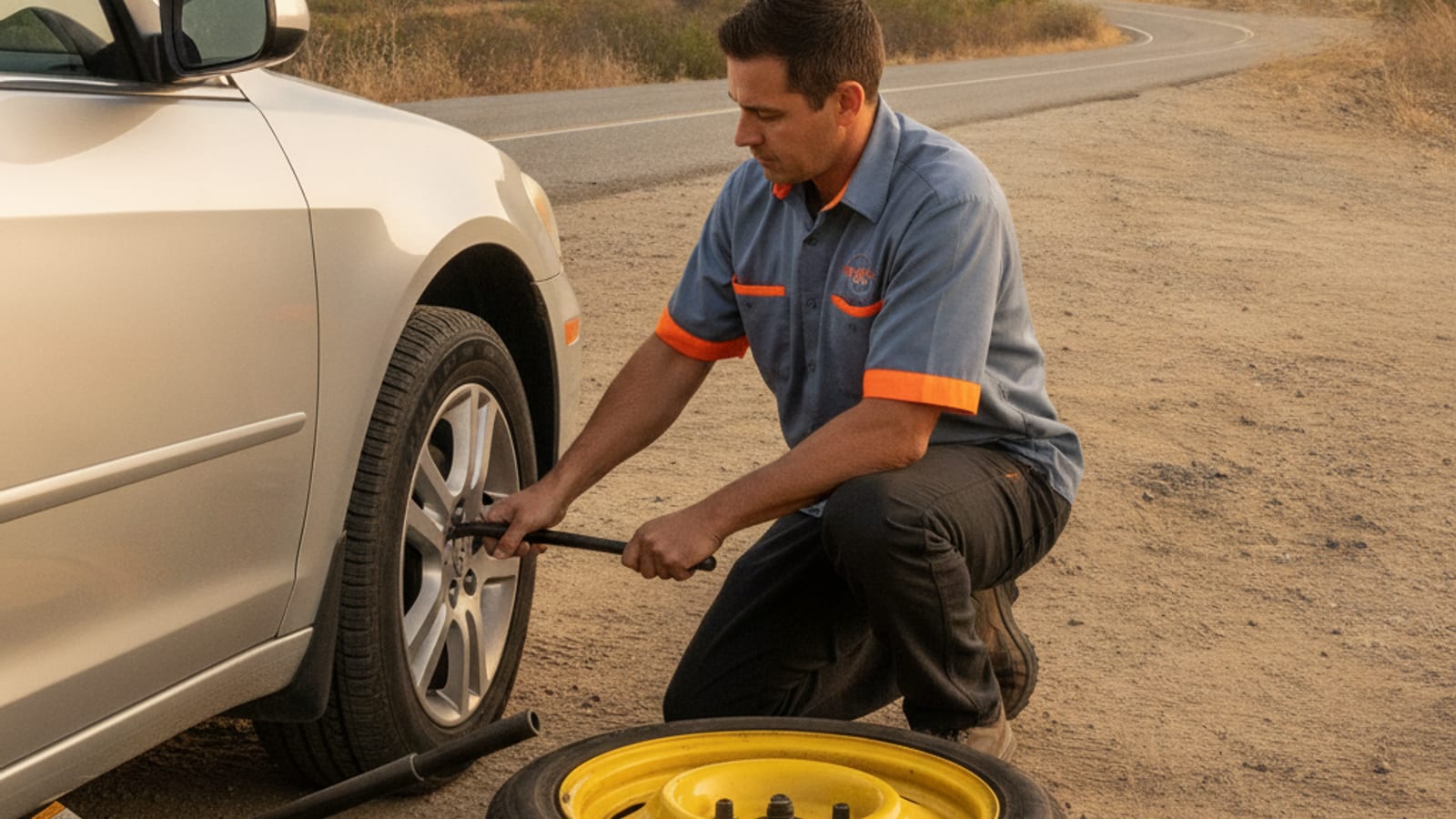
Change a flat tire on the side of the road
The difference between a 20-minute shoulder stop and an hour on the phone with a tow company is knowing where the spare and jack live before you need them.
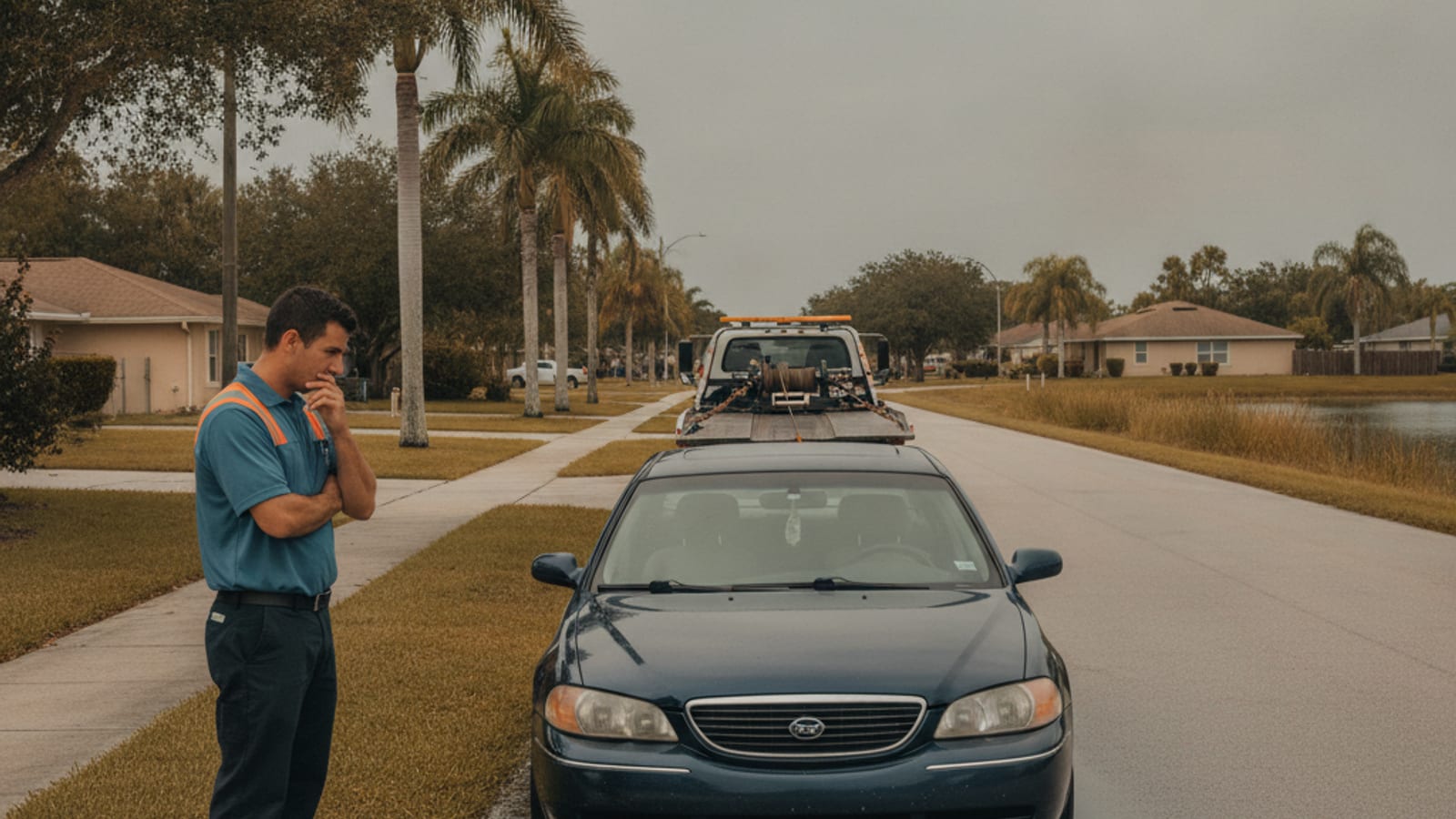
What to do when your car is stuck in mud or standing water
Flooded intersections and soft shoulders on new West Orange County roads swallow cars every rainy season. The first thing to do is stop making it worse.