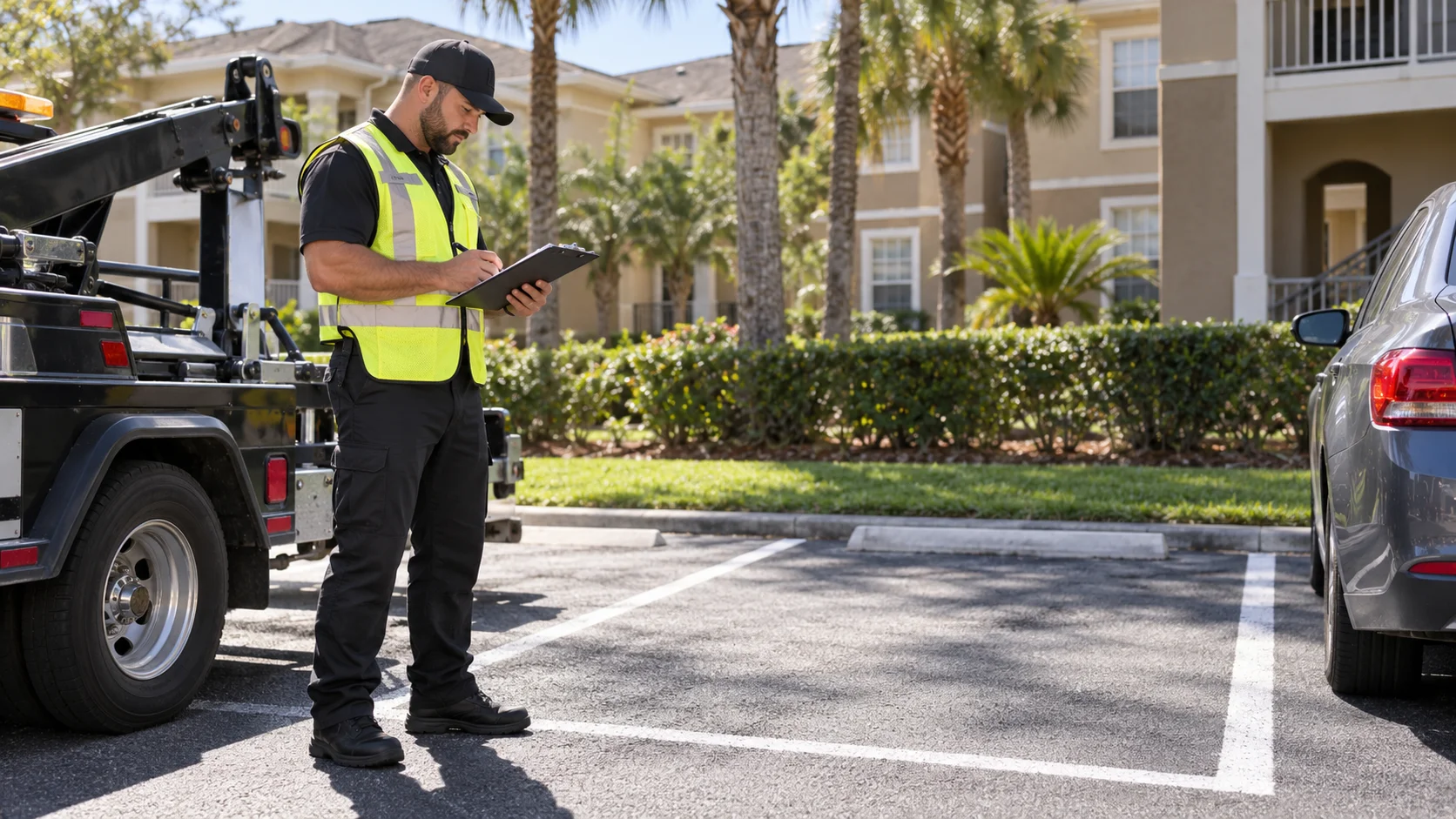
Your car is missing from an Orlando apartment lot. Start with the towing signs, then contact current property management. Those two sources should identify the company used by the property and help confirm where your vehicle went.
Don’t travel to a storage yard based on an old photo or neighbor’s memory. Record the company name, verify the address directly, and confirm that the yard has your vehicle.
Check the parking area before assuming a tow
First, make sure the car is actually gone. Walk the nearby rows, visitor spaces, and overflow parking areas. Check both sides of each building if the apartment complex has several connected lots.
A resident may have moved the vehicle with your permission. Another driver might also have parked it elsewhere. If you’re a guest, contact the person you visited before assuming the property ordered a tow.
Look for changes around the original space. Fresh glass, damaged parking barriers, or other signs of a collision call for a different response. Don’t touch debris or enter an unsafe area.
Check whether the vehicle was parked in an assigned space, fire lane, accessible space, loading area, or marked tow-away zone. Photograph the empty space and nearby markings. Capture the wider parking area too. These images preserve what was visible when you discovered the car missing.
Write down the last confirmed location and time. Include the building number, parking-space number, vehicle description, and plate information. Orlando apartment communities can have several entrances, so note the street or driveway you used.
If you still can’t locate the vehicle, begin with the property’s posted towing information. Our guide to finding a towed car in Orlando covers the broader search when you don’t know whether an apartment, business, or public agency ordered the removal.
This first check prevents a wasted trip. It also gives management and the towing company enough detail to search their records.
Look for the property’s current towing information
Search each vehicle entrance for a tow-away notice. Also check the parking area near visitor spaces, leasing offices, and controlled gates. Don’t rely only on a sign near your building.
For most private-property towing without the vehicle owner’s consent, Florida Statute 715.07 requires posted notices. Exceptions include single-family residences and situations involving personal notice.
The required sign includes the towing company’s name and current telephone number. Its lettering must be reflective against a contrasting background. The “tow-away zone” wording must use letters at least four inches high. Signs must be permanently installed three to six feet above ground.
Florida’s placement rule calls for one sign per 25 feet of lot frontage, or a sign at each driveway access point within 10 feet of the road. The signs must also be maintained for at least 24 hours before towing begins.
Photograph the entire sign. Take a second image showing its location relative to the entrance. Don’t copy only the number, since you may need the company name and sign location later.
Treat the posted information as your strongest first lead, not final proof that the listed company has your car. Call the number shown and provide your plate, vehicle description, and removal location. Ask the company to confirm possession before discussing payment or traveling.
We couldn’t confirm one official lookup that covers every Orlando apartment property. A search result may show a similarly named company, an outdated listing, or a yard serving another community. Use the current sign and current management as your starting points.
For more detail about the notices themselves, read our guide to Florida private-property towing sign requirements.
Ask management who authorized the removal
Contact the apartment’s current leasing office or property manager. Ask which towing company presently serves the property and whether management has a record involving your vehicle.
Be specific. Give the vehicle’s year, make, model, color, and plate. State the exact parking area and the last time you saw it. If you had a resident or guest permit, describe how it was displayed.
Ask management to identify the company by name. Then request the storage location and the company’s current contact route. Compare that answer with the posted sign.
Don’t assume an old lease packet is current. Management companies, parking systems, and contractors can change. A sticker on a gate or a number saved by another resident may also be outdated. Current management should be able to explain which company it presently uses, but you should still confirm possession with the towing company.
Ask who requested or authorized the removal. Record the person’s name or job title if management provides it. Also ask for the stated parking reason and the approximate removal time. Keep your tone factual. At this stage, you’re building a clear record and locating the vehicle.
This process is separate from deciding whether the tow was allowed. If the missing vehicle belonged to a visitor, our guide explains the distinct issue of whether a Florida apartment may tow a guest car.
If the sign and management provide different companies, don’t guess. Tell management about the mismatch and ask for updated information. Save photographs, emails, parking notices, and screenshots. A disagreement about authorization can be addressed after you’ve confirmed the vehicle’s location.
Property owners seeking help with an improperly parked vehicle can review our private-property towing connection service. Quick Tow Orlando connects callers with independent local operators. It doesn’t own a storage yard or perform towing itself.
Gather the vehicle and parking details
Have a short fact sheet ready before calling the listed towing company. Clear information makes it easier for the operator to distinguish your vehicle from similar cars.
Include these details:
- The plate number and issuing state
- The vehicle identification number, if available
- The year, make, model, and color
- The apartment name and street location
- The building, gate, or parking-space number
- The last time the vehicle was seen
- Any resident, visitor, or temporary permit details
- The name of the person who authorized the tow, if known
Keep your registration and identification available. Ask the storage facility what documents it requires before releasing the vehicle. Requirements may depend on ownership, lienholder status, or whether someone else is collecting it. We couldn’t confirm one document list that applies to every Orlando-area yard, so check before leaving.
Ask the company to repeat the plate or vehicle description from its record. Then request the tow origin, storage address, removal time, and stated reason. A matching plate and origin offer better confirmation than a simple “yes.”
Also ask for an itemized statement of charges before paying. Don’t assume a price quoted by a neighbor applies to your vehicle.
If the property is in Orange County’s jurisdiction, the county’s published Class A private-property trespass rate is $135. Published storage is $32 per 24-hour increment. The listed drop fee is half the towing rate, capped at $67.50, when a vehicle is reclaimed after hookup but before the truck leaves. Check the current Orange County towing information page before relying on those figures.
We couldn’t confirm City of Orlando maximum rates from the approved research. Don’t apply Orange County figures to a property inside another jurisdiction without checking the current local rule.
Verify the yard before paying or traveling
Confirm that the storage facility has your exact vehicle. Get the yard’s full street address directly from the towing company. Repeat it back and check the destination before starting your trip.
Ask when vehicle releases are available and which payment methods the facility accepts. Don’t assume the release schedule matches general office hours. Orange County’s published rules say phones must be staffed around the clock, including holidays, and a vehicle must be released within 30 minutes after payment. Those county rules shouldn’t be treated as verified City of Orlando requirements.
Florida’s private-property towing statute also requires a vehicle’s release within one hour of the owner’s request. Owners may inspect the vehicle before accepting it. A towing company can’t require a “no release or waiver” clause as a condition of vehicle redemption.
For an Orange County tow, the vehicle generally must be stored within a 10-mile radius of the tow origin. If no storage facility is available within that radius, the maximum expands to 20 miles. If a claimed yard falls outside those limits, verify the property’s jurisdiction and tow origin before drawing a conclusion.
At the yard, photograph the vehicle before moving it. Capture each side, the wheels, and any visible damage. Compare the vehicle’s condition with photos taken before the tow, if you have them. Ask for an itemized receipt and keep every document.
If the company can’t locate your vehicle, return to management with the information you gathered. Recheck the posted sign and ask whether another operator handled the removal. Don’t send money, provide payment credentials, or travel until a company confirms the matching vehicle and storage address.
For an Orange County towing dispute, the county Consumer Protection Office accepts and investigates complaints. It may review the complaint, request a business response, conduct a site visit, or refer the matter. It doesn’t provide legal advice, represent consumers, or force a specific resolution.
When to call us
Call when a disabled vehicle still needs removal, or when a property representative needs an operator for a private-property situation. Quick Tow Orlando takes calls 24/7 and connects Orlando Metro callers with independent towing and roadside operators. Call us at (321) 321-9797.