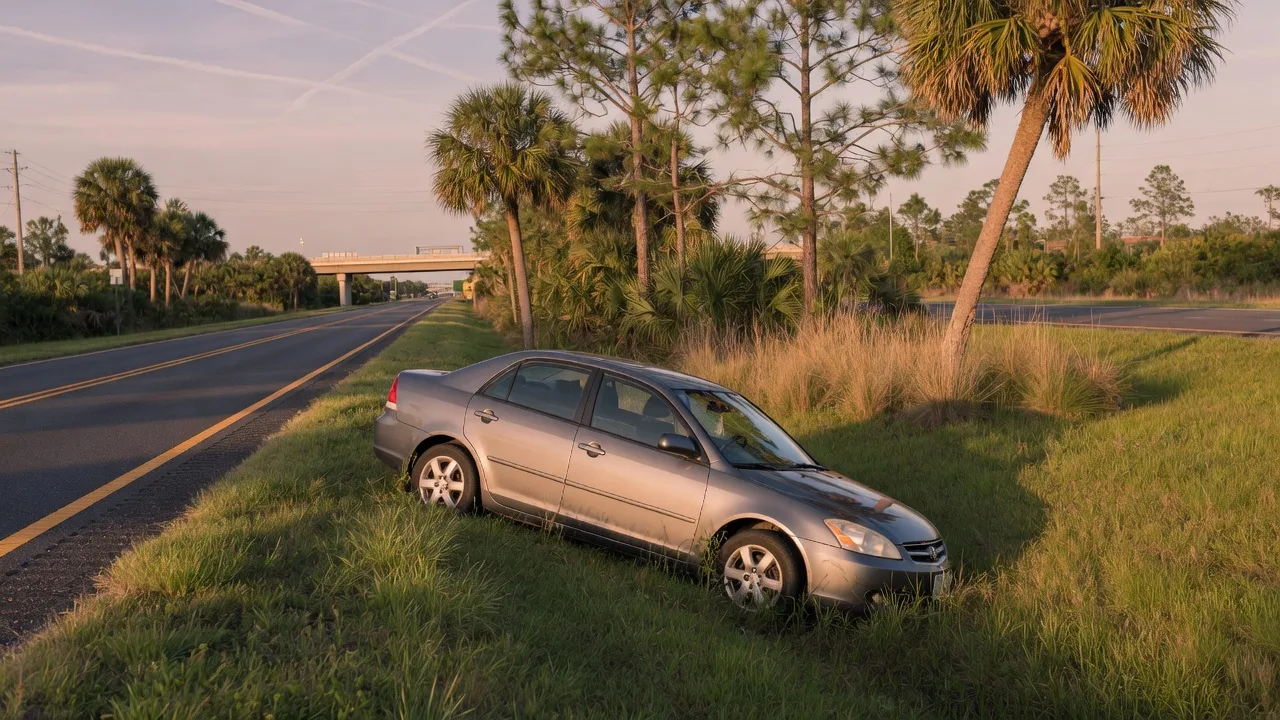
You need a winch-out when the car is not sitting on pavement the wrecker can roll onto: a ditch, a median, a sand shoulder, a parking block, or a slope that the tires cannot climb. A car already in a legal space, with wheels that turn, is a hook or a deck load. Those are different jobs.
Quick Tow Orlando connects you with independent operators. We do not own a wrecker and we do not winch the car ourselves. The line is open 24/7.
Storm mud and standing water have their own page: car stuck after an Orlando storm. A crash with police on scene is accident recovery towing. This page is the dry, off-pavement pull.
Winching is a pull back to pavement, not the tow itself
A winch is a cable or rope on the truck that pulls the vehicle to a place the operator can load it. The tow is what happens after the car is back on something firm, or onto the deck.
Johnson’s Wrecker ranks locally for the word “winching” with an I-4 heavy-duty explainer. The customer question underneath it is simple: my car left the road, can a normal tow truck get it.
It cannot, not as a simple hook, when:
- Two or more wheels are below the pavement edge
- The car is against a curb, a guardrail, or a parking stop in a way that blocks rolling
- The surface is sand, loose fill, or a wet swale even on a sunny day
- The car is nose-down in a drainage ditch along I-4, SR 417, SR 408, or the Turnpike
- A parking block or landscape timber has the car hung up in a lot
It can stay a simple tow when the car is fully on asphalt, the wheels turn, and the operator can line up a wheel-lift or a flatbed. Emergency towing covers that. Accident recovery and winch-outs is the request when you already know it left the pavement.
Do not put a strap on a friend’s bumper and pull. That is how you fold a bumper into a wheel and add a second disabled car in the same ditch.
Describe the drop, the soil, and which wheels are down
The operator plans the pull from those three facts.
Share:
- Which wheels are still on pavement, if any
- How far below the road the lowest corner sits, in plain words: “the rocker is on the grass,” “both passenger tires are in the ditch”
- Soil: mowed grass, sand, gravel, a wet swale, a concrete slope
- Whether a guardrail, fence, or sign is between the truck and the car
- Direction of the highway and which side of the median
- Whether the car will roll once it is back on pavement, or needs a deck immediately
A car that will start and drive after the pull is still a recovery first. Do not assume it should re-enter I-4. Steering, a bent wheel, or a leaking cooler can show up only after it is back on the road. Have a destination.
If a wheel is folded or an axle is broken, say that before anyone tensions a cable. Towing a car with a broken axle is the loading half. The winch still has to happen first if the car is off the pavement.
All-wheel drive does not change the need for a pull. It does change what happens after. Use AWD and wheel-lifts once the car is on pavement.
Stay out of the ditch and out of the travel lane
The recovery truck needs a staging lane. You do not.
If the car is in a live lane or a gore, call 911. Then try FHP Road Rangers at *347 on listed limited-access roads. Rangers can push a car out of a lane. They do not owe you a destination tow, and they may not winch out of a deep ditch.
Florida’s move-over law covers a disabled vehicle with hazard lights and a wrecker showing amber lights. Stand on the safe side of a barrier when one exists. Do not walk the median. Do not climb into the ditch to “guide” the cable.
On a local Orlando street, a car hung on a parking block in a plaza is still a winch if it will not roll over that block. That is a quieter scene than I-4. It is the same equipment question. Share photos of the block, the approach, and the hanging corner.
Sand at a lakefront park in St. Cloud or Kissimmee looks harmless and swallows drive tires. Do not spin them. That digs the car in. Call it as a winch-out on sand, not a jump.
Price and destination before the cable moves
A winch-out plus a tow is two parts. Confirm both with the operator who takes the job, before the truck sets the cable. There is no rate on this page. Quick Tow Orlando does not store cars.
If insurance roadside is involved, ask whether the plan covers recovery off the pavement or only a tow from the shoulder. Those are often written as different lines. Do not assume.
When to call us
Call (321) 321-9797 when the car left the pavement and you need an independent operator for a winch-out, a tow, or both. Say “it is in the ditch” or “it is hung on the parking block” in the first sentence. The line is open 24/7.