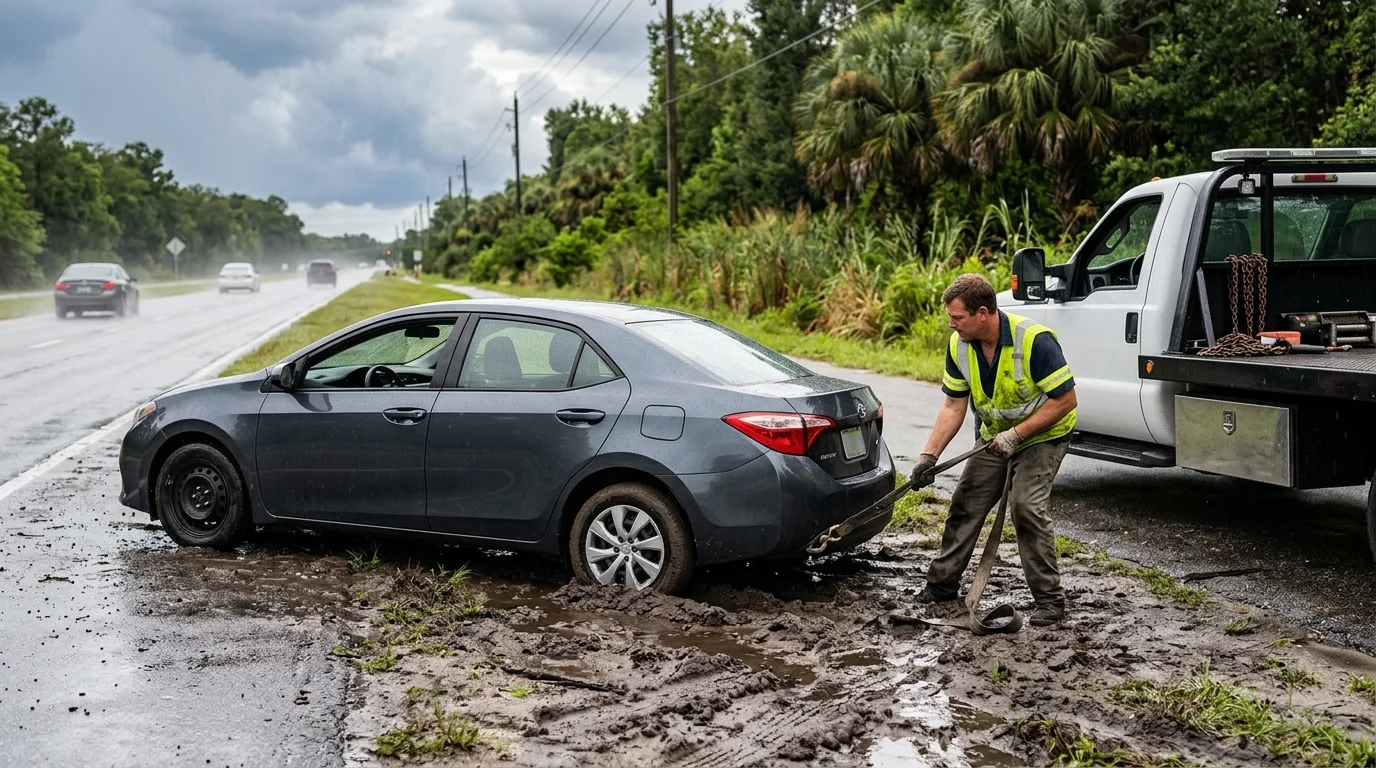
A car that settles into storm-soaked ground may need a winch-out, a tow, or both. The right choice depends on its position, visible damage, nearby water, and access from firm pavement. A local operator should inspect those conditions before deciding how to recover it.
Orlando’s Atlantic hurricane season runs from June 1 through November 30. A stuck-car call can follow a summer thunderstorm or a larger tropical system. Either way, the safest first move is to stop and assess the scene.
Protect yourself before checking the vehicle
Your safety matters more than inspecting a tire or muddy rut. Stay inside if leaving the car would place you near moving traffic. This is especially important beside I-4, SR 408, SR 417, SR 429, or Florida’s Turnpike.
Turn on the hazard lights if you can. Florida’s Move Over law covers disabled vehicles displaying hazard lights. It also covers tow trucks displaying amber lights. Drivers approaching those vehicles have specific duties under the statute.
Don’t step into standing or moving water. You may not be able to see the pavement edge, drainage slope, or ground below it. Treat every flooded depression as an unknown area. Don’t enter it to inspect the tires, attach equipment, or retrieve loose items.
Look for nearby traffic, downed lines, damaged barriers, and unstable ground. Make those observations from inside the car or from firm pavement. If there’s an immediate danger, contact emergency services.
A vehicle on saturated grass near Lake Nona presents a different scene from one beside SR 408. The same applies to a car near International Drive versus a vehicle off a quieter street in Winter Park. Tell the call taker where the firm access point is. Don’t assume the truck should approach by the same path your car took.
If the vehicle is near I-4, our guide to handling an I-4 breakdown covers additional roadside safety considerations. You can also check current FL511 alerts before leaving a safe location.
Know when traction attempts should stop
A stuck car doesn’t always look badly trapped at first. One tire may sit on pavement while another rests in mud. The vehicle may also be level until its wheels move.
Stop traction attempts when the wheels spin without clear progress. Stop if the vehicle settles farther, tilts, or moves toward water. New scraping sounds, warning lights, smoke, unusual smells, or visible fluid are also reasons to quit trying.
Don’t continue if someone must stand behind the vehicle, enter traffic, or step into a drainage area. Don’t attach a strap or cable when you can’t confirm the proper recovery points. Another vehicle and an improvised connection can add movement you can’t safely control.
The operator referred through Quick Tow Orlando decides whether an accident recovery and winch-out setup fits the scene. That decision happens after the operator considers the ground, vehicle position, access, and visible damage. A different recovery setup may be needed when the car is angled, blocked, or close to water.
In practical terms, a winch-out means freeing the car from its stuck position. A tow means transporting it after recovery. Some calls need only the first step. Others require recovery followed by transportation to a repair destination.
Don’t promise yourself that the car will drive normally once it reaches pavement. Mud around a tire doesn’t show what happened underneath. The operator can inspect the position before moving the vehicle and explain the proposed recovery approach.
Describe the ground, water, and vehicle position
Clear details help the referred operator prepare for the actual scene. Start with the street, direction of travel, and nearest safe access point. Mention a visible cross street or recognizable property when available.
Then describe what you can see without entering mud or water:
- Say whether the car is on grass, mud, sand, pavement, or a soft shoulder.
- Explain which wheels are off the firm surface.
- Note whether the car is level, tilted, or facing downhill.
- Report any visible standing or moving water.
- Describe curbs, guardrails, ditches, trees, fences, and parked vehicles nearby.
- Say whether any part of the car blocks a traffic lane.
- Mention whether everyone is safely away from traffic.
Use plain descriptions. “The right-side wheels are in wet grass” is more useful than “the car is barely stuck.” “The front bumper is close to the ground” gives the operator another visible detail.
Photos may help when they can be taken from a firm, safe location. A wide photo can show the vehicle’s angle and surrounding access. A closer photo can show the wheel position. Don’t walk into a travel lane, soft ground, or water to get a better picture.
Also explain how the car entered the area. It may have left a driveway, missed a pavement edge, or moved onto a saturated shoulder. Don’t guess about hidden damage or ground depth. Say what you observed and what remains unknown.
Location details matter across the Orlando metro. A roadside drainage area near Kissimmee may offer different access than a grassy parking edge in Sanford. The operator needs the specific scene, not just the words “stuck in mud.”
How damage changes the recovery plan
A car can appear intact while sitting at an unusual angle. Don’t assume it’s ready to drive because the body looks normal. Tell the call taker about any impact, drop, scrape, or sudden stop that happened before the car became stuck.
Report visible damage without diagnosing it. Useful details include a displaced wheel, damaged bumper, hanging panel, broken glass, or leaking fluid. Mention deployed airbags, dashboard warnings, or steering that no longer feels normal. If the engine stopped during the incident, include that detail too.
An operator may treat a simple immobilization differently from a vehicle with possible collision damage. The safest pulling direction and next step depend on the complete scene. The referred operator makes that decision after evaluating the vehicle and surrounding ground.
Our guide to accident recovery towing in Orlando explains how towing needs change after a collision or roadway incident. That broader process may apply when the storm-related event also involved a curb, barrier, another vehicle, or roadside object.
Don’t crawl beneath the car to inspect it. Don’t reach near a wheel while someone presses the accelerator. If you can’t inspect an area from firm ground, describe it as unknown. That’s more useful than guessing.
The final plan might involve freeing the vehicle, repositioning it, and then transporting it. It might also stop after recovery if the operator finds no reason to tow and the driver chooses to continue. Quick Tow Orlando connects callers with independent local operators. The operator who arrives evaluates the scene and explains the proposed next step.
Confirm where the vehicle should go next
Decide where the vehicle should go before recovery begins, if possible. A winch-out may place the car back on firm pavement, but that doesn’t confirm it should continue driving. Visible damage, warning lights, steering problems, or an impact can change the destination.
Possible destinations include your home, a repair shop, a dealership, or a collision facility. Confirm that the chosen location can receive the vehicle. If the business is closed, ask what after-hours instructions apply. Don’t leave keys or the vehicle without clear authorization from that destination.
If you haven’t selected a destination, say so during the call. The operator still needs to know whether the request may involve transportation after recovery. Distance, access, vehicle condition, and the final destination can affect the proposed service.
For a storm-stuck car that can’t safely continue, emergency towing may be the next step after recovery. The operator decides whether the vehicle can be loaded from its position or must first be moved onto firmer ground.
Have the vehicle’s make, model, color, and location ready. Mention passengers, pets, mobility needs, and any trailer attached to the vehicle. Tell the call taker whether the keys are present and whether the car starts. Don’t force the transmission, steering, or parking brake if something feels damaged or won’t move normally.
If insurance or a roadside plan may apply, contact that provider for its current requirements. Coverage terms can vary, so don’t assume a winch-out and tow receive the same treatment. Ask the referred operator to confirm the full price before the truck rolls.
When to call us
Call when the vehicle is sinking, angled, near water, visibly damaged, or unsafe to approach. Quick Tow Orlando takes calls at any hour, dispatches Monday to Friday from 8 a.m. to 10 p.m., and connects drivers with independent local towing and roadside operators. Call us at (321) 321-9797.