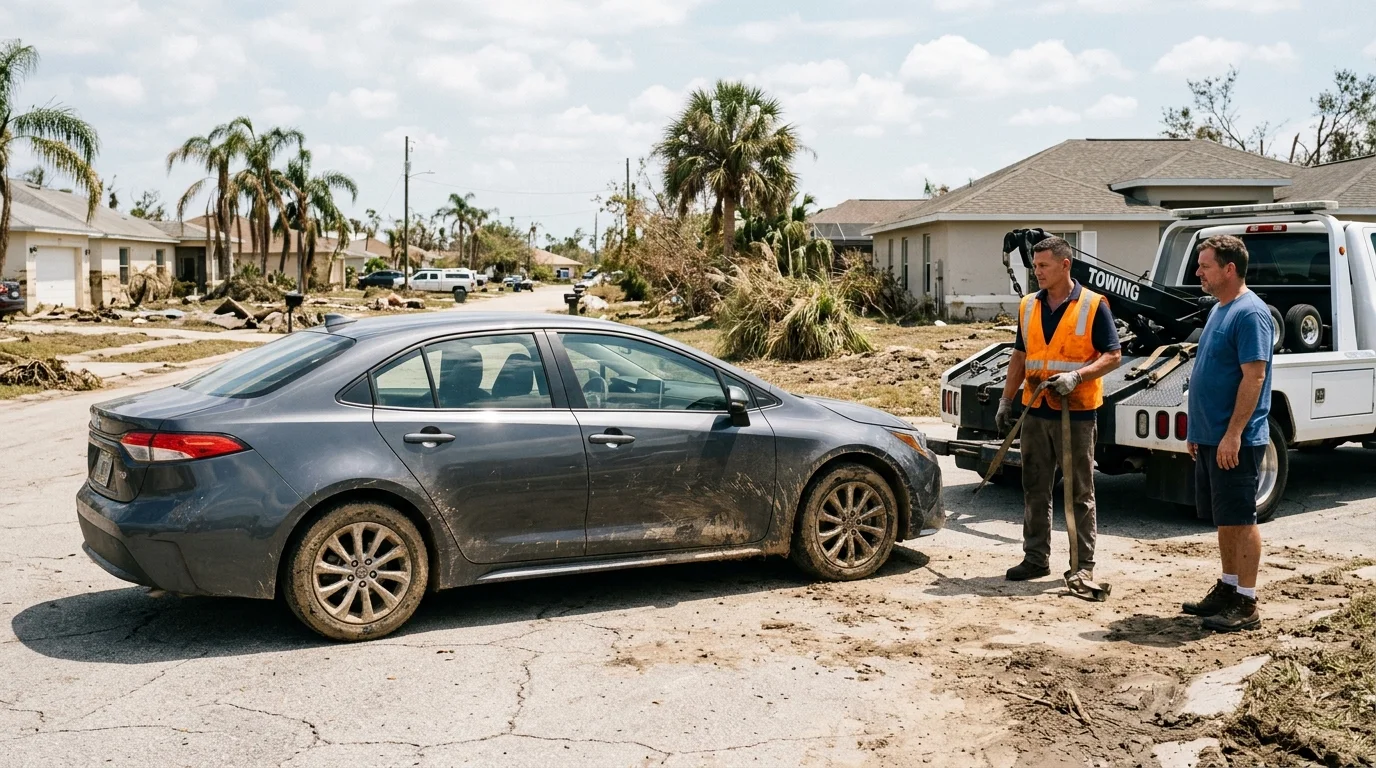
You came back after the rain and the water line is still on the doors. A soaked sedan in an I-Drive hotel lot, a Lake Nona garage, or a low street off SR 408 is not a jump-start job. It is a water-exposure job, and the next move is about staying dry, not turning the key.
Atlantic hurricane season runs from June 1 to November 30. Activity in the basin is usually heaviest around September 10. Orlando also sits through a long stretch of afternoon thunderstorms that fill underpasses, lake-edge streets, and apartment lots from Winter Park to Kissimmee. If floodwater reached the car, flooded car towing in Orlando is how you move it to a shop that can inspect water damage. Do not treat it like a soggy-shoulder pull you drive home.
Stay away from moving or contaminated water
Stay on firm, dry ground. Do not wade to the car, do not open a door in standing water, and do not step into a current that looks shallow. Storm water in Central Florida is not rainwater in a bucket. It can carry sewage, fuel, lawn chemicals, and debris from the lot. It can hide a washed-out drain, a shifted concrete stop, or a live downed line.
If you see a line in the water, or a pole down along the curb, keep back and call 911. For a utility line, look up the power company that serves that street and report it there. Do not use a towing request line as a substitute for that call.
A moving sheet of water across a Winter Garden cul-de-sac, a Meadow Woods swale, or a Sanford side street can shove a parked car a few feet. It can also knock you off your feet. The operator we send works from dry pavement. You should too. If the car is still sitting in water, wait. Receding water is the window. Walking in is not.
This is different from a car that only kissed a wet shoulder. A vehicle that took floodwater into the cabin, the engine bay, or the trunk needs to be treated as contaminated and electrically uncertain. Hybrids and EVs add another reason to stay out. You cannot see what the water reached from the sidewalk, and you should not test it with your hands.
If the car is in a live lane on I-4, SR 417, or the Beachline, stay out of traffic. Use hazards only if you can do that from a safe place. Florida’s Move Over Law requires other drivers to leave a lane or slow down for a disabled vehicle with flashers on, and for a wrecker showing amber lights. That law protects the scene. It does not make the water safe.
Check FL511 alerts before you even drive back to the car. A closed underpass downtown, a flooded ramp on SR 408, or standing water on the Turnpike is a reason to wait, not a reason to walk in.
Check current guidance before trying to restart
Do not assume the car is fine because the water dropped. Do not assume it is ruined because the carpet looks dark. You are not going to settle that in the lot.
Restart advice changes by make, model, and how the water got in. Some owner manuals warn against cranking after water exposure. Some makers publish storm bulletins. Some insurers tell you to leave it off until a shop inspects it. We are not going to invent a depth rule or a start/don’t-start script here. Look up the current guidance from the manufacturer and from any official source you already trust for that vehicle. If you cannot confirm it, leave the car off.
Turning the key can pull water through the engine. It can also close circuits that sat in dirty water. That is a shop question, not a parking-lot experiment. The same goes for jumping a battery, plugging in a trickle charger, or hitting the start button on a hybrid after the floor mats went swimming.
If the car was running when the water came up, say that when you call. If it was parked all night in a College Park lot or a Kissimmee overflow lot, say that too. Those two stories are not the same for the shop that receives it.
A tow after water exposure is a transport. It is not a roadside restart. If you only need a dead battery on dry pavement, that is a different call. If floodwater reached this car, skip the “maybe it will fire” loop and move it to people who inspect water damage.
Florida has no statewide towing license. The operators in this network are independent. They will not diagnose the car from the cab of a wrecker, and you should not ask them to. Their job is to get the car onto dry ground and to the destination you name.
Document the vehicle from a safe location
Insurance and the shop will want a record of what you found, not a guess after the interior has been torn out. Take that record from dry pavement.
Photograph the water line on the fenders, doors, and rocker panels. Photograph the lot, the nearest drain, and any debris against the wheels. If the carpet, seats, or trunk are visible from outside without opening a door in water, photograph that too. Get the street sign, the plaza name, and a landmark: the SR 417 overpass, the I-Drive hotel tower, the Lake Eola-side garage, the Winter Park brick streets, whatever actually marks the spot.
Do not climb in for a better angle. Do not pop the hood in standing water. Do not fish for the registration while the floor is wet if you can get those documents another way.
Write down the time you first saw the car, the time the water appeared to crest, and whether it was still rising. Orlando storms can dump a cell, pause, and come back. A second pulse after you leave is common in summer.
If the car shifted, photograph the new position against a curb, a stall number, or a light pole. If a nearby car is gone, note that. After a tropical system, some lots clear vehicles. If yours is missing later, you will want proof it was here.
Keep the photos on your phone. Do not hand the only copy to anyone at the scene. When you talk to your insurer, ask where they want the car taken and whether they need these pictures first. Coverage questions are between you and the policy. Florida’s insurance rules are a starting point for required coverage, not a verdict on flood claims.
Tell dispatch where and how the car sits
The line takes your details at any hour. Dispatch runs Monday to Friday, 8 a.m. to 10 p.m. Have the scene details ready before you call. The operator we send cannot plan a flooded-car move from “I’m near Disney” or “it’s off I-4.”
Give the city and the county. A car on International Drive inside Orlando is not the same job as a car in unincorporated Orange County, and Kissimmee sits in a different county again. Name the street, the cross street, the lot or garage, the floor, and the stall if you have it. If you are on a limited-access road, say which direction and which mile or exit you can see. If you broke down on I-4, say whether you are on the shoulder, in an underpass, or on a ramp.
Say whether the water has receded, is still around the tires, or is still moving. Say whether the car is on asphalt, in a grassy swale, against a curb, or nose-down toward a drain. Say if a wheel is over a washed-out edge. That is how the driver who shows up decides whether this is a straight hook from dry pavement or a slower recovery that has to wait for the water.
This is also where you separate a flood job from a mud job. A car that drifted into a soft median after rain, with a dry cabin, is a traction problem. A car that took water into the body is a contamination and inspection problem. Do not describe it as “stuck in the grass” if the interior is wet. The equipment and the destination change.
Mention drivetrain: gas, diesel, hybrid, or EV. Mention a lowered car, a running board, or a cover. Mention pets, kids, and whether anyone is still with the vehicle. Mention a smell of fuel. Mention if police already tagged the car or if a property manager said they would have it pulled.
If the car is in a travel lane, or if someone is hurt, that is accident recovery, not a quiet lot pickup. Stay out of traffic and let the operator work with the scene that is actually there. For a wider walk-through of crash and recovery calls, read accident recovery towing in Orlando.
On I-4 and other limited-access highways, Florida’s Road Rangers patrol for disabled vehicles. That is a free roadside program on those roads. It is not a flood-inspection service, and it is not a substitute for a shop destination. If you are on a city street in Thornton Park or a garage in Lake Nona, Road Rangers will not be the call.
Choose a destination that can inspect water damage
Name a destination before the truck rolls. A flooded car should go to a shop that inspects water damage, or to a place your insurer names. A storage yard is not an inspection. Your driveway is not an inspection. A friend’s empty bay is not an inspection.
Ask the shop, while you are still on dry ground, whether they will take a water-exposed vehicle today. Some body shops and dealers will. Some will not until an adjuster looks. Get that yes before you spend the tow.
If the insurer has a preferred shop in Orlando, Winter Park, or Sanford, use that name and the street address. If you do not have an insurer involved yet, pick a shop you can reach by phone and confirm they can receive it. Tell the operator the gate code, the hours, and who meets the truck. The line takes the request. The driver who shows up still needs a place that will open.
Do not ask to “just pull it out and see if it runs” on the lot. That is the restart trap again. The value of flooded car towing is getting a wet car off a public street, out of a hotel deck, or out of an apartment aisle and onto a lift, without you wading in.
If the car is a total as far as you can tell, you still need a legal destination. Do not abandon it on SR 429 or in a Kissimmee overflow lot and hope someone else deals with it. If you later decide it is junk, that is a different service path. The first move is still a controlled tow from a scene that may still have water nearby.
Bring your ID, registration if you have it dry, and the insurer claim number if you have one. If the keys were in the car and you cannot reach them without entering water, say so. Do not climb in for the fob.
Cost, rights, and what this job is not
Quick Tow Orlando does not publish a rate card. The operator confirms the price for that job before the truck rolls. A voluntary request to tow a flood-damaged car is not the same billing category as a trespass tow off private property.
Orange County does publish maximums for a Class A trespass tow (under 10,000 lbs) from private property: a $135 flat towing rate, storage at $32 per 24-hour increment, and a drop fee of half the towing rate, $67.50 max, if you reclaim the vehicle after hookup and before the truck leaves. For those regulated tows, phones must be staffed 24 hours a day, including holidays, and the vehicle must be released within 30 minutes of payment. Read the county’s own table on the Orange County towing information page before you pay a yard. We could not confirm a matching City of Orlando maximum from the sources we have, so do not treat the county figures as a citywide cap.
If a lot towed the car without you after the storm, Florida’s private-property towing statute (715.07) is the rule set for signage, storage distance, and a one-hour release after you request the vehicle. In Orange County, storage for that kind of tow is limited to a 10-mile radius from where the car was taken, or 20 miles if no facility is available inside the first radius. You may inspect the car before you accept it. A yard cannot make you sign a “no release or waiver” clause as the price of getting it back.
If the car sits in storage after a recovery you asked for, Florida’s wrecker lien statute (713.78) is the one that covers charges, notices, and sale timelines. Storage cannot be assessed if the vehicle is held for fewer than 6 hours. Ask for the yard address and an itemized list before you agree. If you need to complain about a tow in Orange County, Orange County Consumer Protection on 33rd Street in Orlando takes those complaints. Look up the office’s current number on the county site. They review complaints. They do not give legal advice, and they do not force a business to a specific outcome.
This job is not a mud winch-out. It is not a soft-shoulder pull so you can drive to work. It is flooded-car towing: keep people out of the water, skip the unverified restart, document from dry ground, and move the car to a shop that can inspect what the water did.
When to call us
Call when floodwater reached the car and you cannot move it from dry ground without wading, cranking, or guessing. Call when the water has dropped enough for an operator to work from pavement, and you have a shop that will take a water-exposed vehicle. The line takes your details at any hour. Dispatch runs Monday to Friday, 8 a.m. to 10 p.m. Call us at (321) 321-9797.