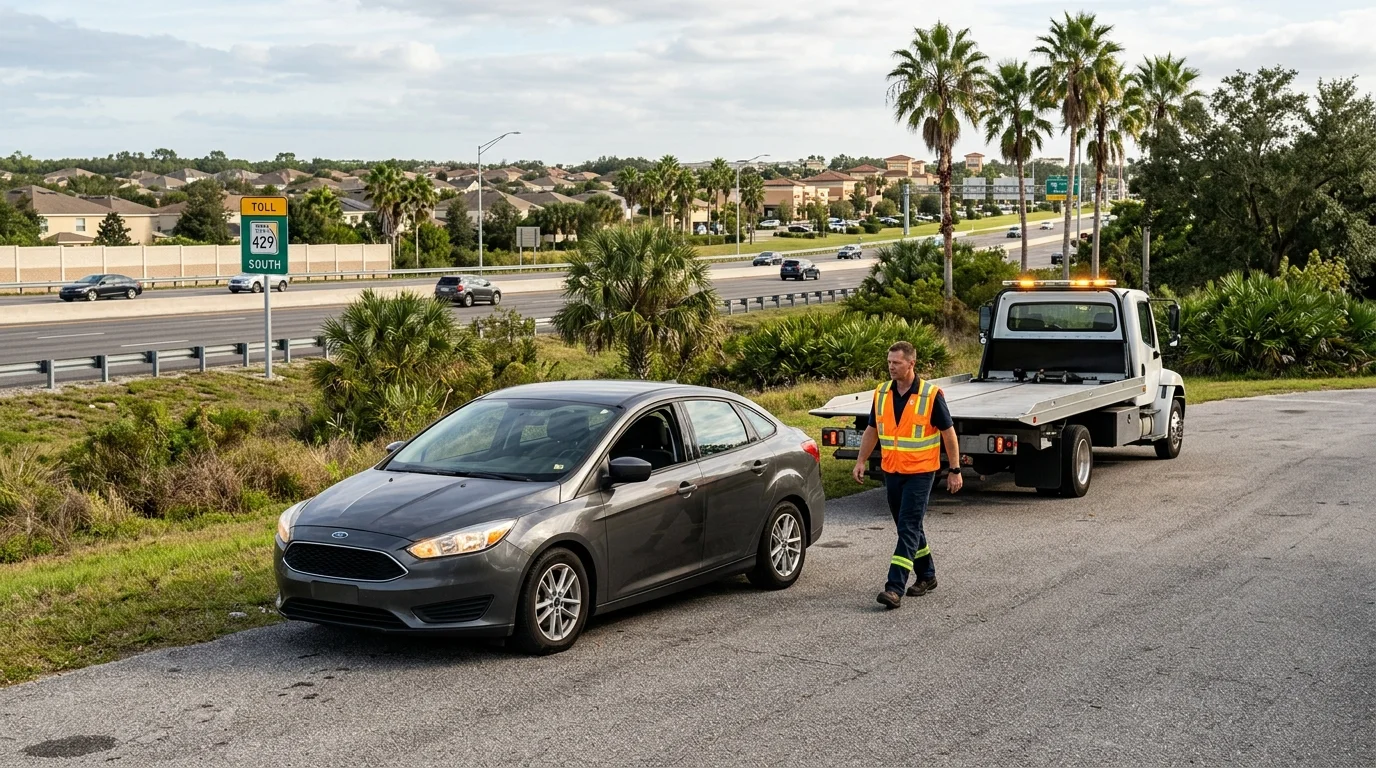
A stall on SR 429 through Apopka puts you next to fast traffic on a limited-access beltway, not a quiet side street. The Western Beltway and Wekiva Parkway run past shopping, new housing, and long gaps toward Rock Springs, Plymouth, and Zellwood. Get the car out of the travel lane first. Then decide if roadside assistance can finish the job, or if you need a tow to a shop that can take the car.
Move away from traffic before checking the car
If the engine dies, your first job is space, not diagnosis. SR 429 is a limited-access toll road. Traffic comes up fast, and a stopped car in a through lane is the danger. Hit the hazards. Keep both hands on the wheel. Ease to the right shoulder if the car still rolls. Do not stop in a travel lane to check a gauge.
If you can still move, take the next exit. US 441 (Orange Blossom Trail) and the local streets off it give you parking lots, gas stations, and wide pads a tow operator can work from. A dead car in a grocery lot in Apopka is a hassle. A dead car in lane two of the beltway is how a stall becomes a crash.
If the car will not roll, stay buckled in unless you are in the path of traffic and can reach a barrier. Keep the hazards on. Florida’s move-over law covers a disabled vehicle showing hazard lights. On a road with more than one lane in your direction, other drivers must leave the lane closest to you when it is safe. On a two-lane road they must slow 20 mph under the posted limit, or to 5 mph if that limit is 20 or less. You cannot make them do it. You can make yourself easier to see.
Do not pop the hood in a live lane. Do not stand behind the bumper. Do not walk the shoulder toward an interchange in the dark. If you cannot get off the pavement and traffic is still coming, call 911. That is the right call for a live lane.
Once you are on the shoulder or off at an exit, then look at the car. Steam, a tire on the rim, a belt hanging, a fuel light: those details matter in a minute. They do not outrank getting out of the lane. The same idea holds on I-4. Our I-4 breakdown guide is the limited-access version of this moment. SR 429 is quieter than I-4. The physics are the same: fast traffic, short shoulders in spots, and no good reason to stand in the road.
On surface streets, pull out of the through lanes if you can. US 441 through Apopka is a commercial strip with driveways, turn lanes, and people hunting for parking. Hazard lights, then a lot. The same goes for Semoran Boulevard, Rock Springs Road, and Ocoee-Apopka Road. A quiet block west of downtown is still not a repair bay. Cars, delivery vans, and golf carts still come around those curves.
Share your direction and nearest location marker
Apopka is spread out. “I’m in Apopka” does not get a truck to you. SR 429 has a northbound and a southbound, and the Wekiva Parkway stretch keeps going toward Sanford. Tell the operator which way you were driving.
Give a marker they can find without guessing. Exit tabs, the last sign you saw, and a cross street beat a vibe. Useful pins on this corridor:
- SR 429 at US 441 / Orange Blossom Trail
- SR 429 near SR 414 (Maitland Boulevard)
- US 441 at SR 436 (Semoran Boulevard)
- Off the beltway near Kelly Park or Rock Springs Road
- A named plaza, church, or grocery on the 441 strip
Share a live map pin if the phone will do it. Read the road name as it appears on the sign. “Western Beltway” and “429” are the same road. “Wekiva Parkway” is the northern stretch. Do not mix those if you can help it.
Say whether you are on the shoulder, in a gore, on an on-ramp, in a plaza lot, or in a neighborhood. Those are four different jobs. A shoulder on 429 may need emergency towing with traffic in mind. A grocery lot off 441 is a simpler hook if the car will roll.
If you already left the beltway, say so. “I took the 441 exit and I’m in the lot on the east side” saves a truck from running the mainline looking for you. One person should talk. Shoulder noise eats details. Read the mile marker or exit tab twice.
You do not need a perfect address. You need a direction, a named road, and a side. Northbound 429, south of the 441 interchange, right shoulder, hazards on. That is enough for the operator we send.
If you are in a pocket that feels like the middle of nowhere, say that too. West and north Apopka still has long gaps between lights, especially toward Plymouth and Zellwood. The operator is not guessing your city. They are guessing which two-lane you are on. Rock Springs Road, Plymouth-Sorrento Road, and the 429 mainline are not interchangeable.
From a safe spot, check FL511 alerts if a ramp or the next interchange looks wrong. On the beltway, FDOT Road Rangers patrol limited-access roads and can be reached at *347. That is a state roadside patrol, not a tow company. They may help you get out of a live lane. They do not replace a shop tow if the car is done for the night.
Decide whether roadside help is enough
Once you are safe, sort the job. Some stalls are a short roadside fix. Some are a tow even if the car “almost” starts.
Roadside is enough when the car is otherwise healthy and the failure is simple. A battery that cranks slow, with lights that still work. A flat with a good spare, a working jack, and a firm, level pad. An empty tank, if you actually ran it dry. Keys locked in, if the car is in a lot, not in a live lane.
Roadside is not enough when the engine seized, overheated, or is knocking. It is not enough when you have no spare, or the tire is shredded to the rim. It is not enough when the shifter will not come out of park. It is not enough if you smell fuel, or the car is in a travel lane and cannot roll. And it is not enough on a 429 shoulder with no safe pad to jack a wheel.
A jump in a lot off US 441 is a normal roadside call. A jump on the beltway shoulder is a different risk. If there is no room to work off the pavement, skip the heroics. Ask for a tow.
Do not turn the shoulder into a mobile-mechanic wait. Shops in Apopka fix cars that arrive. They do not make the beltway safe. Get the car to them. Do not sit in a gore hoping a wrench shows up.
If you have a membership, use it. If you do not, you can still request help. Quick Tow Orlando dispatch runs Monday to Friday, 8 a.m. to 10 p.m., and matches you with a local operator. The operator confirms the work and the price before the truck rolls. This site does not publish a rate card.
Night, rain, and summer storms change the call. Central Florida afternoon storms flood low spots and cut visibility. A spare swap in standing water is a tow. Same if the car died after a hydroplane and you are not sure what you hit. If the car starts, then dies again, stop diagnosing on the shoulder. Intermittent stalls on 429 are how people end up in the lane twice.
Describe how the car rolls, steers, and brakes
The operator needs three facts: does it roll, does it steer, does it stop. Those three decide the truck and the hook.
Roll: can you push it a few feet in neutral on level ground. A car that rolls can often leave a shoulder or a lot without a winch. A car stuck in park, a collapsed wheel, or a snapped axle does not roll. Say it in plain words. “It will not come out of park.” “The right front wheel is folded.” “It rolls, but the tire is off the rim.”
Steer: if the power steering died with the engine, the wheel may be heavy and still turn. If a tie rod or knuckle let go, it will not. Do not plan to drag a car that will not follow the truck.
Brakes: a car with no pedal is a different load. If you had to use the parking brake to stop on the shoulder, say so.
Also say front-wheel, rear-wheel, or all-wheel drive if you know. Mention a low body kit, air suspension, or extra ground clearance. Mention a bike rack, a hitch, or a trailer still attached. Say whether the keys work and whether the wheels lock. None of that is trivia. It is how the driver who shows up picks a wheel-lift or a flatbed. A low car, an AWD crossover, or a wheel that will not turn usually wants a bed. Guessing from the shoulder wastes a trip.
If you already tried to move it, say what happened. “I rolled it onto the shoulder.” “I tried reverse and it clunked.” “Every warning light is on.” A dash photo from inside the car helps. Do not crawl under the car on 429. Do not pull a wheel on a slope. Describe what you can see from a safe place. If the car is a hybrid or EV, say the make. Do not assume it tows like a gas car. The operator will tell you what they need.
Choose an Apopka-area destination that can receive it
A tow without a destination is a car in a yard you did not pick. Before the truck moves, name where it should go.
If the car will be fixed, call the shop first. Apopka’s repair and body places cluster along US 441, Semoran, and the older commercial streets east of downtown. Confirm they are open, they can take this make, and they have a key drop or an after-hours pad. A closed bay with a locked gate is not a drop.
If you do not have a shop yet, you still need a place the car is allowed to sit. A home driveway off Rock Springs Road. A friend’s lot. A dealer that said yes. Do not send a disabled car to a random plaza and hope.
Tell the operator the shop or home name and the street. Say whether the lot has a height bar, a steep apron, or tight turns. Say whether someone will meet them with a key. Say whether the car can sit outside overnight. Apopka’s residential west side and the 441 commercial strip are not the same access problem. A townhome lot with speed bumps and a low tree is a different drop than a wide bay on Orange Blossom Trail.
If you live in Winter Garden, Ocoee, or toward Sanford on the Wekiva Parkway, say that up front. The beltway makes those hops short on a clear night. The destination is still part of the job.
Storage is a last resort. If the car has to go to a yard, ask where, how you pick it up, and what they charge to store it. Orange County publishes towing and parking rules for nonconsensual tows on its towing information page. A voluntary breakdown tow is a private job between you and the operator. Confirm the destination and the price before the truck leaves you.
Do not aim for “the closest shop” if that shop cannot touch the car until Monday and you needed it tonight. Distance on this side of metro Orlando is usually the smaller problem. Receiving hours are the bigger one. If you are from out of town and you died on 429 on the way to I-4 or the parks, pick a shop that will still be there in the morning, then sort a ride. The car’s night and your night are two plans.
When to call us
Call when the car is out of the lane, or cannot get out of the lane, and roadside will not finish it. A dead engine on SR 429, a shredded tire with no spare, or a car that will not roll is a tow, not a driveway project. Quick Tow Orlando takes those requests Monday to Friday, 8 a.m. to 10 p.m., and connects you with a local operator. For nights and weekends, see our after-hours towing guide. Call us at (321) 321-9797.