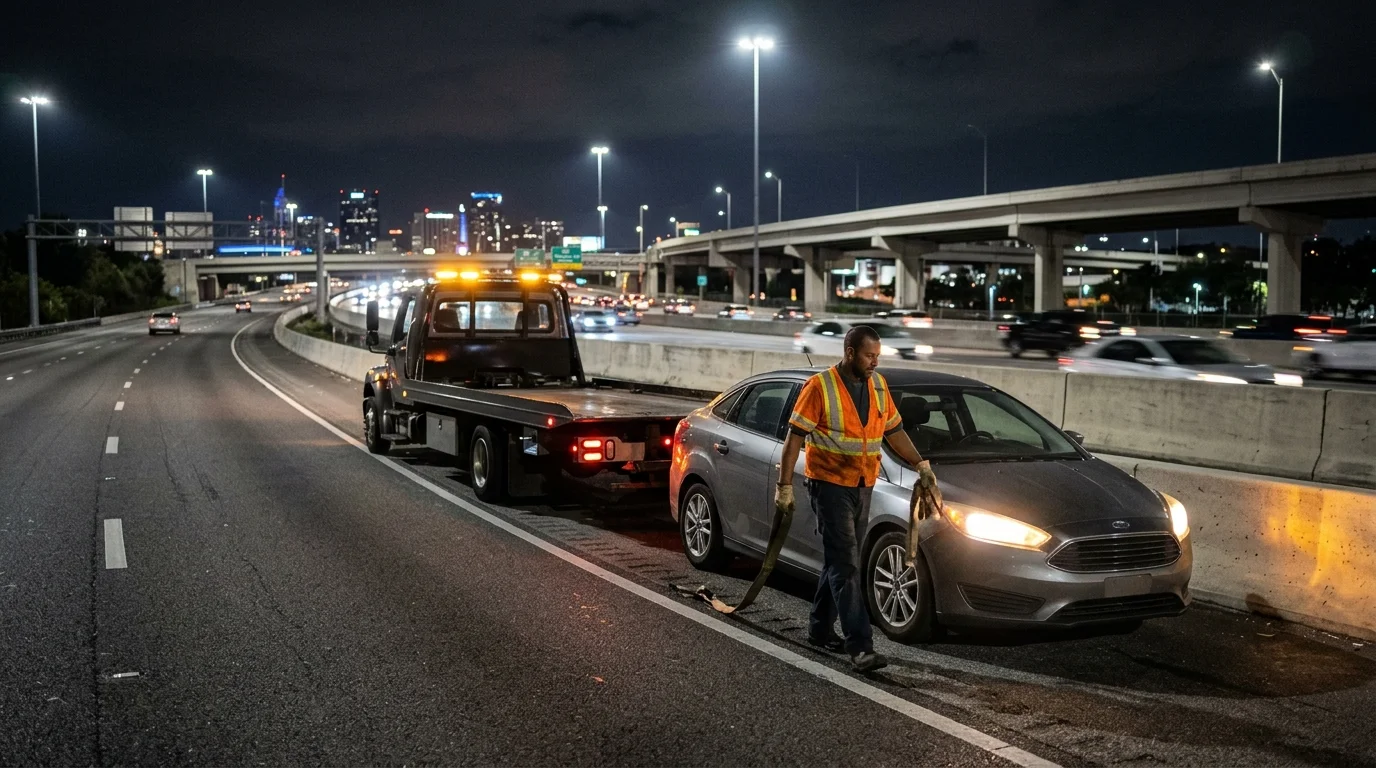
A disabled car in Orlando needs two things first: a safer position and the right help. Quick Tow Orlando connects callers with local operators for emergency towing, and our dispatch runs Monday to Friday, 8 a.m. to 10 p.m. Before anyone is sent, share your location, vehicle condition, and intended destination.
If you are reading this at 2 a.m. or on a weekend, be honest about the clock. Our dispatch is closed, and the line will take your details and call you back when it opens. That works for a car parked somewhere safe. It does not work for a car on a shoulder. For that, dial *347 for the free FHP Road Ranger patrol on a covered segment, or 911 if there is any immediate danger, and read the next section first.
Get yourself clear of moving traffic first
Your first decision isn’t where to tow the car. It’s how to reduce your exposure to passing traffic.
Turn on the hazard lights as soon as trouble starts. If the car still moves normally, look for a place away from active lanes. Don’t force it farther if steering, braking, or visibility feels compromised.
A shoulder on I-4, SR 408, or SR 417 can leave little room. Stop as far from traffic as the situation allows. Avoid standing beside the car or between vehicles. If a barrier is available and you can reach it without crossing traffic, move behind it.
Don’t walk along an active highway to inspect damage. Don’t attempt a tire change inches from passing cars. A problem that seems manageable in a parking lot may need a tow on an exposed shoulder.
Florida’s Move Over law covers tow trucks displaying amber lights. On a highway with several lanes moving the same direction, approaching drivers must leave the closest lane when it’s safe. That protection doesn’t remove the danger around a stopped vehicle. Keep yourself away from the traffic-facing side whenever possible.
Call 911 if there’s a crash, fire, medical emergency, leaking fuel, or immediate traffic danger. Emergency services should handle the active hazard first. Towing can follow once the scene is controlled.
Conditions differ on surface streets. A breakdown near International Drive may leave you in a turn lane, driveway, or busy parking entrance. Use hazards, stay visible, and avoid blocking an intersection. Our guide for drivers who have broken down on I-4 covers highway-specific steps in more detail.
Know when roadside help is enough
Not every disabled car needs to reach a repair shop by tow truck. Some problems may qualify for roadside assistance, depending on the vehicle and stopping place.
A jump-start may be appropriate when the battery is the likely problem. A spare-tire change may work when the vehicle has a usable spare and the work area is safe. Lockout help or fuel delivery may also solve the immediate problem without moving the car.
Tell the call taker what happened before the vehicle stopped. Useful details include warning lights, smoke, unusual sounds, a flat tire, a collision, or an engine that won’t restart. Don’t keep testing the car if doing so could worsen the problem.
Roadside help may not be enough when the car has collision damage, damaged steering, failed brakes, or an overheating problem that returns. A vehicle stuck in mud, soft ground, or a drainage edge may need recovery equipment before it can be transported. The operator needs those facts before dispatch.
Location matters too. A simple battery issue in a Winter Park parking lot differs from the same issue beside SR 408. The operator may recommend towing when roadside work can’t be completed away from moving traffic.
You don’t need to diagnose the car yourself. Describe what you can see, hear, and smell. Mention whether the car rolls, whether the wheels appear straight, and whether anything hangs beneath it. The operator can then decide whether roadside service makes sense or a tow is the better option.
If you’re uncertain, don’t guess. Explain the symptoms and let the operator assess the service needed.
Tell the dispatcher exactly where the car stopped
A map pin helps, but it shouldn’t be the only location detail. Highway shoulders, frontage roads, ramps, and nearby parking lots can appear close together on a screen.
Start with the road name and travel direction. On I-4, say whether you were traveling east or west. For SR 408 or SR 417, include your direction and the last exit you passed. Mention whether you’re before or after an interchange, on a ramp, or beside the main lanes.
Use visible landmarks when they’re clear and safe to read. A business name, parking garage, hotel entrance, or cross street can narrow the location. Around International Drive, identify the exact property entrance or parking area. Large developments may have several driveways that don’t connect internally.
For surface streets in Lake Nona, Winter Park, Sanford, or Kissimmee, share both intersecting roads when possible. Say which side of the road holds the car. Also explain whether the operator can approach directly or must enter through another driveway.
Describe the vehicle carefully. Give its color, make, model, and body style. Mention active hazard lights and any visible damage. Don’t send license plate information in an unsecured public message. Provide identifying details directly to the call taker when requested.
Tell the operator about access limits before dispatch. Examples include a parking garage, gated lot, narrow driveway, low tree cover, soft shoulder, or car trapped between other vehicles. If the keys are missing or the wheels won’t turn, say that too.
Stay available by phone after sharing the location. Keep the line clear enough to answer an operator’s call. If your position changes for safety, report the new location promptly.
Confirm the truck type and destination before dispatch
The operator needs the vehicle’s details before choosing equipment. Give accurate information about its size, drivetrain, condition, and surroundings.
Mention if the vehicle is all-wheel drive, electric, lowered, heavily damaged, or missing a wheel. If you know the manufacturer’s towing instructions, share them. The owner’s manual may identify restrictions for loading or transporting the vehicle. Don’t assume every disabled car can be handled the same way.
A flatbed and a wheel-lift serve different situations. The operator should select the equipment after reviewing the vehicle and access conditions. Ask which type is planned and why it fits the job. If the car sits inside a low-clearance garage, make that clear before anyone is sent.
Choose the destination during the same call. It might be your home, a repair shop, a dealership, or another location that accepts the vehicle. Confirm the complete address yourself. Similar business names can lead to the wrong property, especially across Orlando’s wider metro area.
If the destination may be closed, contact it before dispatch. Ask where the vehicle should be left and how keys are accepted. Don’t assume an unattended lot permits after-hours drop-offs. Get the receiving instructions directly from that location.
Tell the call taker if you’ll ride separately. Don’t assume passenger transportation is available. Arrange a safe way home or to the repair facility before the tow begins.
For longer trips outside the immediate Orlando area, clarify the full route and destination. The requested distance can affect the service plan and authorization. The goal is simple: the operator, driver, and vehicle owner should all have the same destination before the car moves.
Check the final authorization before the car moves
Review the service details while the vehicle is still in place. Once it leaves, misunderstandings become harder to correct.
Confirm the operator’s business name, requested service, destination, and payment methods. Ask how the charge will be calculated. Request any possible mileage, storage, road-access, after-hours, or special-equipment charges in writing before authorizing the work.
Quick Tow Orlando doesn’t publish a rate card. Our research also couldn’t confirm current maximum towing rates for Orlando or Orange County through accessible primary sources. Ask the operator for the current charge and terms before agreeing. Our guide to tow costs in Orlando explains which details to confirm without inventing a local price.
Check that the destination matches what you provided. Repeat the street address, not just the repair shop’s name. Ask what happens if the destination can’t accept the vehicle. Don’t approve a different yard or storage location without understanding the terms.
Take clear photos of the vehicle before loading if you can do so safely. Capture each side, existing damage, the wheel position, and loose exterior parts. Remove essential personal items before the car leaves. Don’t step into traffic or interfere with the loading area to take a picture.
Read any authorization before signing it. The service description and destination should match the call. Ask for a receipt or itemized record and keep messages related to the dispatch.
A requested emergency tow differs from a vehicle removed without consent. Private property removals follow separate rules under Florida’s private property towing statute. If you’re retrieving an impounded vehicle, confirm the yard, documentation, and charges directly with that operator.
When to call us
Call Monday to Friday between 8 a.m. and 10 p.m. when your car can’t be driven safely, roadside help isn’t enough, or damage requires transport. Quick Tow Orlando will gather the job details and connect you with a local tow operator. Call (321) 321-9797.
Outside those hours the same number still records your details for a callback when dispatch opens. If the vehicle is somewhere exposed, treat that as a safety call rather than a towing call and use *347 or 911 first.