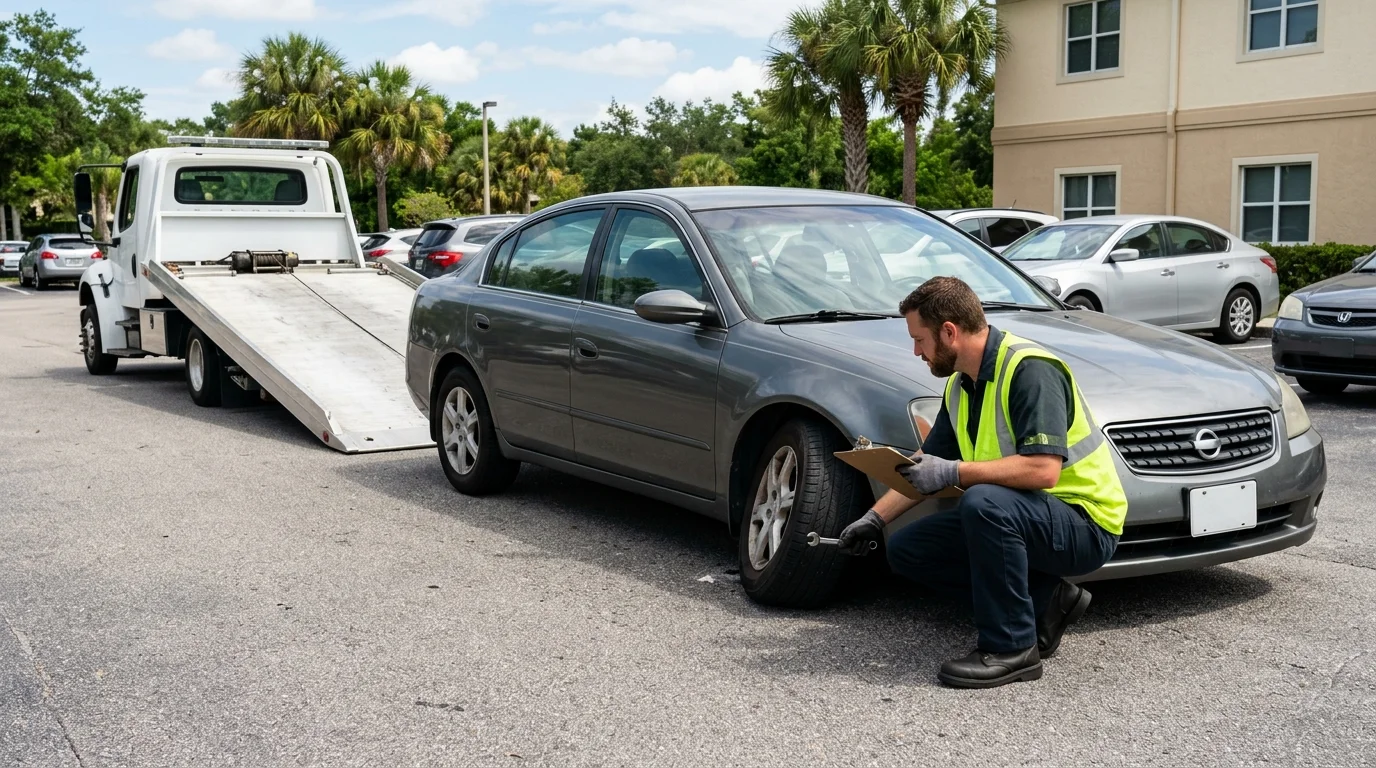
A wheel sitting at the wrong angle is the stop signal. The engine may still run. The car should not keep rolling on that corner.
A referred operator can still move it. The usual path is a load that keeps the damaged corner from having to roll down I-4, SR 408, or a parking aisle. That is the job a broken axle towing service is built for. You describe what you see. The driver who shows up chooses how to pick it up.
Stop moving the car when the wheel position looks wrong
Do not name the failed part from the sidewalk. Axle, hub, CV joint, control arm, and bent wheel can look similar from five feet away. What you can trust is the picture: a wheel leaning in or out, a tire tucked under the fender, a corner sitting lower than the rest, or metal scraping the pavement when you try to creep forward.
That is enough. Put the car in park. Set the parking brake if it still holds. Turn on the hazard lights. Get yourself and passengers out of the travel lane if it is safe to do so. On a multi-lane road such as I-4, SR 417, or the East-West Expressway, stand well behind a barrier or on the far side of a guardrail, not next to the open door.
Other drivers have a duty around a disabled car with hazards on, and around a tow truck showing amber lights. On a highway with more than one lane in the same direction, they should leave the lane closest to you when they can do it safely. On a two-lane road they should drop speed by 20 mph under the posted limit, or to 5 mph if the posted limit is 20 or less. You still should not stand in that open lane counting on them.
Do not jack the car, chain it to a friend’s pickup, or drag it into a space “just until morning.” A corner that already sits wrong can fold farther under load. A short roll across a Millenia parking lot or an International Drive hotel driveway can tear the remaining wheel well, gouge the pavement, and leave a trail of fluid.
If you are on the interstate shoulder, check FL511 incident alerts so you know what traffic is doing around you. Florida’s Road Rangers also patrol limited-access roads and can help with a safe stop. They are not a substitute for a load that keeps a damaged wheel off the pavement. Call 911 if anyone is hurt, if the car is in a live lane, or if you cannot get to a safe place.
Leave the car where it sits unless a law enforcement officer tells you to move it. The operator we send would rather work a car that did not travel another half mile on a broken corner.
Describe the visible damage before dispatch
Dispatch runs Monday to Friday, 8 a.m. to 10 p.m. Outside those hours the line still records your details for a callback when dispatch opens. What you say in that first call is how the referred operator picks equipment before rolling. You are not being asked for a shop diagnosis. You are being asked for what you can see and what the car will still do.
Start with the corner. Front left, front right, rear left, or rear right. Then the look of that wheel: leaning, tucked, missing, or sitting flat while the body sags. Say whether the tire still holds air. Say whether you hear grinding or see fluid under that corner. If the car was in a hit, say so. If you dropped a wheel into a pothole on Colonial, hopped a curb leaving a Winter Park lot, or caught a median on SR 408, say that too. The story is not the diagnosis. It tells the driver whether this is a single-corner problem or a wider mess.
Next, the controls. Does it start. Does it steer. Do the brakes still bite. Will it roll at all, even a few feet, or is that corner locked. Mention all-wheel drive, a lowered stance, aftermarket wheels, or a spare already on another corner. Those details change how a car can be loaded. They do not decide the truck by themselves. The operator on scene still has the last word.
Keys matter. If you have them, say so. If you do not, say that too, because a car that cannot roll and cannot be shifted is a different load. Same for a parking pawl you cannot release, a steering wheel locked, or a wheel that will not turn.
Stay honest about what you cannot see. “The wheel is pointing the wrong way” is useful. “It’s definitely the axle” is a guess, and a wrong guess can send the wrong truck. If you are not sure the car can roll, treat it as a car that cannot roll. That is the conservative call for towing a car that cannot roll, and it is the one that protects the remaining corners.
Have the year, make, and model ready, plus the nearest cross street or a pin. A garage level, a color, and which row you are in at a Lake Nona lot saves the driver a hunt once they arrive.
Explain where the car sits and what access exists
Equipment choice is half the job. Access is the other half. A sedan with a cocked wheel in an open surface lot off Universal is a different setup than the same sedan on a tight ramp in a downtown garage, on a grass shoulder south of SR 417, or against a curb on a brick street in Winter Park.
Tell the line the surface: asphalt, concrete, grass, gravel, brick, or wet dirt after a summer storm. Say whether the car is in a travel lane, on a shoulder, in a marked space, or across two spaces. Say the overhead: garage beams, tree limbs, a porte-cochere, or a low exit. Flatbed decks need room to tilt and a path long enough to winch. A wheel that will not roll makes that path even more important, because nobody should be shoving the car by hand to make the geometry work.
Name the bottlenecks. Bollards, wheel stops, speed bumps, a dumpster, a second car parked too close, a fence, or a gate that closes at night. If you need a property manager to keep a gate open, say that while you are still on the phone. If the car is nose-in against a wall, say which way the damaged corner faces. Loading from the good end is often possible. Loading from the wrecked end is not something you should try to force.
Highway jobs add traffic to the list. On I-4 through downtown, on SR 408, or on the Beachline, the operator has to stage where the truck itself is not a second wreck. Give your direction of travel and the last exit you passed. If an officer is already on scene, say so. That is how accident recovery gets planned around cones and live lanes instead of around a parking-lot aisle.
Off-pavement is its own category. A car that left the pavement after a blowout or a hit may need a winch before it is ever loaded. That is recovery, then transport, not a simple hook. Our Orlando accident-recovery guide covers that sequence when the car is in a ditch, a median, or a wet swale. Do not try to pull it back onto the road with a strap from another vehicle. Describe the drop, the soil, and whether the damaged wheel is buried. The driver who shows up will decide if a second piece of equipment is required.
Why the operator must choose the loading method
A car with suspected axle, suspension, or wheel damage is not a standard roll-up. Some methods ask two wheels to travel on the pavement behind the truck. If the failed corner is one of those wheels, that method is the wrong tool. Dragging a cocked wheel is how you turn one broken part into a torn fender, a ruined brake line, and a gouge down Orange Avenue.
That is why flatbed towing for wheel damage is the usual answer. The whole vehicle rides off the ground. The damaged corner does not have to behave like a rolling wheel. The operator still has to decide how to get the car onto the deck: from which end, with what strap points, and whether a wheel that will not turn needs to be supported before the winch ever takes a load.
A wheel-lift truck is built for cars that can still roll on the trailing end. It is faster to hook on a healthy front-wheel-drive sedan with a dead battery. It is a poor match when the thing that failed is the thing that has to roll. If you want the side-by-side on when each method fits a healthy car, read the wheel-lift versus flatbed comparison. For a cocked wheel, start from the other end of that article: assume the car cannot roll normally until the operator proves otherwise.
Do not pick the truck from a photo on your phone. Clearance, weight distribution, locked parking pawls, all-wheel drive, and a wheel that has walked out of the well all change the plan. The operator inspects from a safe angle, then chooses. You can help by keeping bystanders back, leaving the keys available, and not crawling under the car to “show them the break.”
If the scene is a collision, loading may wait on photos, an officer, or a path through debris. That is still a transport decision, not a repair. The referred operator is there to move the car without making the damage worse. They are not there to tell you which shop part failed.
Select a destination that can receive the vehicle
A car that cannot roll off a truck is not welcome at every bay. Before the truck leaves the scene, name a place that can take it as it sits: a shop with a lift and a way to unload a disabled car, a dealer that will accept a non-rolling drop, or a body shop if the corner is collision damage. Call that shop if you can and ask two questions. Can they receive a car that will not roll. Are they still open when the truck will arrive.
After-hours drops are common in Orlando. Theme-park traffic, late I-4 backups, and overnight garage jobs do not wait for a service writer’s shift. If the shop is closed, ask whether they have a night key drop, an after-hours lot the truck can enter, or a rule that the car must wait until morning. Do not send the operator to a gated service drive that nobody can open.
Be specific about the address and the entrance. “The Toyota on Colonial” is not an entrance. The bay door off the side street is. Same for a storage stall at an apartment in MetroWest, a home driveway in Conway, or a lot in Lake Nona that looks open on the map and is chained at the curb. If the destination cannot accept the car, the operator has to hold or redirect. That is extra handling on a corner that already should not roll.
If this started as a crash, the destination may be a body shop, not a quick-lube. If law enforcement has a hold on the vehicle, the operator has to follow that hold. Florida rules for wrecker storage on an investigation are separate from a regular shop drop, and release happens only as the placing agency directs. Ask the officer before you name a shop.
You do not need to guess repair cost, parts, or how long the car will sit. You need a place that can get it off the truck without asking the damaged wheel to do work it cannot do. Once that is set, the load is a transport job, not a roadside science project.
When to call us
Call when a wheel sits wrong, the car will not roll in a straight line, or you would have to drag it to “get it out of the way.” That is not a spare-tire job and not a friend-with-a-hitch job. Dispatch runs Monday to Friday, 8 a.m. to 10 p.m., and matches you with a local operator who can inspect the damage and the access, then load the car so that corner does not have to travel on the pavement. Call us at (321) 321-9797.