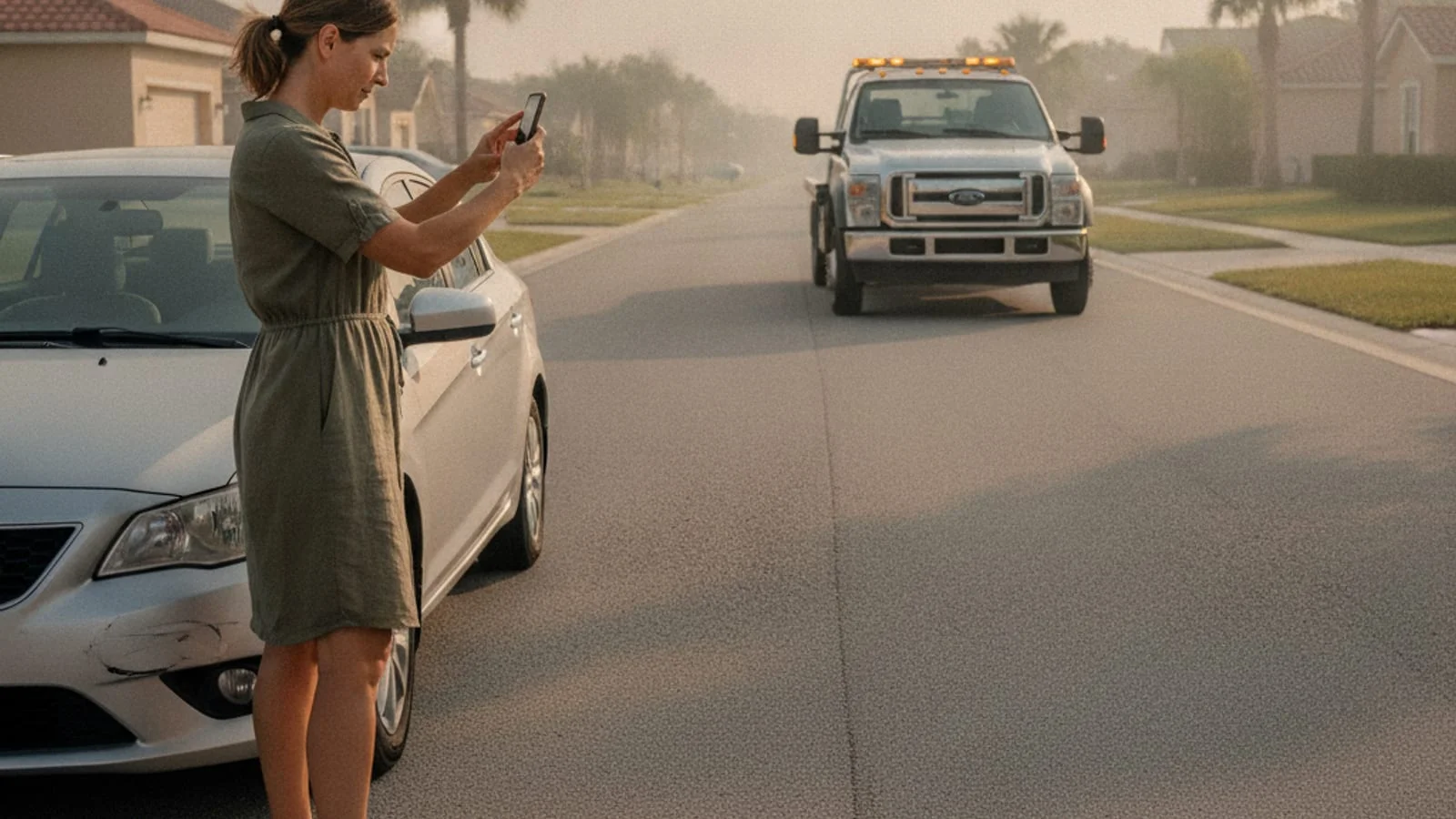
If you need accident recovery towing in Orlando, first confirm who controls the tow. Police may arrange removal, or you may be allowed to choose an operator. That decision affects where the car goes, which rules apply, and when storage starts.
Accident recovery towing starts in the first twenty minutes
Start with the scene, not the car. Call 911 if the crash presents an emergency. Follow instructions from police, firefighters, or other responding personnel.
Don’t stand beside traffic to photograph damage. This matters on I-4, SR 408, SR 417, and the Turnpike. Traffic can approach quickly, even when lanes appear blocked. Move to a safer location when responders direct you there.
Once the immediate danger is controlled, ask one clear question: “Am I choosing the tow, or is an agency ordering it?” Don’t assume the answer. A vehicle blocking traffic may be handled differently from one sitting safely in a parking lot.
If you can choose, tell the towing contact what happened. Mention damaged wheels, locked steering, leaking fluid, or a vehicle off the pavement. Those details help the operator select suitable recovery equipment. Our accident recovery and winch-out service connects callers with operators equipped for damaged or stranded vehicles.
Record the crash location before leaving. Include the road, direction of travel, and nearest exit or intersection. Orlando addresses can be confusing near highway ramps, frontage roads, and large developments. A location pin can help, but confirm the written location too.
Take photographs only when it’s safe. Capture the vehicle, visible damage, license plate, roadway position, and nearby signs. Also write down the towing company’s name and the destination yard. If another person makes the arrangements, ask them for those details before the vehicle leaves.
For traffic conditions after the scene, FL511 provides Florida incident and road information. It can help you plan a safe route away from a closure.
A police-ordered tow is not the same as choosing your own
Florida and Orange County rules separate several kinds of towing. The distinction matters after a crash.
Orange County defines a nonconsensual tow as removal without the owner’s consent at an accident or incapacitation scene. That isn’t the same as a trespass tow from private property. It also isn’t the same as a tow you personally request.
Ask the officer or responding agency whether the removal is being ordered. If it is, ask which agency authorized it and where the vehicle will be stored. Keep the incident information with your photographs and insurance documents.
A tow you choose after the scene is generally consensual. Orlando’s city rate limits don’t cover owner-authorized tows. The city ordinance also exempts law-enforcement-directed towing. That means the city’s nonconsensual private-property rate table shouldn’t be treated as a universal accident-towing price list.
Location creates another dividing line. City of Orlando Chapter 39 applies based on where a covered tow begins within city limits. Orange County Chapter 35 governs unincorporated Orange County and certain municipalities without their own rate schedules. A crash near International Drive may fall under a different authority than one inside downtown Orlando.
Highway handling can differ too. If Florida Highway Patrol arranged the tow, ask FHP which posted rate schedule and complaint process applies. Don’t assume an Orange County or City of Orlando maximum controls the job.
When you select the operator, ask where the vehicle will go. Also ask how hookup, mileage, recovery work, and storage will be presented. Quick Tow Orlando takes calls at any hour, dispatches Monday to Friday from 8 a.m. to 10 p.m., and connects customers with local operators. We’ll state the quoted total before an operator is sent.
Winch-outs, fluid on the road, and why it goes on a flatbed
Crash recovery often requires more than lifting a parked car. The vehicle may be in a ditch, against a curb, or sitting on a soft shoulder. Orlando’s heavy summer rain can make grassy areas unstable. A car that looks accessible may still require a controlled winch-out.
Tell the towing contact if the vehicle isn’t on firm pavement. Describe slopes, standing water, guardrails, trees, and limited shoulder space. Don’t try to pull a crashed vehicle with another personal vehicle. Damaged steering or suspension can make it move unpredictably.
Visible liquid also changes the scene. Don’t touch it or walk through it. Tell 911 or the responding agency about any leak. The driver who arrives should also know before approaching the vehicle.
A flatbed may be appropriate when wheels can’t roll safely. The same applies when steering, suspension, or body damage prevents a normal lift. It keeps the damaged vehicle fully supported during transport. It doesn’t make every wreck automatically suitable for loading, though.
The operator must evaluate the car’s condition and surroundings. Bent wheels, loose body panels, and damaged undercarriage parts can affect that decision. Manufacturer transport instructions may also influence the loading method.
Our flatbed towing page explains when this type of transport may be selected. For accident recovery, share what you can see without climbing under the vehicle. Photographs taken from a safe position can help explain the condition.
Before loading begins, remove only items you can reach safely. Don’t enter a vehicle that’s unstable, partly off the road, or surrounded by debris. You can address personal property at the storage facility if the scene isn’t safe.
Where your car goes, and the clock that starts there
The destination matters because storage rules usually begin when the vehicle reaches the facility. Get the towing company name, yard location, and ordering agency before leaving the crash scene.
If you don’t receive that information, start with the agency that handled the crash. Our guide to finding a towed car in Orlando explains the next steps. For a county-governed tow, the operator must notify the Orange County Sheriff’s Office within 30 minutes after arriving at the storage facility.
Orange County Chapter 35 gives a nonconsensual accident tow a six-hour storage-free period. That clock runs from delivery to the storage facility. It doesn’t erase the towing charge. Afterward, storage accrues in 24-hour blocks rather than calendar days.
Those are county rules, so don’t apply them automatically everywhere. A tow beginning inside Orlando city limits may fall under different authority. The city’s rate provisions also exempt law-enforcement-directed and owner-authorized towing. If FHP ordered removal, ask which rules govern that specific tow.
Orange County allows an administrative fee of up to $50 only after the first 48 hours of fee storage. The operator must also have followed the Florida lien-notice process. The county permits a one-time tarpaulin fee of up to $15 when the vehicle was reasonably tarped.
Ask the facility to identify each charge and the period it covers. Save photographs of posted rates, receipts, and notices. If a charge appears earlier than the county ordinance permits, ask which rule authorizes it.
Under the county ordinance, the vehicle must be released within 30 minutes after payment. The official Orange County towing information page explains county rules and complaint options.
Don’t leave a wrecked vehicle unclaimed while assuming insurance will handle everything. Confirm where it is, who authorized the tow, and what the facility needs from you. Contact your insurer separately to discuss your policy and the vehicle’s next destination.
Getting your things out before you settle anything
A damaged car can contain medication, work equipment, house keys, child seats, and personal records. Retrieving those belongings isn’t the same as paying to release the vehicle.
Under Orange County Chapter 35, an owner may inspect the vehicle and retrieve personal property at the storage facility at any time. The owner doesn’t have to pay first. The facility also can’t require a release or waiver before allowing that access.
This is an Orange County rule. Don’t assume the same wording controls a tow originating inside Orlando city limits or one handled under another authority. Ask the yard which rule applies and what identification it accepts before traveling there.
Make a written list of what you need. That keeps the visit focused and creates a record if something can’t be located. Photograph the vehicle and remaining contents when access is provided. Avoid removing attached equipment or parts that may be treated as part of the vehicle.
You don’t have to settle an insurance claim before requesting personal belongings under the county rule. You also don’t need to sign away a dispute just to retrieve them. If the facility refuses access, ask for the refusal and its reason in writing. Record the employee’s name, date, and time.
Our guide to personal belongings in a towed car explains this county protection in more detail. It also helps separate access to belongings from release of the vehicle itself.
If the car may contain crash evidence, speak with your insurer or the investigating agency before moving damaged components. Keep every receipt and notice connected to the tow. Those records can help establish what happened, which authority controlled the removal, and when each charge began.
When to call us
Call when a crashed vehicle can’t roll, steer, or leave the scene safely. Dispatch runs Monday to Friday, 8 a.m. to 10 p.m., and we connect you with a local tow operator suited to the recovery. Call us at (321) 321-9797.