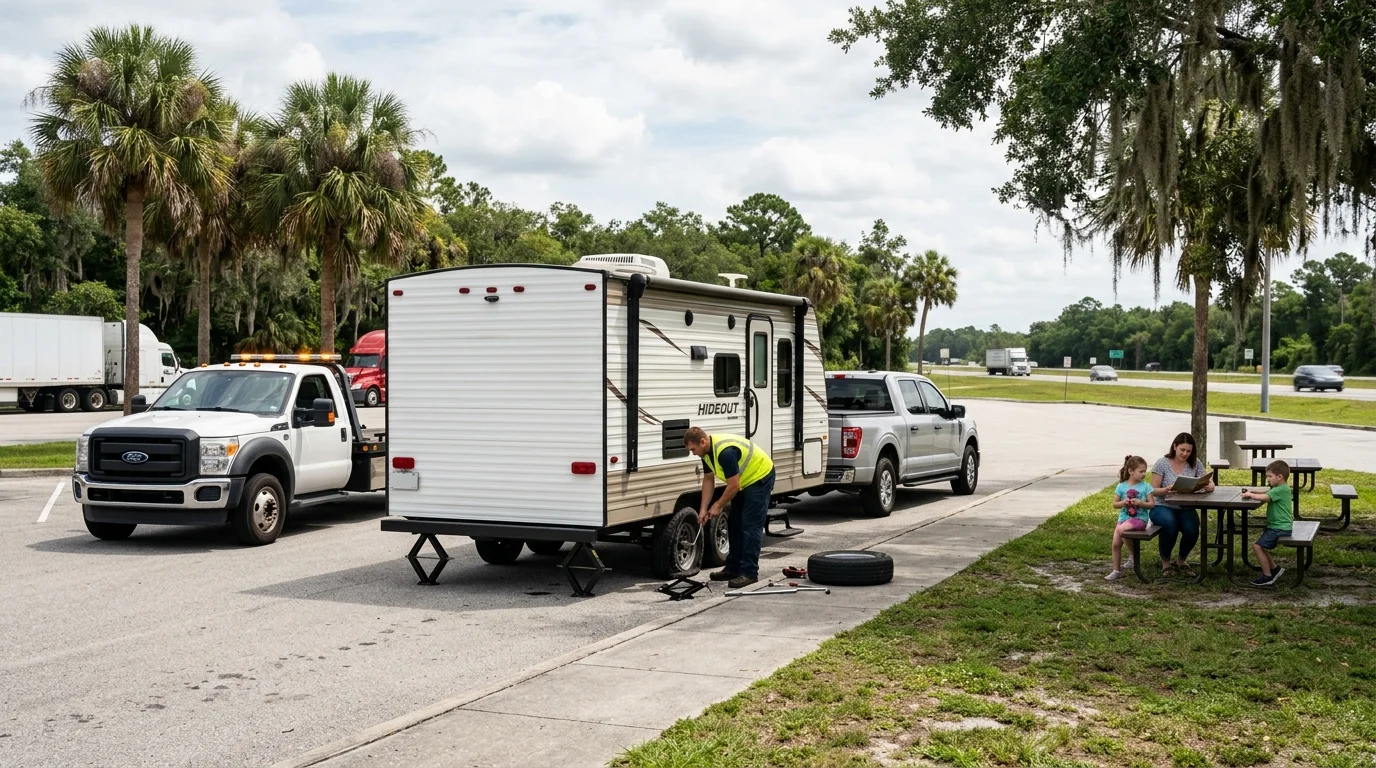
The sidewall is gone and the trailer is dragging on a Florida’s Turnpike, SR 429, or Tourist Corridor shoulder. Travel trailer tire blowout towing is the call when a spare on a quiet lot is not the safe move. Heat, load, hitch, and a shredded wheel decide whether roadside help or a full transport is the right next step.
Get passengers away from moving traffic
People come first. Get everyone out on the side away from traffic. Kids, pets, and anyone who’d hover at the fender belong well off the pavement. A blown trailer tire throws belt, tread, and metal. Standing by the wheel puts you in the path of that debris and of traffic you cannot control.
Leave the hazard lights on. If you have triangles and you can set them without stepping into a lane, do that. If you cannot, stay put. Florida’s Move Over Law covers a disabled vehicle with hazard lights on. On a road with more than one lane in your direction, other drivers must leave the lane closest to you when it is safe. On a two-lane road they must drop 20 mph under the posted limit, or to 5 mph if the limit is 20 or less. That law asks other drivers for space. It does not make a Turnpike shoulder a workshop.
I-4 through downtown, the Turnpike past Kissimmee, and SR 429 around Winter Garden all run fast. A travel trailer eats most of a shoulder. If the combo is still in a travel lane, do not walk the length of it. Call 911 if you are blocking live traffic or anyone is hurt.
A rest area, a wide paved turnout, or a lot off International Drive is a better stop than a narrow limited-access shoulder. If you can ease a short distance on remaining tires without grinding a rim, do that. If the wheel is already metal on asphalt, stop. Rolling on a destroyed tire can chew the wheel, the fender, the underbelly, and the axle. That turns a tire stop into a transport.
FHP Road Rangers patrol many limited-access highways and can help with scene safety on those roads. FL511 shows live incidents if you need a picture of backups around you. Neither one replaces an operator when the trailer cannot move. Do not jack the trailer or fit a spare beside moving traffic. A quiet campground pad or a shop bay is a repair. A live lane is not. For the broader stop-and-call sequence on an RV, see what to do when your RV breaks down.
Describe the trailer and damaged wheel
The operator needs a picture of the rig, not a shrug that “a tire blew.” Start with the trailer type: travel trailer, fifth wheel, pop-up, or toy hauler. Then the axle count. Single, tandem, and triple setups change how the remaining tires share the load. Say whether the unit is still hitched to the tow vehicle, or sitting unhitched in a lot.
Describe the damaged corner in plain words. Which side, and which axle if you have more than one. Is the tire shredded, the tread gone in a hoop, or the sidewall open. Can you see the wheel. Is the rim bent, cracked, or ground flat. Is the fender torn. Is there a smell of hot brakes or a wet stain under the hub. Those details tell the operator whether this is a spare swap in a safe place or a trailer that should not roll on that corner.
Look at the hitch and the safety chains without crawling under the trailer in a lane. If the tongue looks twisted, the coupler is sitting odd, or a chain is gone, say so. A blowout can yank the combo. Hitch damage is a transport issue, not a tire issue.
Cargo matters here too. Empty weekend camper and a loaded toy hauler are different jobs. Say if bikes, a scooter, or a golf cart sit on a rack that now hangs over a torn fender. Say if tanks are full. You do not need a scale reading. You do need an honest picture of how heavy and how tight the setup is.
Central Florida heat is part of the story in summer. Pavement on the Turnpike and SR 417 holds heat. Underinflation, overload, age, and a road cut are the causes people talk about most. This page cannot name a pressure, a speed rating, or a replacement year as a rule, because those live on your tire sidewall and in the trailer’s own plate. Read those before the next trip. For this stop, describe what you can see, not what you guess the tire used to hold.
Decide whether roadside help is appropriate
Roadside assistance is the right path only when the trailer sits in a safe, legal place and the damage is limited to a tire the operator can reach. A wide rest area, a campground pad, a hotel lot off the Tourist Corridor, or a shopping lot in Kissimmee or Winter Garden can make a spare swap possible. A live shoulder on the Turnpike usually does not.
Roadside help is a poor fit when any of these show up. The remaining tires cannot carry the trailer if that corner is lifted. The wheel is bent or ground down. The axle looks shifted. The fender or underbelly is torn into the tire path. The hitch or coupler looks wrong. The trailer is so close to traffic that a jack would put someone in a lane. You have no spare, or the spare is flat, dry, or the wrong size. You cannot say where a jack point is, and you will not invent one on the shoulder.
A passenger-car flat and a travel trailer blowout are not the same job. Our flat tire service in Orlando guide is for cars and light trucks in a place the operator can work. A travel trailer adds tongue weight, axle layout, and a much larger footprint. If the operator we send looks at the corner and says it should not be driven, trust that. Driving out on a ruined wheel can take the second tire on a tandem, or the axle.
RV and trailer towing is the path when the trailer should not roll on that corner. Transport can mean a trailer-capable wrecker, a landoll or other bed built for that length, or a tow of the whole combo if the truck and hitch are still sound. The operator on scene decides the method. We do not. We take the details and match you with someone who can look at tire, wheel, axle, cargo, and hitch before anything is hooked.
If you are still on a limited-access shoulder, treat that as a transport-leaning call until an operator says otherwise. The goal is to get the combo out of the high-speed space, not to finish a repair in it.
Share cargo and access details before dispatch
Before the truck is assigned, say how the operator will reach you and what they will find. Pin your location with a mile marker, an exit, or a named lot. “Southbound Turnpike near the Kissimmee rest area” is useful. “Somewhere on 429” is not. If you are in a theme-park overflow lot, a campground off U.S. 192, or a neighborhood street in Lake Nona, say which entrance a wrecker can use. Low trees, a tight turn, and a gate that closes at dusk all change the job.
Tell them what is in and on the trailer. Water in the tanks. Propane. A motorcycle or golf cart in a toy hauler. Bikes on a rear rack. A generator in a bumper box. You are not writing an inventory for a warehouse. You are flagging weight, height, and anything that sticks out past a torn fender. If a slide is out, bring it in if you can do that from inside without standing in traffic.
Say whether you have a spare, wheel chocks, and the hitch lock key. Say whether the tow vehicle can still pull, or the truck is disabled too. If the truck is fine and the trailer is the problem, the operator may still want both in a safe lot before any unhitching. Do not unhitch on a shoulder to “make it easier.” An unhitched travel trailer on a grade is its own hazard.
Access includes people. If kids are with you, say you need a pickup point that is not the travel lane. If a pet is in the trailer, say so. The operator is there for the rig. You still need a plan for who waits where.
Quick Tow Orlando connects you with independent operators. We do not own the truck that shows up. The clearer your cargo and access notes, the less the driver who arrives has to guess in a hot, tight spot.
Confirm where the trailer should go
A blowout stop is not finished when the trailer leaves the shoulder. You need a destination the operator can actually deliver to. Name it before the hookup. A dealer or independent RV shop in the Orlando metro. A campground that will take a damaged unit. Your driveway in Winter Park, Sanford, or Kissimmee, if the street can hold that length. A storage lot you already pay for. “Just get it off the road” without a pin drops the operator into a search you will pay for in time and extra miles.
Ask whether that destination can receive a trailer with a bad corner. Some shops want it on all tires. Some can take it on a bed. Some lots will not accept a leaking tank or a torn underbelly overnight. If you do not know, say you do not know. The operator can often suggest a nearby shop they already run to. That is their knowledge, not a promise from this line.
If the tow vehicle is still sound, decide whether it rolls with the trailer or goes separately. A fifth-wheel hitch and a bumper-pull coupler are different disconnects. Do not plan that on the Turnpike shoulder. Plan it in the lot you are heading to, or let the operator keep the combo together until you are off the limited-access road.
Insurance, roadside memberships, and shop hours are your paperwork, not ours. We cannot quote what a policy will pay. Confirm with your carrier while you wait in a safe place. If a shop is closed, you still need a legal overnight spot. A random shopping lot can become a private-property tow if you leave the trailer there without permission. That is a different statute and a different headache. Get the destination in writing in your own notes before the truck moves.
Once you have people off the pavement, a clear description of the wheel, a roadside-or-transport call, cargo and access in the open, and a pin for the drop, the job has a shape. That is the whole point of this page.
When to call us
Call when the trailer cannot sit in a safe, legal place, or the wheel, axle, hitch, or body looks like more than a spare in a quiet lot. Call us at (321) 321-9797. Dispatch runs Monday to Friday, 8 a.m. to 10 p.m., and we connect you with a local operator who can sort roadside help from a transport before anything rolls.