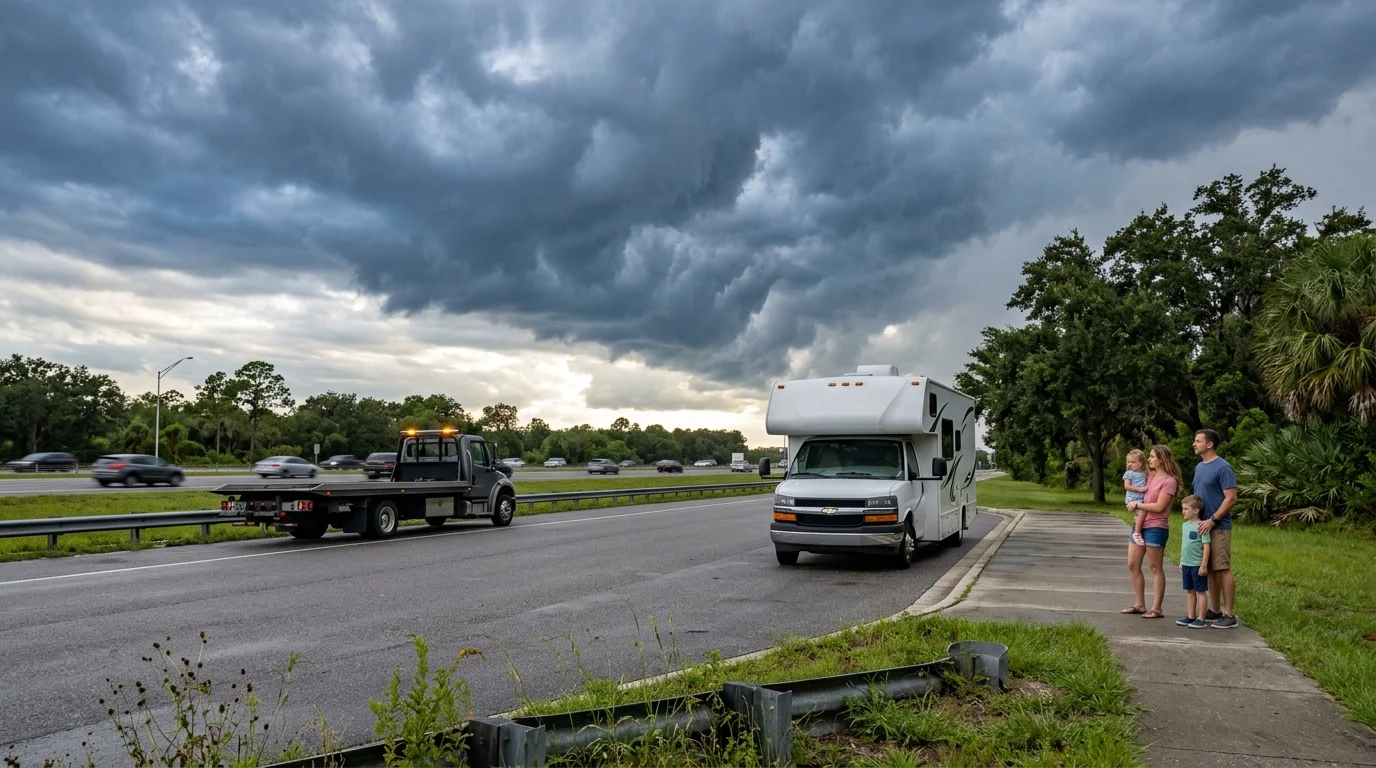
An RV breakdown near Orlando can leave a whole family stranded. Finding the right RV towing service starts with protecting everyone, identifying the vehicle, and choosing a destination that can receive it.
Protect the scene before checking the RV
Your first job is protecting people, not diagnosing the RV. Pull as far from moving traffic as conditions safely allow. Turn on the hazard lights and follow any instructions from law enforcement or roadway personnel.
Don’t walk beside traffic to inspect the vehicle. Don’t crawl underneath the RV on a shoulder. A motorhome can block your view of approaching vehicles, while passing traffic may have little room to move away.
Move passengers to the safest available location. That may be behind a roadside barrier or farther from traffic. Keep children and pets under direct control. If leaving the RV would put anyone closer to traffic, remain inside with seat belts fastened until help provides safer instructions.
Tell emergency services if the RV blocks a travel lane. The same applies when there’s smoke, fire, leaking fluid, a collision, or a medical concern. Those situations need more than an ordinary towing request.
Florida’s Move Over law covers tow trucks displaying amber lights. On multilane roads, passing drivers must leave the closest lane when it’s safe. Drivers on two-lane roads must reduce their speed as the statute directs. That protection matters, but it doesn’t make a roadside shoulder safe for repairs.
This is especially important on Florida’s Turnpike, SR 429, and roads around Lake Buena Vista. Share your exact location before trying to inspect anything. If you’re stranded on another major route, our guide to breaking down on I-4 explains how to report your position clearly.
Separate a roadside repair from a towing problem
Not every RV problem requires a tow. The important question is whether the vehicle can move safely, not whether it can move at all.
A weak battery, lockout, or another limited problem may call for roadside assistance. A damaged wheel, steering problem, collision, or vehicle that won’t run may require RV breakdown towing. Don’t test-drive an RV when doing so could worsen the damage or put traffic at risk.
Start with what you can observe from a protected location. Note any dashboard warnings, unusual sounds, visible damage, smoke, or leaking fluid. Describe what happened immediately before the RV stopped. Don’t touch hot components or enter moving traffic for a closer look.
Motorhomes and towable RVs create different service needs. A motorhome is one powered vehicle. A travel trailer depends on its tow vehicle, hitch, and trailer running gear. If the tow vehicle fails but the trailer appears stable, tell the operator that both units remain connected. Don’t unhitch them beside moving traffic.
Problems inside the living area may not prevent safe driving. Problems affecting movement, braking, steering, wheels, or the connection between vehicles need a professional assessment. When you aren’t sure, explain the symptoms without naming a diagnosis.
Quick Tow Orlando can connect callers with RV and trailer towing help suited to the reported vehicle. For a dangerous stopping position or a breakdown that leaves the roadway blocked, request emergency towing support. The operator who receives the job can decide what equipment fits the situation.
Gather the details that determine the equipment
An RV towing request needs more information than a standard passenger-car call. The operator must understand the vehicle before arriving. Accurate details also reduce the chance of sending equipment that doesn’t fit the job.
Start with the RV type. Tell the call taker whether you have a motorhome, camper van, fifth-wheel trailer, travel trailer, or another configuration. If it’s a motorhome, provide its class when known. If it’s towable, identify the tow vehicle and hitch style.
Next, share the manufacturer, model, model year, and overall length. Read dimensions or weight ratings from the RV’s labels or documents when it’s safe. Don’t guess. Say that a detail is unknown if you can’t confirm it.
Describe the current condition:
- Does the engine start and remain running?
- Can the transmission shift into neutral?
- Does the steering respond normally?
- Are all wheels attached and facing forward?
- Is any tire, wheel, axle, or suspension area damaged?
- Are the leveling jacks fully raised?
- Are slide-outs or awnings extended?
- Is a trailer, car, or other unit attached?
- Did the RV leave the pavement or become stuck?
Location details matter just as much. Give the road name, travel direction, nearest exit, and a visible landmark. On Florida’s Turnpike or SR 429, include any marker you can read safely. Around Lake Buena Vista, name the road and direction instead of giving only a resort or campground name. Large properties may have several entrances.
Explain the available working space. Mention a narrow shoulder, soft ground, low branches, overhead structures, tight turns, or a blocked wheel. Don’t step into traffic to measure the area.
Photos can help with a motorhome towing service match. From a safe position, photograph the full side, front, rear, wheels, visible damage, and attached equipment. Avoid standing between the RV and passing traffic. Never delay a safety call to take pictures.
Plan for passengers, pets, and the trailer
An RV often carries more people and belongings than a passenger car. The towing plan must account for everyone, not only the vehicle.
Tell the call taker how many adults, children, and pets are present. Mention anyone with a mobility concern or medical need. A tow vehicle may not have room for every passenger. Confirm transportation separately before the RV moves.
Central Florida weather can change the roadside situation. Heat, rain, and nearby lightning may make waiting outside uncomfortable or unsafe. Choose shelter based on current conditions and instructions from roadway personnel. Don’t use an awning, slide-out, or roadside setup while stopped near traffic.
Secure pets in carriers or on leashes before opening an RV door. Keep children away from the hitch, wheels, leveling equipment, and recovery area. Loose belongings should be secured inside when you can do so without entering an unsafe space.
A towable trailer may require a separate decision from its tow vehicle. The operator needs to know whether the hitch, safety chains, wiring, wheels, or trailer frame appear damaged. Don’t reconnect, disconnect, or adjust those parts beside moving traffic.
If the RV was pulling a car, boat, or utility trailer, disclose that during the first call. The attached unit might not be able to remain connected during transport. Ask whether one operator can address the complete setup or whether another arrangement is needed.
Travel trailer roadside help also depends on access. A trailer inside a campground site presents a different setup than one stopped along SR 429. Describe gates, tight loops, soft ground, trees, and parked vehicles. Let the responding operator decide how to approach and position the equipment.
Choose a destination that can receive the vehicle
Decide where the RV should go before it’s loaded. The closest repair shop isn’t automatically the right destination. Some facilities may not accept your RV type, dimensions, damage, or drivetrain.
Call the proposed destination directly. Confirm that it can receive the specific motorhome or trailer. Describe the breakdown and any visible damage. Ask whether the property has suitable access for the RV and towing equipment.
Also confirm when and where the vehicle can be delivered. Get clear instructions for an entrance, key drop, contact person, or secured arrival area. If the facility can’t accept the RV, choose another destination before transport begins.
A campground isn’t always a repair destination. It may work when the RV can be placed safely and the needed service can come later. However, property rules, site access, and available space must be confirmed with the campground itself. Don’t assume a disabled motorhome can return to its original site.
Distance deserves early consideration. A suitable RV facility may be outside the immediate Lake Buena Vista or Orlando area. Ask how the destination affects the towing plan before authorizing transport. Our guide to long-distance towing costs from Orlando explains which job details can affect a longer move without claiming a fixed price.
Keep the destination name, exact address, and receiving instructions together. Share them with the operator before the vehicle is moved. If insurance or a roadside plan may apply, contact that provider and confirm its requirements directly.
Quick Tow Orlando connects customers with local towing pros throughout the Orlando metro. We don’t operate the tow truck or repair the RV. We match the reported situation with an operator who can review the vehicle, location, and requested destination.
When to call us
Call when your RV can’t move safely, needs special towing equipment, or is stranded in a dangerous location. Quick Tow Orlando will gather the details and connect you with a local tow operator.