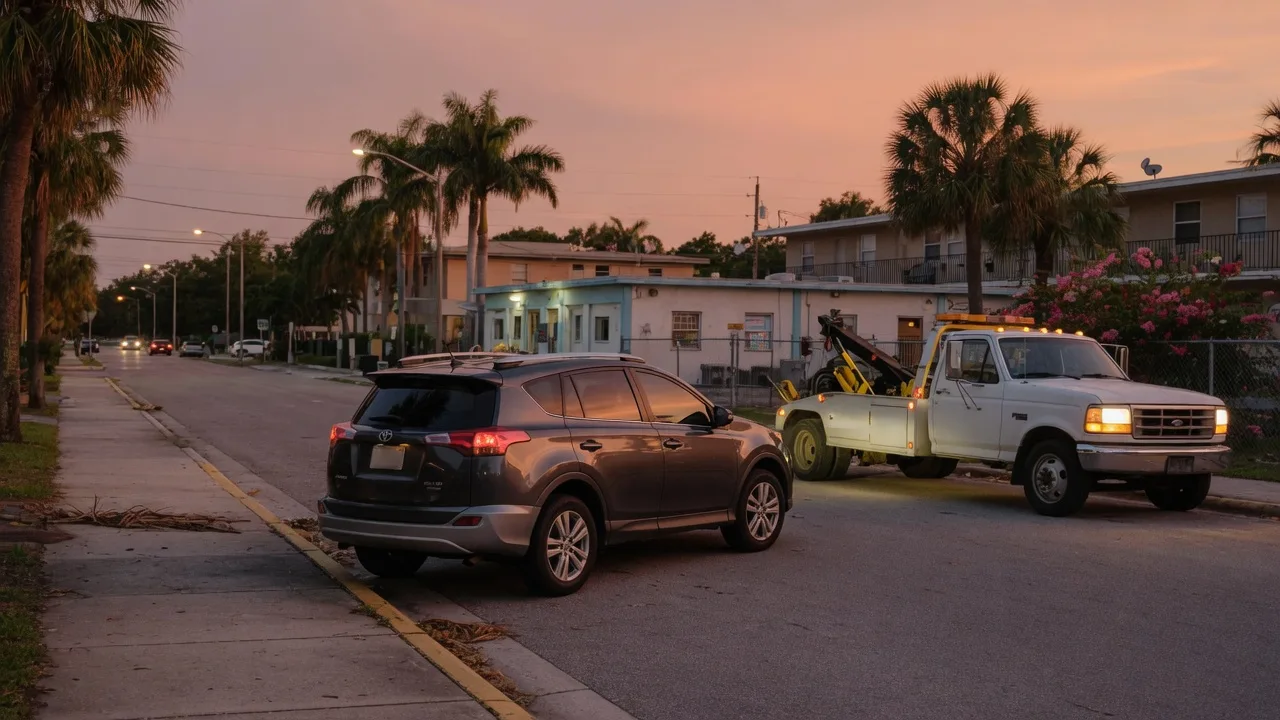
You can tow an all-wheel-drive car with a wheel-lift only when the axle that stays on the road is fully protected, usually with dollies, and the vehicle’s current towing procedure allows it. Putting the transmission in neutral does not make a wheel-lift safe by itself. If you cannot confirm that plan, request a flatbed.
Quick Tow Orlando connects you with an independent operator. We do not own the truck and we do not override the manufacturer’s instructions for your exact year, make, and model.
The wheel-lift versus flatbed guide compares the two trucks. This page answers the AWD loading question, including the “in neutral” version people actually ask.
Neutral does not disconnect every drivetrain
Neutral is a gear position. On many AWD and 4x4 vehicles it does not isolate every drive component.
If the front and rear axles stay coupled through a transfer case, a center differential, or electric drive units, the wheels that remain on the pavement can still spin parts that were never meant to freewheel for miles. That is how a short wheel-lift move turns into transmission or transfer-case damage.
Some body-on-frame 4x4s have a transfer-case neutral that the owner’s manual describes in a towing chapter. Many crossovers do not. A Toyota RAV4, a Subaru, a Honda CR-V with AWD, and a Jeep Wrangler are not the same machine. Do not copy a forum answer from one of them onto another.
Tell the operator:
- Year, make, model, and trim
- Whether the badge says AWD, 4WD, 4x4, or “intelligent” all-wheel drive
- Whether you can select 2WD
- Whether the shifter will go to Neutral and whether the car actually rolls
- Any dashboard warning about drivetrain, parking brake, or tow mode
If you do not know the drivetrain, say that. Guessing from the shape of the car is how the wrong truck gets sent.
When a wheel-lift can still be the right truck
Wheel-lift towing lifts one axle and lets the other axle roll. For an AWD car, that rolling axle is the risk.
A wheel-lift can still be the right tool when:
- The operator brings wheel dollies or a similar device for the rolling axle, so no AWD tire turns on the pavement
- The manufacturer’s current procedure allows that setup for this exact vehicle
- Access is too tight for a flatbed, such as a downtown Orlando garage, a Winter Park side street, or a packed International Drive lot
- The tires, steering, and brakes on the supported end can take the lift
Dollies are not optional flavor. They are the difference between “the truck fit” and “the drivetrain got dragged.” Ask the operator whether the rolling wheels will be off the road or on dollies. If the answer is that Neutral is enough, push for the manual’s method or a flatbed.
A wheel-lift is also the wrong default when a wheel is bent, a CV axle is broken, or the car will not come out of Park. Those jobs need a different loading plan. See towing a car stuck in Park and towing a car with a broken axle.
Tight access still does not beat the manual. A compact truck that fits the garage can still be the wrong support method.
When the car should go on a flatbed instead
A flatbed keeps every tire off the road once the car is loaded. For most AWD crossovers and for AWD hybrids and EVs, that is the method the owner’s manual describes.
Choose a flatbed, or expect the operator to, when:
- The manual says transport all four wheels off the ground
- You cannot confirm a transfer-case neutral or a factory tow mode
- The car is an EV or hybrid with AWD drive units, including many Teslas. Use can a Tesla be towed normally and hybrid towing for those drivetrains
- A tire, wheel, or steering part already failed
- The car sits where a deck can be lined up: a plaza, a wide residential street, a shoulder with room to ramp
Flatbed is not magic in a low garage. Overhead clearance, ramp angle, and nearby cars still matter. Low-clearance towing covers the loading angle. Share photos of the approach, the ceiling, and the car’s ride height.
Do not start the engine and idle it in Neutral as a workaround so a wheel-lift can drag it. That is a forum trick, not a procedure.
What to tell dispatch before the truck is chosen
The operator we connect you with picks the truck. Your job is to describe the car and the hole it is sitting in.
Have this ready:
- Full vehicle description and drivetrain
- Whether it rolls, steers, and comes out of Park
- Parking orientation: nose-in, backed against a wall, on a hill
- Garage height, gate width, and whether a flatbed can enter
- Destination that can receive the car tonight
- Any factory “Tow,” “Transport,” or “Neutral tow” mode you already found in the manual
If the car is on I-4, SR 417, or US 192, say the direction and the nearest exit before you debate equipment. Scene safety comes first. The I-4 breakdown guide is the highway version of that order.
There is no price on this page. Confirm the method and the total with the operator who takes the job, before the truck moves.
When to call us
Call Quick Tow Orlando when an AWD car needs to leave and you need an operator who will match the truck to the drivetrain. The line is (321) 321-9797. It is open 24/7.
Say it is all-wheel drive in the first sentence. That one fact changes the load.