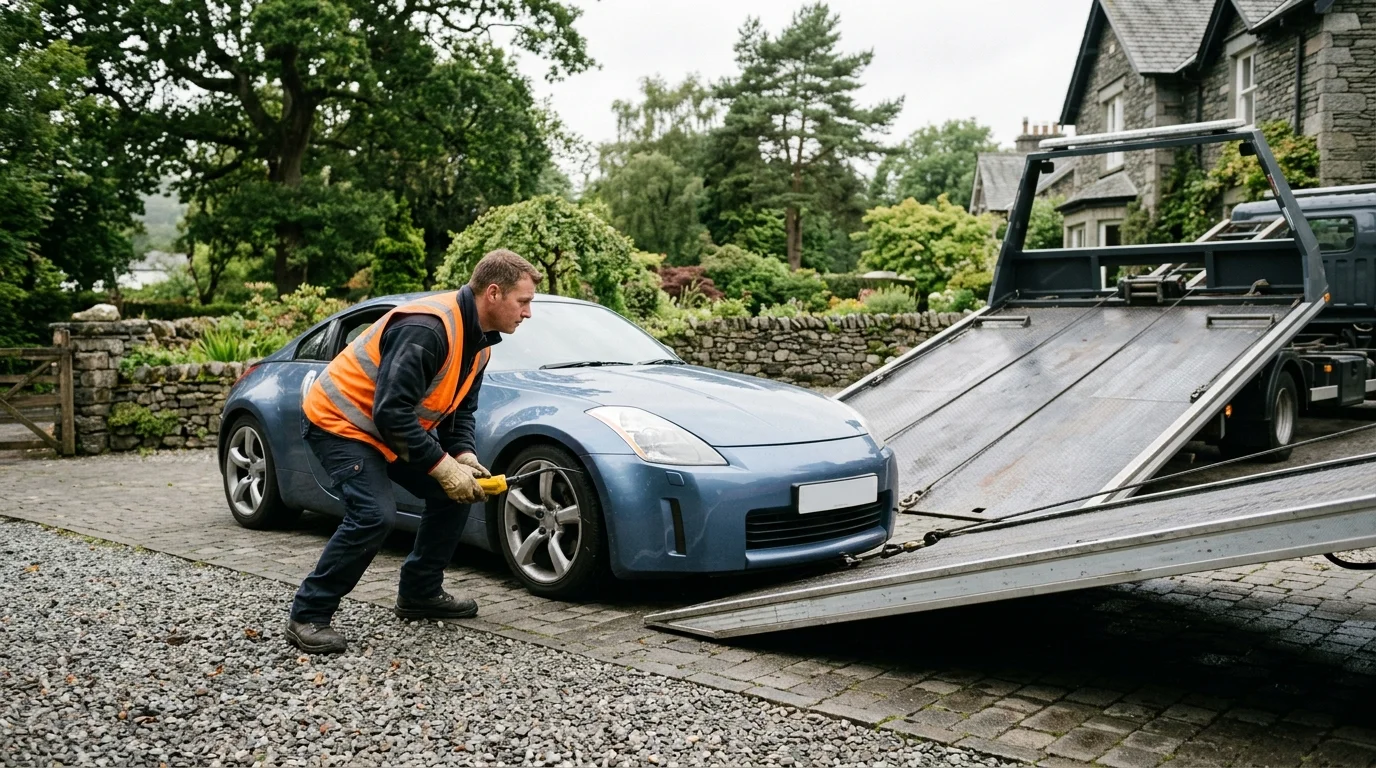
A low-clearance car needs a towing plan built around its shape, condition, and location. Before dispatch, describe the vehicle and both access points so the referred operator can choose a suitable loading method.
That conversation matters as much as the equipment. A flatbed may be appropriate, but the operator still needs enough information to manage the loading and unloading angles.
Why ground clearance changes the loading plan
A normal-looking loading path may not work for a low vehicle. The front lip can approach the equipment before the tires do. The center of the car may also pass close to a transition point. Rear bodywork or exhaust components can present another concern as the vehicle changes angle.
Those risks depend on more than ground clearance alone. Wheelbase, overhangs, body modifications, suspension position, and surface slope all affect the approach. Two sports cars parked together may need different plans.
That’s why low clearance car towing shouldn’t start with a blanket equipment request. It should start with an accurate description. Tell the referred operator what sits low and where you’re concerned about contact.
Many owners ask for flatbed towing because they want the car carried rather than pulled behind the truck. That’s a useful starting point, not a complete loading plan. The operator still must assess how the vehicle will reach the carrying surface.
Ask these questions before the truck is sent:
- How will the operator assess the front and rear overhangs?
- Does the car need to roll and steer during loading?
- What changes if a wheel is locked or damaged?
- Is there enough space to position the equipment?
- Could the pickup slope change the loading approach?
- How will the operator protect loose or damaged bodywork?
Don’t rely on a universal clearance figure or ramp angle found online. We couldn’t confirm one specification that applies to every low vehicle and towing setup. The vehicle maker’s instructions and the operator’s assessment should guide the plan.
For rare, restored, or specialty vehicles, start with exotic and classic vehicle towing. It helps frame the request around the car’s condition and handling needs.
Describe modifications and existing damage first
Tell the operator about every change that affects the car’s height or shape. Don’t wait until the truck reaches a tight garage or sloped driveway. A useful dispatch description is specific, short, and based on what you can see.
Start with the year, make, model, and trim. Then explain whether the car appears factory height or has been lowered. If you don’t know the suspension details, say that plainly. Photos can help the operator evaluate what you can’t identify.
Mention parts such as a front splitter, side skirts, diffuser, low exhaust, or added body kit. Include wheel and tire changes if they affect how the car sits. Tell the operator whether adjustable or air suspension is installed, but don’t change its position without checking the vehicle’s instructions.
The car’s working condition matters too. Report whether it starts, shifts, steers, brakes, and rolls. Mention a flat tire, broken wheel, damaged suspension, or locked steering. If the vehicle was in a collision, describe loose panels and visible fluid before anyone attempts to move it.
Take clear photos of existing damage before loading. Capture the front, rear, both sides, wheels, and low bodywork. These images help separate existing marks from concerns noticed later. They also give the operator another view of the car’s stance.
Owners of restored vehicles can use our classic car towing guide for additional preparation steps. A classic may combine low bodywork with fragile trim, nonstandard controls, or restoration work that deserves advance notice.
When asking how to tow a lowered car, don’t describe it only as “very low.” Explain what was changed, what’s damaged, and whether the vehicle can move under its own power. Those details give the referred operator something useful to plan around.
How the pickup surface affects loading
The ground beneath the car is part of the loading problem. A level parking space offers a different approach than a sloped Windermere driveway. A garage in Winter Park creates different limits than an open lot near International Drive.
Describe the pickup surface before dispatch. Say whether it’s pavement, gravel, grass, packed dirt, or another material. Mention visible soft ground, standing water, broken pavement, curbs, parking stops, and steep changes in slope. Don’t assume the operator can correct an access problem after arrival.
Space matters around the vehicle as well. Tell the operator about walls, columns, low branches, gates, parked cars, or tight turns. If the car is inside a garage, provide the garage opening and available working space only if you can measure them accurately. Never guess.
A clear description might sound like this: “The car is nose-in inside a residential garage. The driveway slopes toward the street. It rolls, but the front splitter sits close to the pavement.” That gives more useful information than simply requesting a flatbed.
Pickup conditions can change quickly during an Orlando storm. If rain has softened a grass shoulder or left water across a parking area, update the operator. A photo taken earlier may no longer show the current surface.
Location also changes the safety discussion. A disabled car on I-4, SR 408, SR 417, or the Turnpike presents traffic exposure that a private driveway doesn’t. Tell the call taker if the vehicle is near moving traffic, blocking a lane, or under law enforcement direction. If there’s an immediate danger, contact emergency services first.
Don’t attempt to improvise ramps, boards, or lifting points. Those choices depend on the car, surface, equipment, and operator’s assessment. Keep people away from the loading path and follow the instructions given at the scene.
Check manufacturer guidance before transport
The owner’s manual is the best place to start for vehicle-specific transport instructions. Look for sections covering towing, roadside emergencies, recovery, transport, or a disabled vehicle. The wording varies by manufacturer and model.
Don’t substitute advice for a similar-looking car. Drivetrain, suspension, parking controls, and electronic systems can differ between model years and trims. If the manual isn’t available, tell the operator that you couldn’t confirm the procedure.
Share any instructions you find before loading begins. Useful topics may include:
- Whether the transmission can enter neutral
- Whether the steering can remain unlocked
- Whether the parking brake can be released
- Whether the vehicle has a transport or tow setting
- Where the manufacturer identifies recovery points
- Whether any wheels must avoid rolling
- Whether suspension settings require special handling
These are questions to verify, not universal directions. Don’t activate an unfamiliar mode or attach equipment to a point based only on appearance. Let the operator compare the vehicle guidance with the condition at the scene.
Electric vehicles deserve the same model-specific check. Our guide on whether a Tesla can be towed normally explains why the exact model and current condition matter. Don’t assume instructions for one electric vehicle apply to another.
If the manual conflicts with a proposed method, pause and clarify the plan. Ask the referred operator to explain how the vehicle will be loaded within the manufacturer’s guidance. If collision damage makes that procedure impossible, the operator may need to reassess the equipment or recovery approach.
Keep the manual accessible during the job. A saved digital copy can help when the printed book is locked inside the car or missing.
Confirm unloading access at the destination
A careful pickup can still lead to trouble at an unsuitable destination. Confirm the unloading area before the vehicle leaves Orlando, Lake Nona, Kissimmee, Sanford, or another part of the metro.
Start with the exact destination and an on-site contact. Verify that the repair shop, dealer, storage location, residence, or event venue expects the vehicle. Ask where the operator should enter and where the car should be placed.
Then check the final approach. Look for steep driveways, high curbs, narrow gates, speed bumps, parking structures, loose gravel, and limited turning room. Tell the operator if the delivery spot sits behind another vehicle or inside a tight bay.
After-hours access needs extra attention. Don’t assume a closed shop has an approved drop area. Confirm whether the property can accept the car and whether someone must be present. If you can’t verify access, discuss another destination before transport begins.
The vehicle’s condition also affects unloading. A car that doesn’t steer, brake, roll, or start may be difficult to position after it leaves the transport equipment. Explain where it needs to end up and whether the receiving location can handle a non-running vehicle.
For a modified car, send destination photos when possible. Include the entrance, driveway slope, gate, and intended parking spot. The operator can compare them with the pickup conditions and the car’s overhangs.
Before departure, confirm these points:
- The destination address is correct
- The property expects the vehicle
- Entry instructions are available
- The unloading surface has been described
- The final parking position is clear
- Someone can answer access questions if needed
Don’t focus only on getting the car onto the truck. Low-clearance transport ends when the vehicle reaches an appropriate resting place without an avoidable access surprise.
When to call us
If a sports car sits unusually low, has body modifications, or can’t roll normally, professional transport planning is the safer choice. Quick Tow Orlando takes calls at any hour, dispatches Monday to Friday from 8 a.m. to 10 p.m., and connects drivers with independent towing and roadside operators across the Orlando metro. Call us at (321) 321-9797.