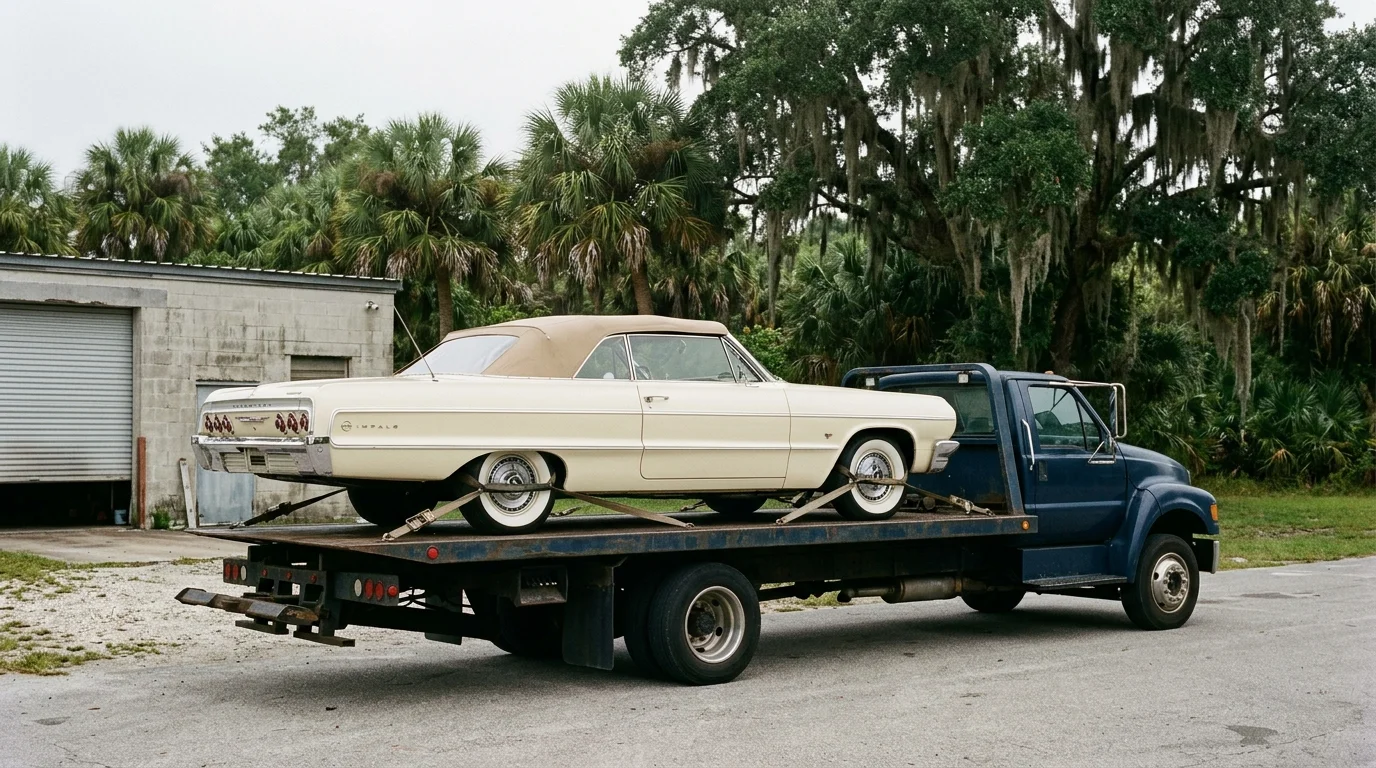
For classic car towing in Orlando, start by confirming the carrier, loading angle, securement plan, and weather exposure. The operator needs details about your specific car before choosing equipment. A generic request for a tow doesn’t give them enough information.
Why classic car towing needs a different truck
The important question isn’t whether a truck can move your classic. It’s whether the proposed setup fits this car, in this condition, at this location.
Start with the year, make, model, and current condition. Tell the operator whether the car runs, rolls, steers, and brakes. Mention a lowered suspension, long nose, side pipes, loose trim, or low exhaust. Point out anything that changed during restoration.
The pickup location matters too. A car inside a workshop presents different access than one beside I-4. Measure narrow gates, garage openings, and tight turns. Mention curbs, slopes, gravel, soft ground, and overhead limits. Share photos showing the car and the full loading area.
Don’t stop at asking for a flatbed. Ask what carrier will arrive and how the car will reach its deck. Some loading problems appear before a tire touches the ramp. The operator should understand the available approach and the vehicle’s lowest visible points.
Our exotic and classic vehicle towing service connects owners with local operators for these specialized moves. If an open carrier fits the job, review the planned flatbed towing setup before agreeing.
A familiar model name doesn’t settle the equipment choice. Restorations, custom wheels, and suspension changes can alter the plan. Give the operator enough information to match the actual vehicle, not a stock version remembered from a photograph.
Open deck or enclosed trailer, and how to decide in one question
Ask yourself one direct question: would you drive this car uncovered along the same route today?
An open deck leaves the vehicle exposed during transport. An enclosed trailer places walls and a roof around it. That difference matters when the car has fresh paint, delicate trim, an aging convertible top, or an interior that shouldn’t meet rain.
The route should guide the decision. A short move between two Orlando shops isn’t the same as a run across Florida. Check the forecast, road conditions, pickup access, and delivery space. Enclosed equipment still needs room to load and unload safely.
Don’t accept “enclosed” as the whole explanation. Ask how the vehicle enters the trailer. Confirm whether it loads from the rear or side. Ask whether the operator expects to move it between carriers. Find out whether other vehicles will share the trailer.
An open deck can still be a considered choice. You may prefer it when conditions are dry, access is limited, and the car can tolerate exposure. The operator should still explain the ramp, winching, and securement plan.
The one-question test helps identify what you’re protecting. It doesn’t replace a close equipment check. A roof won’t solve a steep ramp. An open deck isn’t automatically unsuitable. Match the carrier to the car, route, weather, and handoff location.
Get that choice settled before the vehicle leaves its garage. Changing plans beside a narrow driveway creates pressure to accept equipment you haven’t reviewed.
Soft straps, low clearance and the angle of the ramp
“Soft straps” is a helpful phrase, but it isn’t a complete securement plan. Ask exactly where each strap will touch the car. Confirm that no chain, hook, or tensioned strap will contact painted or chromed bodywork.
Request tire-based securement when it suits the vehicle. Then discuss custom wheels, tight fenders, wheel covers, and narrow tire gaps. A method that sounds gentle can still be a poor fit around delicate finishes.
Ramp angle deserves the same attention. Identify the car’s lowest points before loading. Check the front valance, chin spoiler, exhaust, frame hardware, and rear bodywork. Photos taken near ground level can show details missed in a standing shot.
Ask how the operator will reduce the loading angle. The answer should describe the actual carrier and equipment being sent. Don’t rely on a general statement that the car “should clear.” Measurements and current photos give everyone better information.
An inoperable classic needs another conversation. Tell the operator whether the wheels turn freely and the steering unlocks. Ask where the winch line will attach. Don’t volunteer an attachment point unless the car’s documentation or a qualified mechanic confirms it.
Before loading, photograph all four corners, both sides, the roof, the wheels, and the underside areas you can safely see. Keep those images with the booking details. Repeat the walkaround after unloading, before the operator leaves.
Finally, discuss the parking brake, transmission position, alarm, battery switch, and keys. Procedures vary by vehicle. The operator should follow the car’s documented instructions instead of guessing from a newer model.
An open deck in June: storms, salt air and the drive home
Central Florida is the Lightning Capital of the United States. Florida averages 59 lightning flashes per square kilometer each year. The National Weather Service also identifies lightning as Florida’s deadliest weather hazard.
That doesn’t make open transport the wrong choice. It makes current conditions part of the decision.
Check the forecast before pickup and again before loading. Watch the full route, not only the sky above your driveway. Conditions near Lake Nona may differ from those around Winter Park, Sanford, or the Turnpike.
Use FL511 to check current traffic and incidents on I-4, SR 408, SR 417, and SR 429. A route change can increase exposure or alter the delivery approach. Discuss any change with the operator before the carrier moves.
Rain deserves extra attention with a convertible, an imperfect weather seal, an exposed cabin, or fresh restoration work. Tell the operator what can’t get wet. Ask what happens if conditions deteriorate before loading or during the trip.
Orlando isn’t coastal, so salt air isn’t an everyday inland issue. It becomes more relevant when the car comes from Daytona Beach, Cocoa, or another coastal location. Tell the operator about recent coastal exposure and ask your restorer how the car should be cleaned after delivery.
Longer routes add more weather and handoff variables. For a trip beyond Central Florida, review the carrier and delivery plan through our long-distance towing service.
Plan the drive home separately. A car arriving on a carrier isn’t automatically ready for public roads. If its roadworthiness is uncertain, arrange delivery to a qualified shop. Don’t let a successful transport turn into an avoidable roadside problem.
The five things to confirm before you agree to anything
A good booking leaves little room for assumptions. Confirm these five points with the operator assigned to the move.
-
The exact carrier and loading method. Ask whether the vehicle will travel on an open deck or inside a trailer. Confirm how it will load, whether a winch is needed, and how the operator will address its lowest points.
-
Every securement contact point. Ask where straps, hooks, and winch hardware will touch. Describe delicate wheels, trim, paint, and suspension parts. Request a different plan if the proposed contact points concern you.
-
The pickup and delivery access. Share current photos of both locations. Include gates, slopes, curbs, garage doors, tree limbs, tight corners, and surface conditions. Confirm where the carrier can stop without blocking unsafe space.
-
Weather and route exposure. Decide whether an open deck fits the forecast and the car’s condition. Review the planned route through Orlando. For a longer trip, ask how route or weather changes will be communicated.
-
Documentation and operator coverage. Make a dated photo record before loading. Ask the operator what insurance applies to this specific transport and request proof directly. Quick Tow Orlando is a referral service and doesn’t carry the vehicle, so don’t treat the referral line as the hauling operator’s coverage.
Also confirm who may release and receive the vehicle. Provide keys, written operating notes, and any documented instructions the operator needs. Remove loose personal items and note anything that must remain untouched.
Keep the operator’s business details, your photos, and the agreed transport terms together. If an answer changes at pickup, pause and review the new plan before loading begins.
When to call us
Call when your classic is low, inoperable, weather-sensitive, freshly restored, or headed beyond Orlando. Leave the vehicle details on our line and we’ll connect you with a local tow operator. Call us at (321) 321-9797.