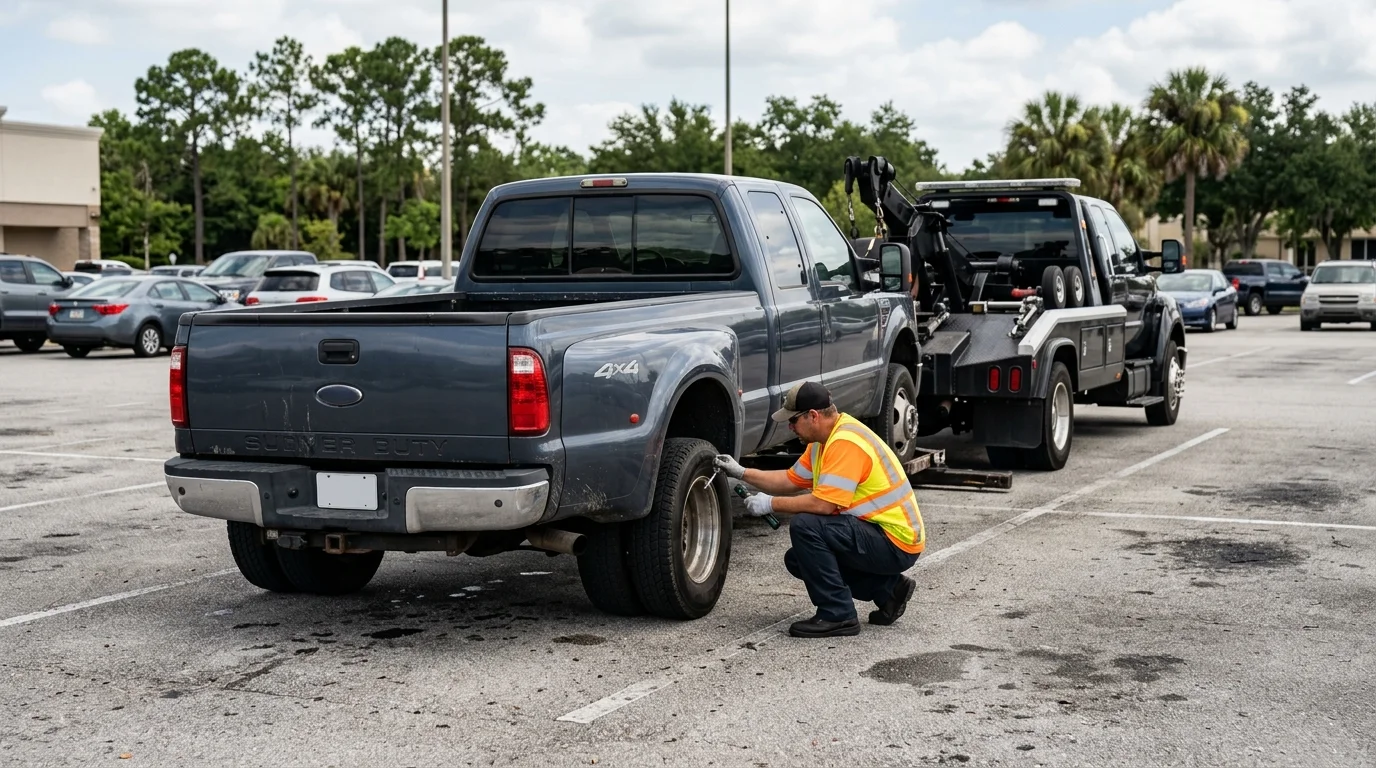
A regular tow truck may move some dually pickups, but the answer depends on the truck and the scene. Safe dually pickup truck towing starts with matching the equipment to the pickup’s exact configuration, condition, cargo, and location.
That decision should happen before an operator heads your way. Clear details help prevent an unsuitable truck from reaching an I-4 shoulder, Central Florida job site, or narrow rural driveway.
Why the rear axle changes the dispatch details
A dually has two rear wheels on each side. That wider rear axle is the first detail an operator needs to hear. Saying only “pickup truck” can leave out the feature that matters most for planning the tow.
The dually label still doesn’t answer every equipment question. These pickups come in different cab, bed, drivetrain, and chassis configurations. Some carry service bodies, tool storage, hitches, or other attachments. Their condition also varies. A running pickup parked on pavement presents a different problem from one with locked wheels or accident damage.
That’s why there isn’t one universal answer to “Can a regular tow truck tow a dually?” A towing operator must decide whether the available truck and recovery method fit that specific pickup. The operator also considers how the vehicle can be approached, loaded, secured, and delivered.
This equipment check may lead to heavy-duty towing, depending on the vehicle and circumstances. It may also lead to another setup. Quick Tow Orlando connects the owner with an independent local operator who makes that decision.
Location matters as much as the rear wheels. A wide commercial lot near International Drive may offer room to position equipment. A construction entrance near Lake Nona could have loose ground, stored materials, or limited turning space. A shoulder along SR 408 creates another set of access concerns.
Give the complete picture during the first call. The phrase “dually pickup” should come before the address, not after the operator arrives.
Share the truck’s exact configuration and condition
Start with the year, make, model, and drivetrain if you know them. Then describe the cab and bed. Tell the operator whether it’s a standard pickup body, chassis cab, utility body, or another configuration. Don’t guess when you’re unsure. A clear “I don’t know” is more useful than an incorrect detail.
Explain why the truck needs towing. State whether it starts, shifts, steers, and rolls. Mention any warning that makes you unwilling to drive it. If the pickup was in a collision, describe the visible damage without diagnosing it.
The position of the truck also matters. Tell the operator whether it’s facing forward into a space, backed against a fence, angled beside a building, or stopped across a lane. A dually parked at a Winter Park business may have open pavement around it. The same pickup inside a gated Sanford work yard may offer only one approach.
Share where the keys are and whether someone can meet the operator. If access depends on a property manager, gate code, or job-site contact, arrange that before pickup when possible. Don’t publish a gate code in an online request or leave it where others can see it.
Photos can help the operator assess the situation. Capture the full truck, both sides, the front, the rear wheels, and the surrounding space. Include visible damage and nearby obstacles. Avoid standing in moving traffic to take them.
For a broader preparation checklist, see what to have ready when calling a tow truck. Those details give the operator a better basis for selecting the recovery setup.
Describe cargo, attachments, and wheel damage
A dually pickup may look ordinary from the cab forward while carrying an unusual setup behind it. Tell the operator what’s in the bed and what’s mounted to the truck. That includes toolboxes, tanks, racks, service bodies, fifth-wheel hardware, gooseneck hardware, liftgates, and removable equipment.
Don’t describe the bed as empty if mounted equipment remains attached. The operator needs the truck’s current condition, not its original showroom configuration. If you don’t know the cargo weight or an attachment’s specifications, say so. Don’t estimate equipment ratings.
Also explain whether the pickup is connected to a trailer. Towing the truck doesn’t automatically address the trailer, its cargo, or its location. The operator needs to know about that combination before choosing an approach. A separate plan may be required, but only the operator can confirm it for the actual scene.
Wheel and axle conditions deserve specific attention. Identify which tire is flat, separated, missing, or trapped. Mention bent-looking wheels, loose body panels, or anything touching the pavement. If the steering appears stuck or a wheel won’t turn, report what you observe without forcing it.
Damage near the paired rear wheels can change how the pickup is handled. Don’t attempt to remove damaged parts beside traffic or crawl beneath an unstable vehicle. Wait somewhere away from moving lanes when the surroundings allow it.
Similar planning applies when cargo changes the character of a commercial vehicle. Our guide to loaded box truck towing explains why operators need the current load and condition, not only the vehicle name.
Check pickup clearance and destination access
A suitable tow setup still needs room to reach the pickup. Describe the entrance, surface, overhead space, turns, and nearby obstacles. The operator needs access at both the pickup point and destination.
Central Florida locations vary widely. A disabled dually might sit in a broad Kissimmee parking area, beneath an apartment overhang, behind a Winter Garden home, or beside materials at an active job site. Rural driveways can add gates, soft shoulders, tight bends, or limited turnaround space.
Look above the truck for garage structures, tree limbs, utility lines, signs, and covered loading areas. Look beside it for parked cars, curbs, posts, dumpsters, fencing, and construction materials. At ground level, report mud, sand, standing water, broken pavement, steep transitions, or a wheel that has left the firm surface.
Don’t promise that the area has enough room. Instead, give measurements only when you can obtain them safely and accurately. Photos taken from several angles may show the operator more than a general statement like “it’s a little tight.”
On a highway or major road, your first priority is the scene around you. Share the direction of travel, nearest exit, visible marker, and whether the pickup is in a travel lane or off the roadway. You can review FL511 traffic and incident alerts for current roadway information. Don’t step into traffic to search for a sign or photograph the truck.
Confirm the destination before the tow begins. A repair shop, commercial yard, or private property may have its own entrance and access limits. Check that someone can receive the pickup. A closed gate can turn a straightforward delivery into another access decision.
Let the operator match the recovery setup
The operator should make the final equipment choice. Your job is to provide accurate details and avoid hiding complications. The operator can then compare the pickup, damage, cargo, attachments, roadway position, and available working space with the equipment available.
Some situations may point toward flatbed towing. Others may call for a different method or a heavier recovery setup. A general comparison of wheel-lift and flatbed towing can help you understand the basic options, but it can’t settle the choice for a damaged dually at a specific location.
Be cautious with anyone who makes an equipment decision from the word “pickup” alone. Repeat that the truck has dual rear wheels. Then mention any service body, cargo, trailer connection, wheel damage, lowered clearance, or blocked access.
Ask the operator to confirm the plan after reviewing the details. If the truck’s condition changes, update them. A tire may collapse further, weather may affect an unpaved entrance, or another vehicle may block the planned approach. New information can change the setup.
Quick Tow Orlando doesn’t own tow trucks or perform recoveries. We take calls at any hour, dispatch Monday to Friday from 8 a.m. to 10 p.m., and connect drivers across the Orlando metro with independent towing and roadside operators. The operator who accepts the job evaluates the vehicle and handles the towing decision.
Don’t try to prove that a regular tow truck should be enough. “Regular” isn’t a useful equipment specification. A clear description helps the operator choose based on the actual dually, not an assumption.
When to call us
Call when a dually is disabled, damaged, carrying equipment, or sitting where access may be difficult. Handling it yourself isn’t worth the risk when the correct recovery setup hasn’t been confirmed. Call us at (321) 321-9797.