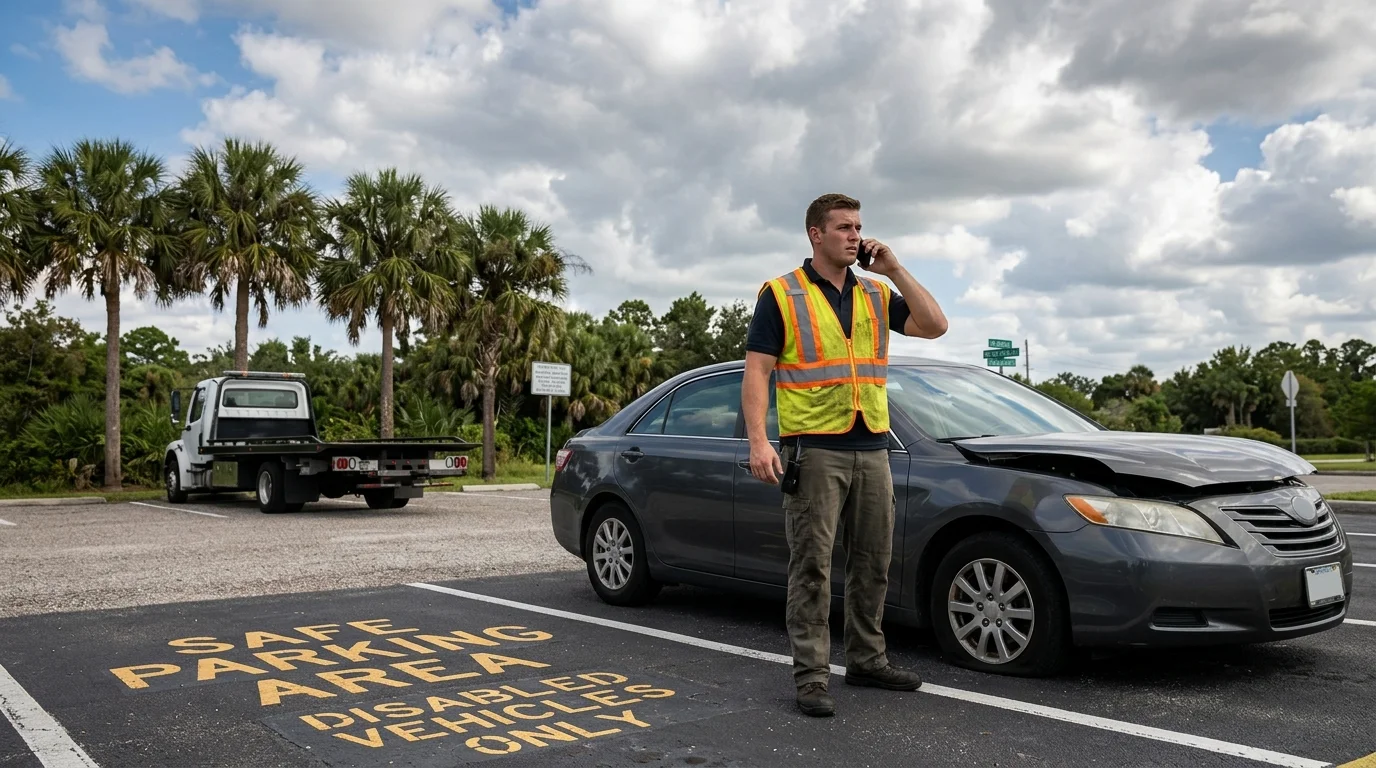
When you call towing in Orlando, have five details ready: your location, vehicle condition, access limits, destination, and requested service. That information helps the referred operator prepare for the actual pickup. Quick Tow Orlando connects you with an independent towing or roadside operator.
Start with your exact pickup location
A street address works in a driveway or open parking lot. It may not identify your car inside an apartment complex, garage, or highway interchange. Give the vehicle’s exact position, not only your current location.
For an I-4 or SR 408 breakdown, share:
- The road name and travel direction
- The nearest exit, ramp, or visible marker
- Whether you’re on the main roadway or an entrance ramp
- Which side of the road holds the vehicle
- The car’s color, make, and model
- A dropped map pin, when available
“I-4 near downtown” leaves too much unclear. “I-4 eastbound, before the SR 408 interchange, on the right shoulder” gives the referred operator a more useful starting point. Don’t guess an exit or direction. Check your navigation app or nearby signs first.
You can also review FL511 live traffic and incident alerts while gathering your location details. If you’re dealing with an active-roadway breakdown, our guide to what to do after breaking down on I-4 covers the immediate safety steps.
Inside an Orlando parking garage, provide the property name, entrance, level, row, and space. Note whether you entered from a different street than the garage’s listed address. For an apartment lot, give the complex name, gate entrance, building number, and parking section.
If you’ve moved away from the car, say so. Your phone’s location may show where you’re standing instead of where the vehicle stopped. Share where the keys are and how the operator can identify you.
Describe whether the car rolls, steers, and brakes
Calling a tow truck requires more than saying the car won’t start. The referred operator needs a clear picture of its condition and position. You don’t need to diagnose the mechanical problem.
Start with the basic vehicle details:
- Year, make, and model
- Vehicle color
- Approximate size or body style
- Gas, diesel, hybrid, or electric
- All-wheel drive, if you know
- Current gear position
- Whether the keys are available
Then explain whether the car rolls, steers, and brakes. Mention a steering wheel that won’t turn, a transmission stuck in park, or brakes that won’t hold. Don’t test these functions beside moving traffic or when the vehicle could roll unexpectedly.
Report visible damage around each wheel. Tell the operator about flat tires, a wheel pointing at an unusual angle, loose body panels, or anything hanging below the car. Mention collision damage and visible fluid on the ground without guessing what caused it.
Photos can help when words aren’t enough. Take wide photos showing the whole vehicle and its surroundings. Add close views of damaged wheels, low clearance, or blocked access. Don’t stand in traffic to get them.
Not every disabled vehicle needs transport. A dead battery, lockout, flat tire, or fuel problem may be suitable for roadside assistance, depending on the vehicle’s condition. Explain the symptoms first. The referred operator can discuss whether roadside service or towing fits the situation.
Don’t assume one truck type works for every car. Vehicle design, damage, drivetrain, clearance, and access can affect the plan. Share the facts you know and let the operator confirm the approach.
Share access problems before dispatch
Access can change a simple pickup into a more involved job. Describe every gate, garage, narrow lane, or blocked wheel before the referral proceeds.
Orlando apartment communities often have several entrances and parking areas. Tell the operator which gate reaches your building. Explain whether there’s a guard, call box, resident entry process, or property contact involved. Share private access instructions directly, not in a public post or review.
For a parking garage, report the posted entrance clearance. Include the level, ramp layout, and vehicle position. Say whether the car is parked nose-in, backed in, beside a wall, or between other vehicles. Mention tight turns and low overhead fixtures visible near the car.
The operator should also know if:
- Another vehicle blocks the disabled car
- The drive wheels can’t roll
- The parking brake won’t release
- The vehicle sits against a curb
- A gate, bollard, or chain limits entry
- The keys aren’t at the pickup site
- Property staff must approve access
Take a wide photo from the route an operator would use to reach the car. A close photo of the damaged wheel doesn’t show a narrow garage ramp or locked gate. Include both views when possible.
If your vehicle is in an assigned apartment space, confirm how the operator can enter and leave the property. If you’re requesting removal of someone else’s vehicle, say that immediately. That’s a different situation from arranging a voluntary tow for your own car.
Don’t wait until someone arrives to mention a low garage ceiling or locked entrance. Early access details give the referred operator a chance to review the setup and discuss what’s possible.
Choose a destination that can receive the car
Have an exact destination ready before calling a tow truck. “A repair shop near me” isn’t enough. Give the business or property name, full address, correct entrance, and preferred drop location.
Contact the repair shop before choosing it. Ask whether it can accept your specific vehicle and when the property will be accessible. Confirm where the vehicle should go if the service entrance is closed. Don’t assume every business has an open lot, key drop, or after-hours intake process.
For a dealership, identify the service entrance rather than the showroom entrance. For an apartment or house, describe the legal parking space where the vehicle can be left. Check any property access or parking rules before arranging the move.
Your destination plan should answer these questions:
- Has the receiving location agreed to accept the vehicle?
- Can the operator enter the property?
- Where should the keys go?
- Will someone meet the vehicle?
- Is there a gate or restricted entrance?
- Does the destination have room for the vehicle?
Dispatch runs Monday to Friday, 8 a.m. to 10 p.m., but that doesn’t confirm access at the receiving property. The guide to after-hours towing requests in Orlando explains what to organize when the call happens outside regular business hours.
Tell the referred operator before changing destinations. A different address can affect the route, scope, and final arrangements. Confirm the new destination rather than asking for an unplanned change during transport.
If you haven’t selected a shop, be direct about that. You can still discuss the pickup while you contact possible receiving locations. A confirmed destination helps keep the vehicle from reaching a closed or inaccessible property.
Confirm the scope with the referred operator
Quick Tow Orlando answers your call and connects you with an independent local operator. We don’t own tow trucks, operate a storage yard, or perform the towing. Confirm the service details with the operator handling the job.
A useful recap includes the pickup point, vehicle description, condition, access, and destination. What to tell a tow dispatcher can fit into one clear statement:
My sedan is disabled in an apartment garage in Orlando. It’s on the third level, parked nose-in, and stuck in park. The keys are with me. I need it taken to a repair shop that has confirmed it can receive the car.
Before accepting the service, ask the referred operator to confirm:
- The business handling the pickup
- The vehicle and pickup location on the request
- The planned destination
- The service being discussed
- Any access information still needed
- What charges are included
- What conditions could change the charge
- Which payment methods are accepted
- What happens if the vehicle’s condition differs on arrival
We couldn’t confirm current City of Orlando or Orange County maximum towing rates from the approved primary sources used for this guide. Confirm the current charge directly with the operator before agreeing to service. Ask for clarification if the scope or payment terms aren’t clear.
Don’t treat a request for emergency service as a guaranteed arrival time. Traffic, weather, location accuracy, vehicle condition, and access may affect the job. Ask the operator for current information about your specific referral.
Keep your phone available after the match. If you move away from the pickup point, update the operator with your location and key plan. Report a destination change, opened gate, blocked entrance, or newly discovered damage promptly.
Our emergency towing page explains the roadside requests Quick Tow Orlando can help route. Giving complete information at the start makes the conversation clearer for everyone involved.
When to call us
Call a tow operator when the vehicle can’t continue safely, roadside service won’t address the problem, or controlled transport is needed. Quick Tow Orlando can connect you with an independent operator serving the Orlando metro. Call us at (321) 321-9797.