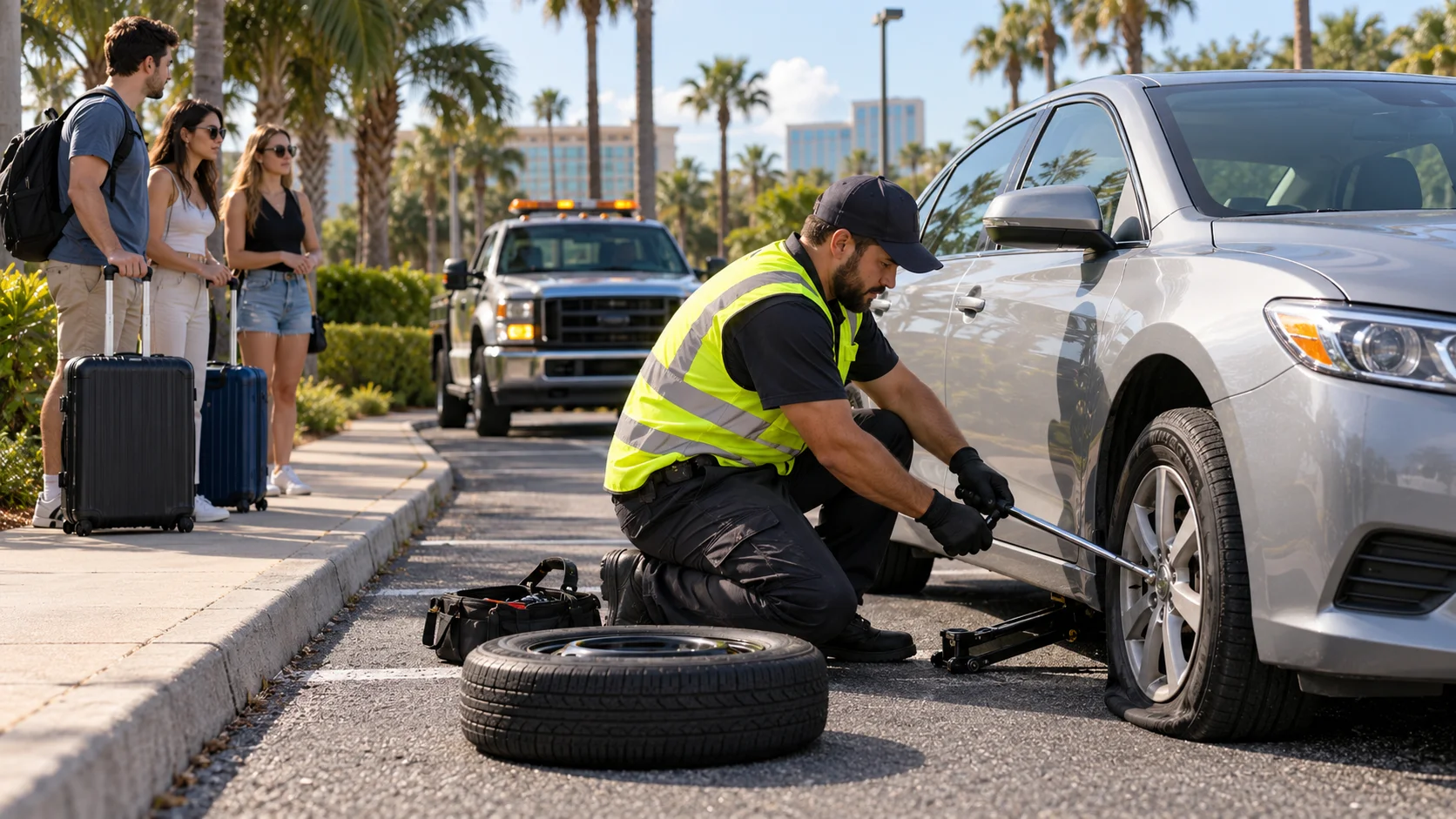
A flat tire on International Drive creates an immediate choice. Roadside help may get you moving, or wheel damage may require a tow. Your location, spare tire, passengers, and vehicle condition determine the next step.
Before requesting help, move away from active traffic if that’s possible. Then share a precise location and describe what happened. Quick Tow Orlando connects drivers with independent roadside and towing operators across the Orlando Metro.
Move away from active tourist traffic
International Drive carries local drivers, visitors, buses, and vehicles entering busy properties. A stopped car can be difficult to see amid turning traffic. Don’t remain in an active lane to inspect the tire.
If the vehicle still responds normally, move toward a nearby parking area or another place away from moving traffic. Don’t continue driving farther than needed on a damaged tire. A short move for safety differs from trying to reach your hotel or destination.
Turn on the hazard lights. Keep passengers together and away from traffic. Children, older travelers, and anyone carrying luggage may need extra space. A sidewalk or building entrance may offer separation from the vehicle, but use the safest available place for your situation.
Don’t unload bags beside moving cars. Wait until everyone can stand somewhere protected. If the vehicle is near SR 528, I-4, or another high-speed road, avoid walking along the shoulder to search for help.
A disabled vehicle displaying hazard lights is covered by Florida’s Move Over Law. Other drivers must change lanes when safely possible on multilane roads. Different speed rules apply on two-lane roads. That legal protection doesn’t make a traffic lane or narrow shoulder safe for passengers.
Tell the operator whether the car is in a travel lane, entrance, garage, surface lot, or marked parking space. That detail helps determine whether roadside assistance on International Drive is practical at the vehicle’s current location.
Share the nearest crossing or parking area
“International Drive” isn’t a complete pickup location. The corridor covers many entrances, parking areas, hotels, resorts, and convention-related properties. The operator needs enough detail to find the correct side and access point.
Start with the nearest street crossing. Add the property name only if you can confirm it from a sign, map, or reservation. If you’re inside a large parking area, give the entrance used, garage level, row marker, or nearby building section.
A map pin can help, but describe the surroundings too. Pins may land on the wrong driveway or opposite side of a property. Tell the operator if access begins from International Drive or another road. Mention gates, ticket arms, valet lanes, height limits, or security checkpoints.
If you’re unfamiliar with Orlando, open your phone’s map when it’s safe. Read the street names exactly as shown. Don’t guess which direction you’re facing. A nearby crossing is more useful than saying you’re north or south of an attraction.
Also describe the vehicle clearly. Share its color, body type, and parking position. If it’s a rental, say so. Don’t rely only on a plate number, especially when you can’t safely walk behind the car to read it.
Tell the operator about passengers and luggage. A full vehicle may affect how everyone reaches the next destination if towing is needed. For more location details worth gathering, see our guide to calling for a tow in Orlando.
Check whether the vehicle has a usable spare
Roadside help may make sense when the vehicle has a usable spare and no visible wheel or body damage. You don’t need to remove anything before calling. Tell the operator what you can confirm without standing near traffic.
Some drivers assume every vehicle includes a spare. Don’t base the service request on that assumption. Check the cargo area or vehicle information only when you can do so safely. Rental paperwork or the vehicle guide may identify the equipment provided.
A spare also needs to be accessible. Luggage, mobility equipment, child gear, or business supplies may cover the storage area. Tell the operator if the cargo compartment is packed. That warning can prevent confusion after help arrives.
Don’t attempt a roadside tire change unless the location and conditions are safe. Soft ground, limited clearance, traffic exposure, or an unstable parking position can make the job unsuitable. You also shouldn’t improvise with unfamiliar tools.
If you have a rental vehicle, review the agreement or roadside instructions when safety permits. The agreement may explain whom to contact and how roadside incidents should be handled. Quick Tow Orlando can connect you with an operator, but it can’t interpret or change your rental contract.
If there’s no spare, say that during the call. The vehicle may need towing instead of a tire change. Our broader Orlando flat-tire guide explains other details that help separate a roadside request from a towing request.
Describe wheel or body damage before dispatch
The words “flat tire” don’t describe the whole problem. A simple loss of air differs from a tire that separated while driving. The wheel, suspension, steering, or nearby body panel may also be affected.
Tell the operator what you saw and felt. Useful details include a loud impact, scraping sound, strong vibration, steering change, or a wheel that appears out of position. Report visible damage without trying to diagnose its cause.
Mention whether the tire is merely low, fully collapsed, torn, or missing material. Say if the metal wheel touched the road. Also report fluid under the vehicle, hanging parts, or a body panel rubbing against the tire.
Don’t reach beneath the car or touch damaged components. Don’t move sharp tire material from a traffic lane. Your description is enough for the operator to evaluate the service request.
A curb impact or road debris strike can change the decision. Even with a spare available, visible wheel or body damage may make roadside service inappropriate. If the car won’t roll, won’t steer normally, or appears unstable, explain that before an operator is matched.
The vehicle’s drivetrain and condition can also affect towing equipment. Share the year, make, and model if available. Tell the operator whether the car is electric, hybrid, all-wheel drive, lowered, or parked in a garage. Don’t guess if you aren’t sure.
Clear information helps avoid sending the wrong type of service. When damage extends beyond the tire, emergency towing may be the safer next request.
Choose a destination if roadside help isn’t enough
A tow request needs a destination. Visitors often haven’t chosen one when the tire fails. Decide where the vehicle should go before the operator arrives, if you have enough information to do so.
The destination might be a tire shop, repair facility, rental return location, or another place authorized by the vehicle owner. Confirm that the destination will accept the vehicle. Check its current hours and after-hours instructions directly. Quick Tow Orlando can’t confirm another business’s availability.
Rental drivers should contact the rental provider when safety permits. The agreement may direct the vehicle to a specific location or require notice before outside service. Read the instructions rather than relying on advice from another traveler.
Consider the people in the vehicle too. A tow truck may not accommodate every passenger or all luggage. Arrange separate transportation when needed. Keep medication, identification, travel documents, phones, and essential child items with you. Don’t leave those decisions until the vehicle is ready to move.
If your party is headed to a resort, convention, airport, or attraction, share that context during the call. It helps clarify whether passengers have a safe waiting place and whether luggage fills the vehicle. Our guide to a rental-car breakdown near Orlando attractions covers that situation in more detail.
Don’t choose a destination only because it appears closest on a map. Confirm it handles your vehicle and the apparent damage. If you can’t confirm a suitable destination, tell the operator before the truck rolls. The operator can then discuss the available towing request with you.
When to call us
Call when a usable spare isn’t available, the location is unsafe, or wheel damage makes roadside help unsuitable. Quick Tow Orlando takes calls 24/7 and connects drivers with independent local operators.
Call us at (321) 321-9797.