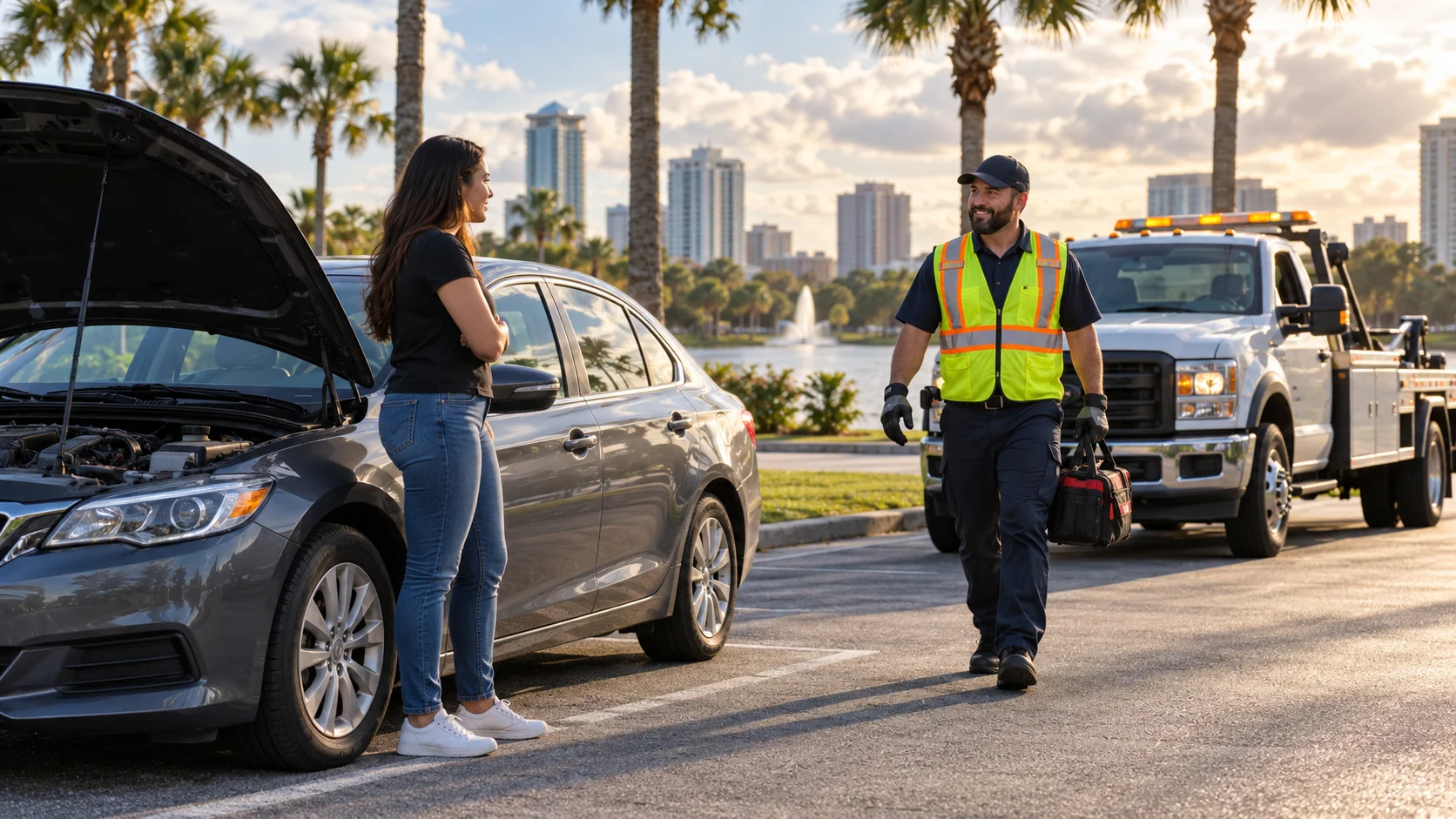
The cost for jump starting a car in Orlando depends on the actual service call. The operator needs your location, vehicle details, access conditions, and symptoms before confirming a quote. Quick Tow Orlando connects you with an independent local operator, but it doesn’t set that operator’s final charge.
Separate the service call from a battery replacement
A roadside jump-start and a battery replacement aren’t the same request. Make that distinction clear before an operator heads your way.
A jump-start request means you need help trying to start the vehicle. A replacement request adds a battery, installation, and compatibility questions. Don’t assume a quoted price includes both. Ask the operator to identify exactly what the quote covers.
Start with a simple description:
- The engine won’t start.
- The lights come on, but the engine doesn’t turn over.
- You hear clicking when you try the ignition.
- The dashboard stays dark.
- The vehicle started with a jump but stopped again.
- You already tried another power source without success.
Those details don’t establish the cause. They help the operator understand the requested scope. A no-start problem may involve more than the battery, so avoid diagnosing it from one symptom.
If you only want a jump attempt, say so. If you’re asking about testing or replacement, request separate confirmation. Battery testing, battery delivery, installation, and disposal shouldn’t be treated as included unless the operator says they are.
This distinction matters when comparing a price for roadside jump start service. One quote may cover only the service call and jump attempt. Another may describe a broader service. Compare the written or spoken scope, not just the first figure mentioned.
Our roadside assistance service can connect Orlando-area drivers with an independent operator. Confirm the complete current quote before dispatch. That’s the clearest way to avoid confusing roadside help with a separate repair or replacement purchase.
Explain how location and access change the job
“Orlando” isn’t enough location detail for an accurate service request. A vehicle beside a Winter Park home presents a different access situation than one inside a downtown garage.
Give the operator your precise location. Include the street address, garage name, business entrance, parking level, or nearest safe landmark. Share the vehicle’s space number when one is posted. If you’re near International Drive, Lake Nona, or another busy district, identify the correct entrance rather than naming only the area.
Access details matter too. Tell the operator if the vehicle is:
- Inside a parking garage
- Behind a gate or security checkpoint
- Parked nose-first against a wall
- Wedged between other vehicles
- In a hotel or apartment parking structure
- On a road shoulder
- In a surface lot with restricted entrances
- At Orlando International Airport or another controlled property
Mention garage clearance before dispatch. Also explain whether another vehicle can reach the front, side, or rear of your car. Don’t move into traffic or an unsafe position just to simplify access.
For a gated community, tell the operator what entry process applies. If parking management must approve access, handle that before the vehicle arrives when possible. A garage name without a level or entrance can leave the operator searching the wrong section.
Road conditions also change the conversation. A disabled car along I-4, SR 408, SR 417, SR 429, or the Turnpike isn’t the same as one in a private driveway. Tell the operator if you’re exposed to moving traffic, blocking a travel lane, or unable to remain safely with the vehicle.
These details help define the job before a quote is confirmed. They also help the operator decide whether a jump-start attempt is practical at that location.
Describe the symptoms before requesting help
“Dead battery” is often a driver’s best guess. Give the operator what you can see and hear instead. That creates a clearer request without turning your roadside call into a diagnosis.
Describe what happens when you press the start button or turn the key. Does the dashboard light up? Do the interior lights appear normal, dim, or completely dark? Does the vehicle click, crank slowly, crank normally, or remain silent?
Then explain what happened before the problem began. Useful details include whether the vehicle sat unused, whether lights were left on, or whether it recently needed another jump. Mention any warning message visible on the dashboard. Read the wording carefully, but don’t guess at symbols you can’t identify.
Tell the operator whether the car stays running after a successful jump. If it starts and then stops, that information can change the next recommendation. It may also prevent a second service request based on incomplete details.
Don’t assume a particular drive time will recharge the battery. A twenty-minute drive isn’t a reliable promise for every vehicle or every no-start condition. If the car starts, ask a qualified repair provider whether the battery and related starting system need inspection.
Share the year, make, model, and fuel type. Tell the operator if it’s a hybrid, electric vehicle, motorcycle, large truck, or modified vehicle. Don’t try an unfamiliar jump procedure while waiting. Follow the vehicle manufacturer’s instructions for your specific model.
Our guide to deciding between a jump-start and a tow covers that decision in more detail. For service outside normal weekday routines, the weekend jump-start guide explains what information to prepare.
Ask what the quoted scope includes
A useful quote should match the service you requested. Before dispatch, ask the operator to describe the complete current charge and its scope.
Start by confirming that the quote applies to your exact vehicle and location. Repeat the garage level, gated entrance, shoulder location, or access restriction. If any detail changes, ask whether the confirmed scope changes too.
Then ask direct questions:
- Does the quote cover the service call and jump attempt?
- Is battery testing included or separate?
- Does the scope include more than one start attempt?
- What happens if the vehicle starts but won’t stay running?
- Is a battery replacement part of this quote?
- Would a tow require a separate quote?
- Are parking, garage, or property access issues included?
- When is payment due, and what payment methods are accepted?
Don’t rely on a bargain headline or an incomplete starting figure. The number that matters is the complete current quote for your location, vehicle, and requested work. Get that confirmation before the operator travels to you.
If roadside coverage may apply, check the terms with the company that issued it. Ask whether you need authorization before requesting service. Don’t assume a membership, insurance policy, credit card benefit, or vehicle warranty covers the call. Coverage depends on the terms attached to your own account or policy.
Quick Tow Orlando doesn’t publish a rate card or set the independent operator’s final charge. We take calls around the clock and pass the service details to a local operator. The operator confirms the scope and price.
Keep your phone available after making the request. If you move the vehicle, enter a garage, or change entrances, pass along the updated location. Accurate details make the confirmed quote more useful and reduce confusion when the operator arrives.
Know when the vehicle may need a tow
A jump-start attempt isn’t always the end of the problem. The car may still fail to start, stop after starting, or show another condition that needs repair.
Tell the operator immediately if you notice smoke, a strong unusual odor, visible battery damage, leaking fluid, damaged cables, or signs of a collision. Don’t touch damaged components. Move away from the vehicle if remaining nearby feels unsafe.
A tow may also be the better request when the vehicle can’t be driven safely after it starts. Describe any warning lights, steering problems, brake concerns, overheating signs, damaged tires, or collision damage. The operator can use those details to discuss the appropriate next service.
Your destination matters. Have a repair shop, home address, dealership, or other permitted drop-off point ready. Confirm that the destination can receive the vehicle, especially after regular business hours. If you don’t have a destination yet, say that before dispatch.
Ask for a separate towing quote if the original request covered only a jump attempt. Don’t assume the roadside price carries over to towing. Distance, vehicle condition, loading access, and destination can change the scope.
For a vehicle that needs transport, our emergency towing service can connect you with a local operator. Explain whether the car rolls, steers, shifts into neutral, or has damaged wheels. Don’t force the transmission or attempt to move a vehicle that appears unsafe.
The safest decision isn’t based only on whether the engine starts once. It’s based on whether the vehicle remains running and can be driven without creating another roadside problem.
When to call us
Call when you need dead battery help in Orlando, can’t safely attempt a jump, or may need towing instead. Quick Tow Orlando will take your details and connect you with an independent local operator, who will confirm the complete current quote before dispatch. Call us at (321) 321-9797.