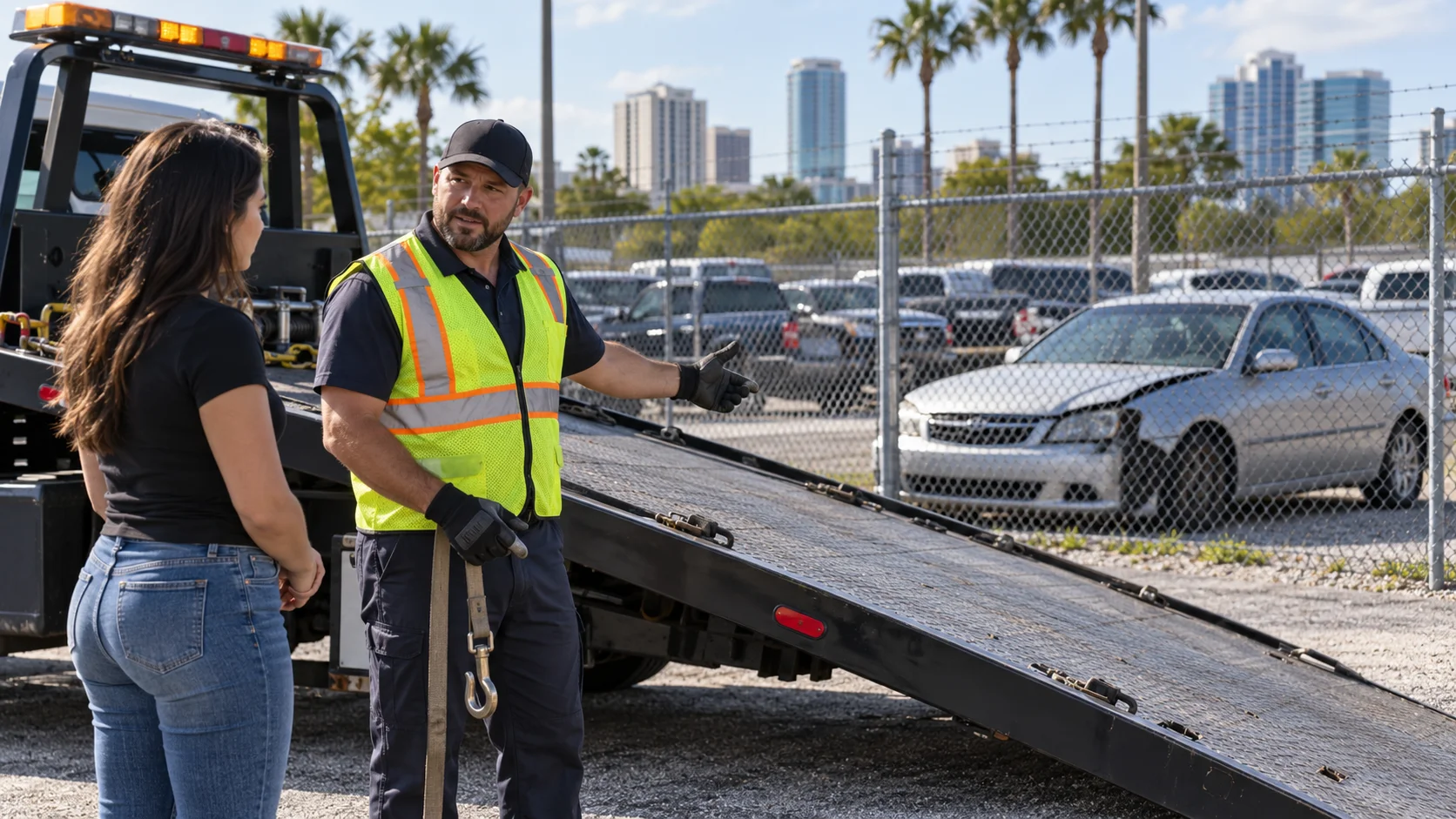
Another tow truck can usually collect your car after the storage yard clears it for release. If you searched for “towing impound lots near me,” confirm the release first, then arrange the second tow.
Release eligibility and permission to drive are separate issues. A yard may release the vehicle even when damage, missing keys, or a mechanical problem keeps you from driving it away.
Confirm that the vehicle is eligible for release
Start with the storage yard holding the car. Ask whether it’s eligible for release today and whether any hold remains. Don’t send another operator until the yard confirms the vehicle can leave.
A law enforcement hold can prevent release even after other requirements are settled. Florida law requires storage facilities to follow holds placed by law enforcement officers. The facility can release a held vehicle only as directed by the agency that placed the hold. That means paying the yard doesn’t necessarily clear an investigative hold.
If the car was removed from private property, different rules may apply. Florida’s private-property towing statute covers nonconsensual towing from places such as apartment lots and commercial properties. Our guide to private property towing explains that type of removal in more detail.
Confirm that the yard has matched the car to the correct owner. Have the vehicle identification number, plate information, and tow location ready. Ask whether the account has a balance and how payment must be completed. Current payment methods and release steps vary, so get them directly from that facility.
Still looking for the vehicle? Follow the separate steps in our guide to finding your towed car in Orlando. That guide covers locating the car. This page begins once you know which yard has it.
Write down the employee’s instructions and the time you called. Also ask whether a second towing operator may enter the property. A confirmed release doesn’t always mean the arriving truck can enter without prior notice.
Ask what the storage yard requires at pickup
Each storage yard controls access to its property. Call before arranging transport and ask exactly what the owner and towing operator must bring. Don’t assume the procedure used by another Orlando yard will apply.
Ask whether you must appear in person. If someone else will act for you, ask what authorization the yard accepts. The required paperwork couldn’t be confirmed as one universal rule for every Orlando facility. The yard should explain its current process before you travel there.
You should also confirm:
- Which documents the yard wants to inspect
- Whether the registered owner must be present
- Whether keys are required for release
- How an authorized tow truck enters the property
- Where the operator should wait or check in
- Whether pickup must occur during set access hours
- Whether the yard needs advance notice
- Whether any vehicle condition could delay loading
Ask for the current total owed directly from the yard. Don’t rely on an older receipt, a third-party website, or a remembered rate. Orange County publishes towing information and current county rules, but the specific location and tow circumstances still matter.
For qualifying Class A trespass tows from private property in Orange County, the verified county rules say the vehicle must be released within 30 minutes of payment. Florida law also requires release within one hour of the owner’s request for covered private-property tows. Those rules don’t erase a lawful agency hold or establish every yard’s pickup procedure.
Insurance concerns may also affect your next step. Read our guide to getting a car out of impound without insurance if that’s part of the problem. Then confirm the current release requirements with the yard itself.
Describe why the car can’t be driven away
Tell the towing operator why you need onward transport. “It won’t drive” isn’t enough information to choose suitable equipment or prepare for loading.
Explain what happened before the impound. Was the car in a collision near I-4 or SR 408? Did it stop running in Lake Nona? Was it removed from an apartment lot near International Drive? The pickup location is now the storage yard, but the earlier event may explain hidden damage.
Share any known issue with the wheels, steering, suspension, transmission, battery, or ignition. Mention whether the car starts and whether it can shift into neutral. If the keys are missing, say so during the first call. Also disclose flat tires, locked steering, a broken axle, low ground clearance, or loose body panels.
Don’t try to diagnose damage you can’t see. Use plain observations instead. For example, say that the front wheel points inward or fluid appears beneath the engine. Photos can help the operator understand the condition, but ask the yard whether photography is allowed on its property.
A flatbed towing operator may be appropriate when the car can’t roll normally or shouldn’t travel with wheels on the road. Equipment selection still depends on the actual vehicle and its condition. Give the year, make, model, and drivetrain if you know them.
Don’t drive the car merely because the yard allows its release. Release means the vehicle may leave custody. It doesn’t confirm that the brakes, tires, steering, lights, or drivetrain are ready for Orlando traffic.
If the condition is uncertain, arrange transport to a repair facility. That avoids turning an administrative release into a roadside breakdown on I-4, SR 417, or the Turnpike.
Share access and vehicle condition with dispatch
Quick Tow Orlando connects callers with independent towing and roadside operators. The request line takes calls 24/7, but the storage yard may have its own access schedule. Confirm the yard’s schedule before requesting the pickup.
Provide the facility’s exact name and street address. Similar business names can cause confusion across Orlando, Winter Park, Sanford, and Kissimmee. If the vehicle sits at a separate storage entrance, give that location instead of the office address.
Share the contact name or instructions the yard provided. Tell us whether the owner will meet the operator, whether release paperwork is already complete, and whether payment remains due. If the yard gave you a reference number, keep it available. Don’t include sensitive personal information unless the yard or operator needs it for the pickup.
Then describe the vehicle clearly:
- Year, make, model, and color
- Plate information
- Exact location inside the facility, if known
- Whether the keys are available
- Whether the car starts, rolls, steers, and brakes
- Known collision or undercarriage damage
- Flat, missing, locked, or damaged wheels
- Low-clearance parts or modifications
- Loose items that could move during loading
Ask the yard whether the arriving operator may inspect the car before loading. Florida law allows vehicle owners to inspect a vehicle before accepting it after a covered private-property tow. Vehicle owners also have rights concerning personal property, subject to the applicable documentation and business-hour requirements.
Remove permitted personal belongings before transport when practical. Don’t enter a restricted area or open the vehicle without the yard’s approval. If you notice new damage, document what you can and raise it with the facility before the car leaves.
Accurate details reduce avoidable complications at the gate. They also help the matched operator decide what equipment the vehicle’s condition requires.
Choose a destination that can receive the car
Decide where the vehicle will go before the operator reaches the impound lot. A home driveway may work for temporary storage, but only if the property allows the vehicle and the unloading area is accessible.
For a repair shop, call the shop first. Confirm that it will accept the vehicle and ask where deliveries should enter. A shop near Colonial Drive may use a different entrance after its front office closes. Don’t assume an open parking lot means the car can be left there.
Give the operator a complete destination address. Include the business name, entrance details, gate instructions, and contact information you’ve confirmed. Mention parking garages, narrow driveways, steep approaches, locked gates, soft ground, or limited turning space.
Think beyond the trip itself. A non-running car unloaded nose-first into a tight driveway may be difficult to move later. If repairs are planned, ask the receiving shop where it wants the vehicle placed. If the car is going home, choose a lawful location where it won’t block a sidewalk, driveway, fire access point, or another vehicle.
Don’t direct an operator to leave the car on private property without permission. This is especially important at apartment communities, hotels, repair shops, and gated neighborhoods. An unauthorized drop could create another towing problem.
The final destination can also affect equipment selection. A car with locked wheels may be manageable at an open shop lot but harder to place inside a cramped garage. Share those limits before the operator accepts the trip.
Confirm that someone can receive the car when required. The impound yard’s release and the destination’s acceptance are separate. Both should be settled before transport begins.
When to call us
Call when your released vehicle can’t be driven safely, has missing keys, or needs transport from an Orlando storage yard to a home or repair shop. Quick Tow Orlando can take the details and connect you with a local operator.
Call us at (321) 321-9797.