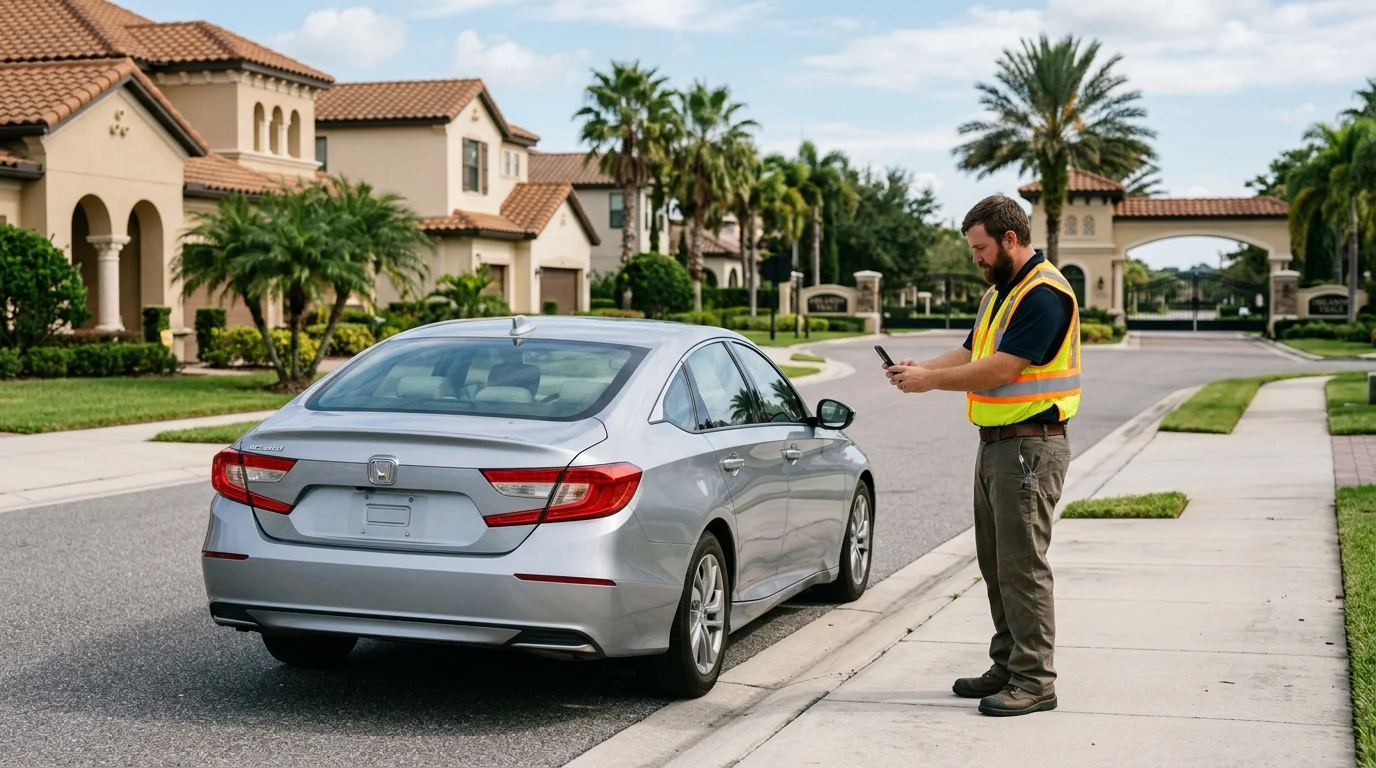
Florida law allows nonconsensual towing from private property when governing requirements are met. Whether an HOA can arrange that tow depends first on where the car sat and who controlled that area. The community rules, posted notices, and authorization still need separate checks.
Start with where the vehicle was parked
Begin with the exact parking spot, not the HOA’s general boundaries. A community can contain association-controlled areas, individually owned parcels, and public streets. Those locations shouldn’t be treated as interchangeable.
For a car in a clubhouse lot, guest space, or common parking area, ask who owns or controls that parcel. Request a written answer from the HOA or property manager. If they rely on a community map or recorded document, ask for the relevant page.
A car in an owner’s driveway presents a different question. Check the parcel boundary and governing documents before assuming the association controls that space. Florida’s private-property towing notice rules also contain exceptions involving single-family residences or personal notice. An HOA common area near a house isn’t automatically the same as the homeowner’s private driveway.
When another vehicle is preventing access, our guide to a car blocking your driveway in Orlando explains the checks to make before arranging removal. Don’t move or damage the other vehicle yourself.
Public streets require another path. Ask the government agency responsible for that street who may request a tow. An HOA rule may address resident conduct, but that doesn’t establish who controls the roadway.
Apartment parking is separate too. Apartment managers, leases, guest permits, and assigned spaces involve different documents. Don’t apply an apartment parking answer to a deeded home or HOA common area.
Location matters throughout Orlando Metro. A gated entrance in Lake Nona or Kissimmee doesn’t settle who controls every road behind it. Inside Orlando and in unincorporated Orange County, verify the property address and current local guidance before acting.
Check the recorded rules and posted notices
Read the HOA documents that address vehicles and parking. These may include declarations, covenants, bylaws, parking rules, or later amendments. Look for the exact restriction involved, such as overnight parking, guest permits, commercial vehicles, or parking outside marked spaces.
Then check whether the current rule applies to that vehicle and location. Record the document name and page. Ask management when the rule took effect and how owners received notice. If the association can’t identify the governing provision, don’t fill that gap with assumptions.
Community rules and tow-away signs are separate checks. A recorded restriction may describe prohibited parking. It doesn’t, by itself, confirm that every Florida requirement for a nonconsensual tow was followed.
Under Florida Statute 715.07, property owners generally must post notices before vehicles are towed without consent. The confirmed sign requirements include:
- “Tow-away zone” text in letters at least 4 inches high
- Light-reflective lettering on a contrasting background
- The towing company’s name and current telephone number
- Permanent installation between 3 and 6 feet above ground
- Maintenance of the signs for at least 24 hours before towing
The confirmed placement rule calls for one sign per 25 feet of lot frontage, or a sign at each driveway access point within 10 feet of the road. Florida’s rule has exceptions for single-family residences and situations involving personal notice. Confirm whether an exception actually fits before relying on it.
Photograph each entrance, the complete sign, and its position relative to the road. Capture missing, damaged, blocked, or unreadable notices. Our guide to Florida private-property towing sign requirements provides a focused review of these details.
Confirm who can authorize the tow
The association’s name alone doesn’t answer the authority question. Ask which person or entity owns or controls the parking area. Then ask who approved the specific tow and what document gave that person authority.
An HOA board member, community manager, security contractor, resident, and property owner aren’t automatically interchangeable. Don’t assume any person can authorize removal because they enforce another community rule. Request a written explanation from management if the authority isn’t clear.
Useful questions include:
- What exact parcel or parking area does the HOA control?
- Which governing document covers that location?
- What parking rule was allegedly violated?
- Who authorized this specific vehicle’s removal?
- Was the decision based on posted notice or personal notice?
- Which towing operator received the request?
Florida’s private-property towing statute addresses action by property owners. It doesn’t provide a universal answer for every HOA arrangement. Whether a particular association can act for a particular space may depend on ownership, recorded documents, and its management authority. If those points can’t be confirmed, say so and seek current legal guidance.
For association-controlled property, our private property towing service connects callers with independent local operators. Quick Tow Orlando’s role is making that connection. It doesn’t decide whether an HOA has authority over a parcel.
A responsible operator may also need clear information about the property and authorization. Have the parking address, vehicle description, posted restriction, and authorizing party ready. Don’t describe the car as abandoned, trespassing, or illegally parked unless the applicable facts and rules support that description.
If the vehicle is on a public street, contact the agency responsible for that roadway. If it’s within an owner’s parcel, confirm who controls the property before requesting removal.
Document the vehicle and parking area
Good records help both before and after an HOA tow. Take wide photos showing the vehicle, parking space, nearby entrances, curbs, pavement markings, and surrounding signs. Then take closer photos of the plate, permit area, and any notice placed on the vehicle.
Record the date and time shown by your device. Save HOA emails, warning letters, parking permits, tow receipts, and relevant governing pages. If management gives an explanation by phone, write down who spoke and what they said. Ask for the same information in writing.
Don’t move a sign, touch another person’s vehicle, or alter the parking area. Document the condition as you found it. If the car is creating an immediate hazard, keep a safe distance and contact the agency responsible for that location.
When a car has already been towed, photograph it before leaving the storage facility. Florida’s verified private-property towing rules allow the owner to inspect the vehicle before accepting it. A towing company also can’t require a “no release or waiver” clause as a condition of redemption.
The vehicle must be released within one hour of the owner’s request. During business hours, owners must also be permitted to inspect and retrieve personal property within one hour after presenting appropriate documentation.
Storage fees can’t be assessed when the vehicle has been held for fewer than 6 hours. Keep records showing when the tow occurred, when storage began, and when release was requested.
For a tow originating in Orange County, the confirmed large-county storage rule generally requires storage within a 10-mile radius. If no facility is available within that radius, the maximum becomes 20 miles. Ask for the facility address and compare it with the tow origin.
Our guide to your rights after an Orlando tow covers the next steps without assuming every dispute has the same outcome.
Verify the current process before taking action
Rules, contacts, and rate schedules can change. Check the current Florida statute, the posted tow notice, HOA management, and the local government responsible for the property address. Keep a copy of whatever guidance you relied upon.
If the tow hasn’t happened, ask management to confirm four things in writing: control of the parking area, the applicable community rule, the authorization process, and the notice supporting removal. If any answer remains unclear, pause before arranging the tow.
If the vehicle is already gone, contact the operator listed on the posted sign. Ask where the car is stored, what documents are needed, and how the charges are itemized. Verify the operator’s identity before sharing personal information.
We couldn’t confirm a current maximum-rate schedule for the City of Orlando or Orange County from the verified material used for this guide. Don’t rely on an old forum post or an unverified amount. Contact the local government responsible for the tow location and ask where to find its current rate schedule before paying or challenging a charge.
Florida law assigns maximum-rate authority to local governments where they’ve set rates. Where they haven’t, the Florida Department of Highway Safety and Motor Vehicles must establish and publish maximum towing and storage rates. Confirm which schedule governs the tow’s location.
Orange County Consumer Protection accepts and investigates towing complaints. The office may request a business response, refer a complaint, or conduct a compliance visit. It doesn’t provide legal advice, represent consumers, or force a particular resolution. The office recommends first trying to resolve the issue with the business manager or owner.
Florida’s wrecker lien law also provides a court-bond process. An owner or lienholder may post a bond equal to the accrued charges, obtain a clerk’s certificate, and present it to the towing-storage operator. The operator must release the vehicle after receiving that certificate. Confirm the current filing process with the appropriate court clerk or an attorney.
Keep HOA common areas, owner driveways, public streets, and apartment parking separate throughout the process. The correct answer depends on the location and documented authority, not the neighborhood label.
When to call us
An association or property manager should contact a tow operator after confirming property control, authorization, and current notice requirements. Quick Tow Orlando can connect callers across Orlando Metro with an independent local operator for private-property towing. Call us at (321) 321-9797.