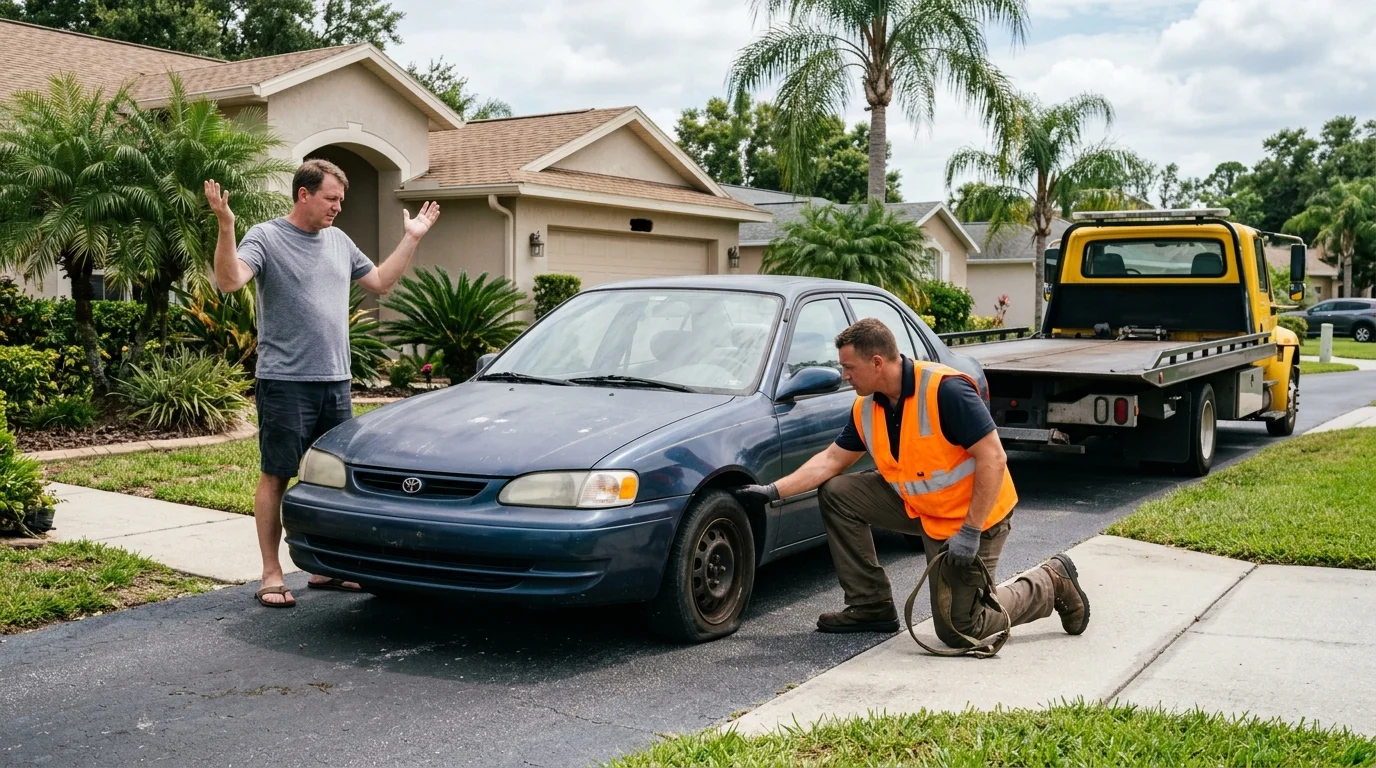
Missing car keys don’t automatically stop a tow. A tow truck can often move the vehicle, but the method depends on its steering, parking position, drivetrain, damage, and surrounding space. The operator needs those details before choosing a loading plan.
Start with whether the car can roll and steer
Rolling and steering are separate questions. A car might roll while its front wheels remain turned. Another vehicle might steer but stay locked in Park. Missing keys can also affect the steering lock or electronic parking brake.
Tell the operator what happens when you use the controls normally. Don’t force the shifter, steering wheel, or parking brake. You also shouldn’t crawl beneath the car or attempt to release anything manually.
Describe these details during the call:
- Is the transmission in Park, Neutral, or an unknown position?
- Is the parking brake on?
- Are the front wheels straight or turned?
- Does the steering wheel move?
- Does any tire appear flat, blocked, or unable to rotate?
- Are the doors locked, or are only the keys missing?
Locked doors and locked steering aren’t the same problem. Make that distinction clear. If you can’t check something without forcing the vehicle, say that it couldn’t be confirmed.
A car that won’t roll may still be movable by a towing operator. It simply requires a different assessment than a car sitting freely in Neutral. The same applies when you need to move a non-running car without a key.
Don’t push the car into an Orlando street to make loading easier. That can place you and the vehicle near moving traffic. Leave it where it stopped unless an operator gives you a safe, vehicle-specific instruction.
Explain where the vehicle is parked
The exact parking spot can shape the entire tow. “At my house” doesn’t tell an operator whether the car is inside a garage, behind a gate, or facing a wall.
An open Lake Nona driveway offers different access than a narrow Winter Park parking area. A nose-in vehicle beneath an apartment garage has different constraints than one parked beside an open curb. International Drive garages may also have turns, entrances, or overhead space that affect the truck choice.
Give a clear description of the area around the vehicle. Mention nearby walls, curbs, columns, fences, parked cars, landscaping, and closed gates. Say which direction the vehicle faces and whether another car blocks the approach. If the driveway slopes, include that detail.
For roadside locations, name the road and your direction of travel. A disabled car beside I-4 or SR 408 needs different planning than one inside a private lot. Stay away from moving traffic while gathering information. Don’t stand between the disabled vehicle and an approaching truck.
A car deep inside a garage may not offer the same loading path as one outside. That doesn’t automatically rule out a tow. It means the operator needs an accurate picture before selecting equipment.
If you’re unsure how to describe the spot, focus on the route from the street to the car. Include every narrow turn, low opening, locked entrance, or surface change along that route. Those details are more useful than a general neighborhood name.
Share the drivetrain and current damage
The drivetrain matters because it identifies which wheels power the car. Tell the operator whether the vehicle is front-wheel drive, rear-wheel drive, all-wheel drive, or four-wheel drive. Don’t guess from the car’s appearance.
Check the owner’s manual, manufacturer information, or vehicle records when available. If you still can’t confirm the drivetrain, share the year, make, model, and trim. The operator can then decide what information is still needed.
Also identify electric and hybrid vehicles during the first call. Their towing instructions may differ by model. Missing keys may prevent access to a vehicle setting that would otherwise assist with loading. Don’t attempt to bypass that restriction.
Damage can matter as much as drivetrain. Mention a collision, broken suspension, missing wheel, flat tire, fluid leak, or wheel that sits at an unusual angle. Report visible damage without touching loose parts. If the vehicle stopped after an Orlando summer storm or exposure to standing water, share that history too.
Low-clearance and collectible vehicles need their own assessment. Our guide to classic car towing in Orlando explains why vehicle condition and clearance should be discussed before loading.
A vehicle that ran yesterday may still have a wheel or brake that won’t release today. Likewise, a non-running engine doesn’t mean every wheel is locked. Give the operator observations, not a diagnosis. That helps avoid choosing a plan based on an incorrect assumption.
Confirm ownership and pickup authorization
A no-key tow also raises a basic authorization question. The operator needs to understand who requested the move and why the keys aren’t available.
Be ready to provide your name, the vehicle’s location, its destination, and your relationship to it. An operator may request identification or vehicle paperwork. If registration documents are locked inside, explain that during the call. Don’t claim you can provide something you can’t access.
Common situations include lost keys, a broken key, an estate vehicle, a recent purchase, or a car being moved for repairs. Each situation may involve different records. If somebody else owns the vehicle, confirm that you have permission before arranging the tow.
An owner-requested move isn’t the same as removing an unauthorized vehicle from private property. Florida’s private-property towing law governs towing wrongfully parked vehicles and includes notice requirements. A landlord, apartment manager, business, or homeowner requesting removal should describe the situation accurately.
The destination matters too. Tell the operator whether the car is going to a repair shop, residence, dealership, storage location, or another property. Confirm that the destination expects the vehicle and can accept it without the keys.
Don’t try to solve an authorization problem by opening the car or bypassing its controls. Explain the circumstances plainly. The operator can then identify what verification is needed before the move proceeds.
Let the operator choose the loading plan
Missing keys don’t point to one required truck. The operator weighs the vehicle’s condition, drivetrain, wheel position, parking angle, and available access together.
A flatbed towing service carries the vehicle with its tires off the road during transport. That can be relevant when the drivetrain, steering position, or existing damage limits other options. Still, a flatbed tow without keys isn’t automatically right for every location. The truck must also reach and load the vehicle from its current position.
A wheel-lift towing service raises one axle for transport. Whether that approach fits depends on the drivetrain, which axle can be lifted, the steering position, and the vehicle’s condition. Our wheel-lift versus flatbed guide explains the basic differences between those truck types.
Avoid requesting a specific loading procedure based only on an online video. Two vehicles with the same missing-key problem may require different plans. One may be sitting straight in an open driveway. The other may have turned wheels, collision damage, and a wall directly ahead.
Give the operator a complete summary: keys unavailable, doors locked or unlocked, transmission position, parking-brake status, wheel direction, drivetrain, visible damage, exact location, destination, and authorization. If one detail remains unknown, identify it as unknown.
The operator may ask for more information or choose a different approach after seeing the car. That’s normal when the initial description can’t show every clearance or damage issue. It also means nobody should promise that every locked or keyless vehicle can be moved in every setting.
When to call us
Call when missing keys prevent you from starting, steering, or safely repositioning the vehicle. Quick Tow Orlando takes calls at any hour, dispatches Monday to Friday from 8 a.m. to 10 p.m., and connects Orlando Metro drivers with independent local towing and roadside operators. Call us at (321) 321-9797.