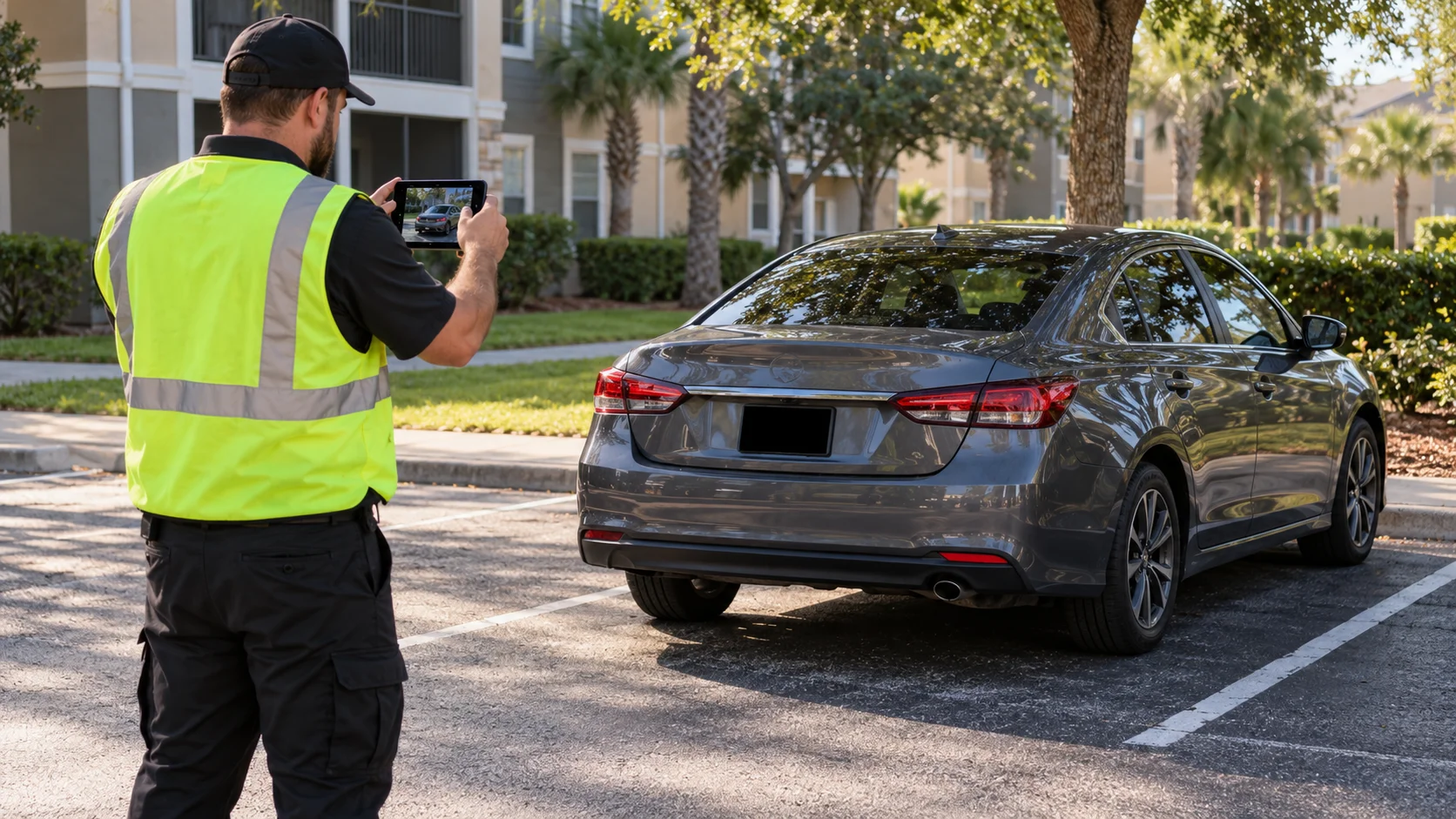
A tow operator can document the license plate displayed on a vehicle. That doesn’t automatically mean every operator can open private owner records or “run” the plate like law enforcement.
No verified Florida source reviewed for this guide confirms universal database access for towing companies. The safer answer is that access depends on the operator, the reason for the tow, who authorized it, and the lawful process involved.
Separate plate access from private database access
A license plate is visible on the vehicle. An operator can write down or photograph characters that anyone standing nearby could see. That basic observation is different from retrieving information held in a restricted record system.
People often use “run a plate” to describe several separate actions:
- Recording a visible plate before moving a vehicle
- Comparing it with parking or permit information
- Giving the plate number to a property representative
- Including the number in towing paperwork
- Seeking information needed for a required legal notice
- Asking law enforcement about a vehicle or removal
Those actions don’t all involve the same records or authority. A photograph of your plate doesn’t prove that someone accessed private registration information. A tow notice bearing the correct plate number doesn’t prove it either.
The approved Florida sources for this site don’t identify a database that every towing company may search. They also don’t establish identical access rights for every operator. That specific rule couldn’t be confirmed, so don’t rely on a broad yes-or-no claim.
If you’re concerned about a tow company plate lookup in Florida, ask a narrow question: “Did you only record the visible plate, or did you obtain registered-owner information?” Then ask which organization supplied that information and under what process.
For general state information about registration records, start with the official FLHSMV vehicles, tags, and titles page. Confirm the current access rules directly with FLHSMV before drawing conclusions about a specific lookup.
Explain why the reason for the tow matters
The plate alone doesn’t establish why a vehicle was removed. Start with the event that caused the tow.
Florida’s verified towing rules recognize several different situations. These include recovery requested by the vehicle owner, removal of a wrongfully parked vehicle from private property, removal directed by a landlord after a tenancy ends, and towing directed by law enforcement. Each begins with different authority.
For an apartment, shopping center, office lot, or other private property, review the circumstances under Florida’s private-property towing law. The statute includes notice requirements for many nonconsensual private-property removals. Single-family residences and situations involving personal notice have different treatment.
A law-enforcement-directed tow is another category. The storage operator must follow holds placed by law enforcement and release held vehicles as directed by the placing agency. If your vehicle was connected to an investigation, the tow yard may not control every release decision.
Florida’s wrecker lien law also requires notices before a vehicle can be sold under a lien. Certified-mail notice must go to the registered owner, the insurance company if known, and lienholders. That requirement explains why identifying the proper parties may become necessary. It doesn’t confirm which database an operator used or whether the operator personally ran the plate.
Our guide to your rights after an Orlando tow covers the broader retrieval process. Keep the plate-access question separate from whether the removal itself was authorized.
Check who authorized the vehicle removal
Ask who requested the tow before arguing about record access. The answer may point to a property owner, property representative, landlord, vehicle owner, or law-enforcement agency.
For a private lot, request the property name and the reason given for removal. Look for the tow-away signs at each entrance. Florida requires qualifying signs to include “Tow-away zone” text, the towing company’s name, and its current telephone number. The signs must also meet placement, height, visibility, and maintenance requirements.
Photograph the entrance you used. Capture the full sign, its location, nearby curb markings, your parking space, and the surrounding lot. Don’t move or alter anything for the pictures. If a permit or guest-parking rule was involved, preserve the permit, parking confirmation, lease page, or message you relied on.
Our guide to Florida private-property towing signs explains the verified sign standards. Property representatives who need an authorized removal can also review our private-property towing connection service.
If law enforcement authorized the removal, ask which agency placed the request or hold. Don’t assume the storage yard can override that agency. If the property authorized it, ask the property manager to confirm the rule and the vehicle information supplied.
This sequence matters. It may reveal that the plate was simply recorded at the scene. It may also show that information came from the authorizing party. Neither possibility should be treated as proven until the operator or property representative explains what happened.
Verify notices through current official sources
A document that lists your plate accurately isn’t proof of improper access. Compare the notice with current official requirements and the facts of your tow.
For an Orange County private-property tow, the county’s official towing information page is a useful starting point. It includes county towing information and directions for locating a removed vehicle. Rules may differ when a tow occurred inside another local jurisdiction, so confirm which government area covers the property.
Check these details on every document you received:
- The plate and vehicle description
- The address or property where the vehicle was taken
- The stated reason for removal
- The party identified as authorizing the tow
- The towing and storage operator’s contact information
- The date and sequence of the events
Don’t post an unredacted notice online. Plate numbers, vehicle identification numbers, addresses, and account details can expose information unrelated to the dispute.
If the operator says registered-owner information came from a government record, ask for the name of the agency or record source. Then contact that agency through an official page and ask about its current access and disclosure process. The sources approved for this guide don’t confirm whether a specific operator had direct access, indirect access, or no private database access.
When a vehicle is missing, first rule out theft, repossession, and an authorized tow. Our guide to finding a towed car in Orlando gives you a practical search order without assuming who removed it.
Know what to document after a questionable tow
Build a clean timeline while the details are fresh. Start with when you parked, what entrance you used, where the vehicle sat, and when you discovered it missing. Save original photos and messages instead of relying on screenshots alone.
Request an itemized receipt and copies of the paperwork connected with the removal. Record the names or roles of the people you spoke with. Note what each person said about authorization, the plate, and any owner information. Keep facts separate from your suspicions.
Before accepting the vehicle, Florida law allows an owner to inspect it. A towing company also can’t require a “no release or waiver” clause as a condition of redemption after a qualifying private-property tow. If the vehicle was held for fewer than six hours, Florida’s verified lien rules say storage fees can’t be assessed.
When personal property remains inside, an owner or lienholder must be allowed to inspect and retrieve it within one hour after presenting appropriate documentation during business hours. Follow the storage facility’s access instructions and document any refusal.
If the dispute involves an Orange County towing service, the Orange County Consumer Protection Office accepts and investigates towing complaints. It can review complaints, request business responses, make referrals, and conduct compliance visits. It doesn’t provide legal advice, represent consumers, or force a particular resolution.
Keep your complaint focused. State who authorized the tow, what the signs showed, which documents you received, and what the operator said about the plate. Avoid claiming illegal database access unless you have evidence identifying the record source and access method.
When to call us
Call when you need an authorized private-property removal or help connecting with a local towing operator in the Orlando Metro. Quick Tow Orlando takes calls 24/7 and connects customers and authorized property representatives with independent operators. Call us at (321) 321-9797.