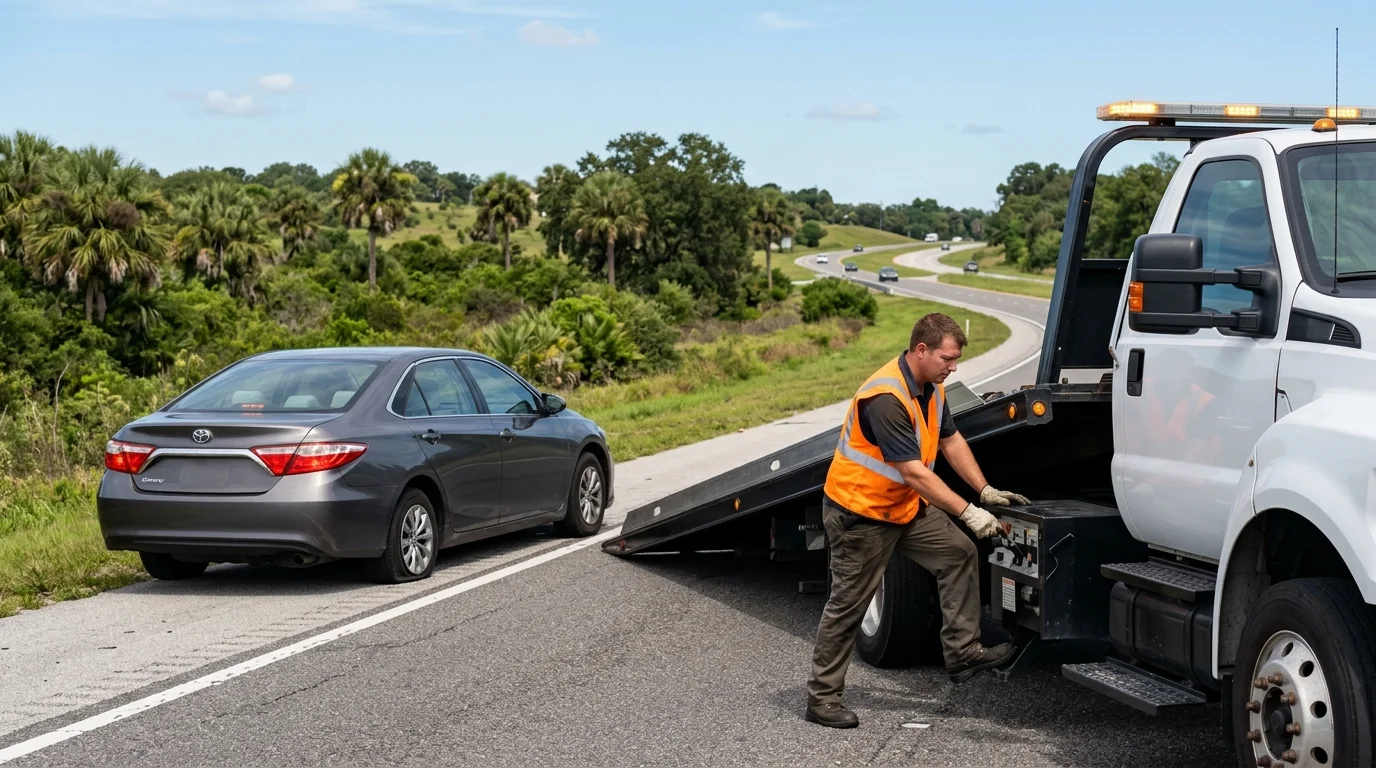
US 27 through Clermont is a fast arterial with real grades, plazas, and lake-side curves. When the car quits on that highway, on SR 50, or on a rolling side street, the first job is getting out of the travel lane. After you’re clear, you can decide whether roadside assistance can finish it or you need emergency towing to a shop that can take the car.
Quick Tow Orlando connects drivers around Clermont with independent operators. The request line is open 24/7.
Get clear of traffic before checking the car
Get the car out of live traffic before you pop the hood. On US 27 that means a paved shoulder if it is wide enough, a turnout, a plaza entrance, or a side street you can reach without crossing lanes on foot. Stopping in a gore, a merge, or the left lane to “just look” puts you in the path of through traffic that is not expecting a stalled car on a hill.
If the car still rolls, use the remaining momentum to reach pavement that sits fully outside the travel lane. Put the hazards on as soon as you can. At night, keep the cabin light off so you can see headlights coming up the grade. If you cannot step out onto solid ground away from traffic, stay in the vehicle with the seat belt on.
Florida’s move-over law tells other drivers to leave the lane closest to a disabled vehicle showing hazard lights when the road has more than one lane in that direction. On a two-lane stretch they are supposed to drop 20 mph under the posted limit, or to 5 mph if the posted limit is 20 or less. That law also covers a tow truck showing amber lights. It helps. It does not turn a Clermont shoulder into a workshop.
If people are already stacked behind you in a travel lane, call 911 and report a disabled vehicle in the roadway. A car sitting in live traffic on US 27 or SR 50 is an emergency for the people still moving, even when no one is hurt. Once you are on solid pavement, set the parking brake. On a Clermont grade, block a downhill wheel if you have a wedge, a spare, or even a solid object that will not roll. Keep everyone on the side away from traffic. Kids stay in the car if the shoulder is narrow.
Do not walk uphill in the travel lane to read a sign. Do not stand behind the car on a downgrade. After you are clear, you can check FL511 incident alerts to see if a crash or lane block is already posted near you.
If you made it onto Florida’s Turnpike east of town, FHP Road Rangers patrol some limited-access highways. US 27 through Clermont is a different kind of road. Make the call yourself once you are out of the lane. The same safety order shows up on I-4: get clear, then work. The I-4 breakdown guide covers that limited-access version. Here, the grades and the arterial traffic are the local part.
Explain whether the problem started on a grade
Clermont sits on some of Central Florida’s real hills. US 27 climbs and drops between Groveland, downtown, Minneola, and the lakes. SR 50 does the same as it comes in from Winter Garden. If the trouble started on a grade, say so when you call.
You are not asking anyone to diagnose the engine. You are telling the operator how the car is sitting and how it got there. A car that faded on an uphill may be hot or unable to restart. A car that died on a downhill may roll. That changes where the wrecker stages, how the operator chocks, and whether the job needs a winch-out instead of a simple hook.
Share the slope in plain words. “Northbound US 27, pointed downhill toward the lake” is useful. “It started missing on the climb near Citrus Tower” is useful. Skip the guess about the part that failed. The operator we connect you with will see the car.
If the car is still in gear and you can hold it with the brake, keep it there until the parking brake is set and a wheel is blocked. Do not release the brake to “see if it holds.” On a Clermont grade, it may not. Keep the wheels turned so a roll aims away from the travel lane if the surface allows it.
Tell the operator if the pavement is narrow, if a guardrail is on one side, and if a driveway or plaza is in sight. An operator who knows you are on a hill can pick a truck that can hold the load and a spot that does not put the driver in US 27 traffic. If you already coasted onto a level lot, say that too. Level ground is a different job. The rolling part of Clermont is why this stop is different from a flat parking-lot no-start in Orlando.
If the car got hot on a climb, let it sit. You can still call. The operator does not need a running engine to load it. Trying to nurse it to the next light is how a hill fade becomes a car in the left lane.
Share your direction and nearest location marker
Operators cannot see “near Clermont” on a map. Give a direction and a marker they can drive to.
Start with the road and the compass. Northbound or southbound US 27. Eastbound or westbound SR 50. If you are on a cross street, name it. Then add the nearest thing you can read without walking into traffic: a mile marker, an overpass, Citrus Tower Boulevard, Hooks Street, Hartwood Marsh Road, Lakeshore Drive, the SR 50 junction, a plaza name from the seat, or the lake on one side. Downtown versus the south side toward Four Corners also helps.
A dropped pin from your phone is the backup, not the whole story. Pins drift, and a pin on the wrong side of a divided highway sends the truck to a median it cannot cross. Pair the pin with “southbound US 27, just north of SR 50, hazards on, right shoulder.” Say which side of the median you are on. US 27 is divided through much of this stretch.
If you left the highway and sat in a lot, name the business and the entrance you used. “East-side lot, second driveway” is enough once the road name is clear. Passengers can watch for the next marker while you stay with the car. Do not send someone walking along US 27 at night to find a sign.
The same habit helps east of here on SR 50. The Winter Garden breakdown walkthrough uses the same pattern: road, direction, marker, then the call. Clermont’s version just adds the hill and the US 27 / SR 50 split.
Decide whether roadside help is enough
Roadside help is the right call when the car is already in a safe, level, paved spot and the job is small. A dead battery. An empty tank. A spare that is inflated and matches the car. A lockout where the car is legally parked and out of the lane.
It is the wrong call when the car is still in a travel lane, hanging on a grade, leaking, or unable to roll. It is the wrong call when you have no spare, a damaged wheel, a drivetrain that will not turn, or a car that dies every time you put it in gear. A jump on a narrow US 27 shoulder with traffic at your hip is not a small job. Treat that as a tow.
Roadside assistance in Clermont is for the jobs that finish on the paved area you already reached. Emergency towing is for the jobs that have to leave. You do not need to pick the truck type. Share what the car is doing. “It cranks and will not fire.” “It rolled to a stop and the shifter will not come out of drive.” “The right front is on the rim.” The operator we connect you with decides whether a jump, a tire change, a wheel-lift, or a flatbed is the safe tool.
If a shop already told you not to drive it, do not try one more mile on US 27 to get closer to town. That extra mile is how a no-start becomes a car in the fast lane on a hill. If you only need air or a gallon of fuel and you can walk to a station without crossing US 27 on foot, do that. If you cannot, stay with the car and call.
Membership cards, apps, and insurance roadside lines are fine to try. If they cannot take the job, the Quick Tow Orlando line still takes the call and passes it to an operator. There is no arrival window on this page, and no price. The operator confirms the job before anything rolls.
Choose a destination that can receive the car
A tow is only half the plan. The car has to land somewhere that can receive it tonight.
Name a shop that is open, or a home driveway the wrecker can actually enter. A closed bay is not a destination. A gated complex that will not let a truck in is not a destination. A steep, tight driveway in the Clermont hills may need a different truck than a flat lot on SR 50. If you do not have a shop yet, say so. The operator can often name a nearby facility that takes after-hours drop-offs. That is their call. Quick Tow Orlando does not run a yard and does not store cars.
Tell them the car’s height, if it is all-wheel drive, and if a wheel will not turn. Low cars and locked center diffs change the load. You are still describing what will not move, not diagnosing it. Ask where the car will sit if you cannot pick it up until morning. Get the facility name and how you retrieve it. Confirm hours and access with the place that receives it.
Confirm any rate with the operator who takes the job before the truck moves. Clermont sits in Lake County. A number you saw for another metro county does not automatically apply here.
If the plan is a dealer under a warranty tow, have the dealer name ready. If the plan is home, have a person there who can open a gate. Do not send the car to a random shoulder near the shop. The destination has to accept the drop, and you should know how you will get the keys and the car back in the morning.
When to call us
When the car is in a live lane, on a Clermont grade, or unable to roll to a safe lot, call for an operator instead of working on it yourself. The Quick Tow Orlando line takes those calls 24/7 and connects you with a local pro. Call us at (321) 321-9797.