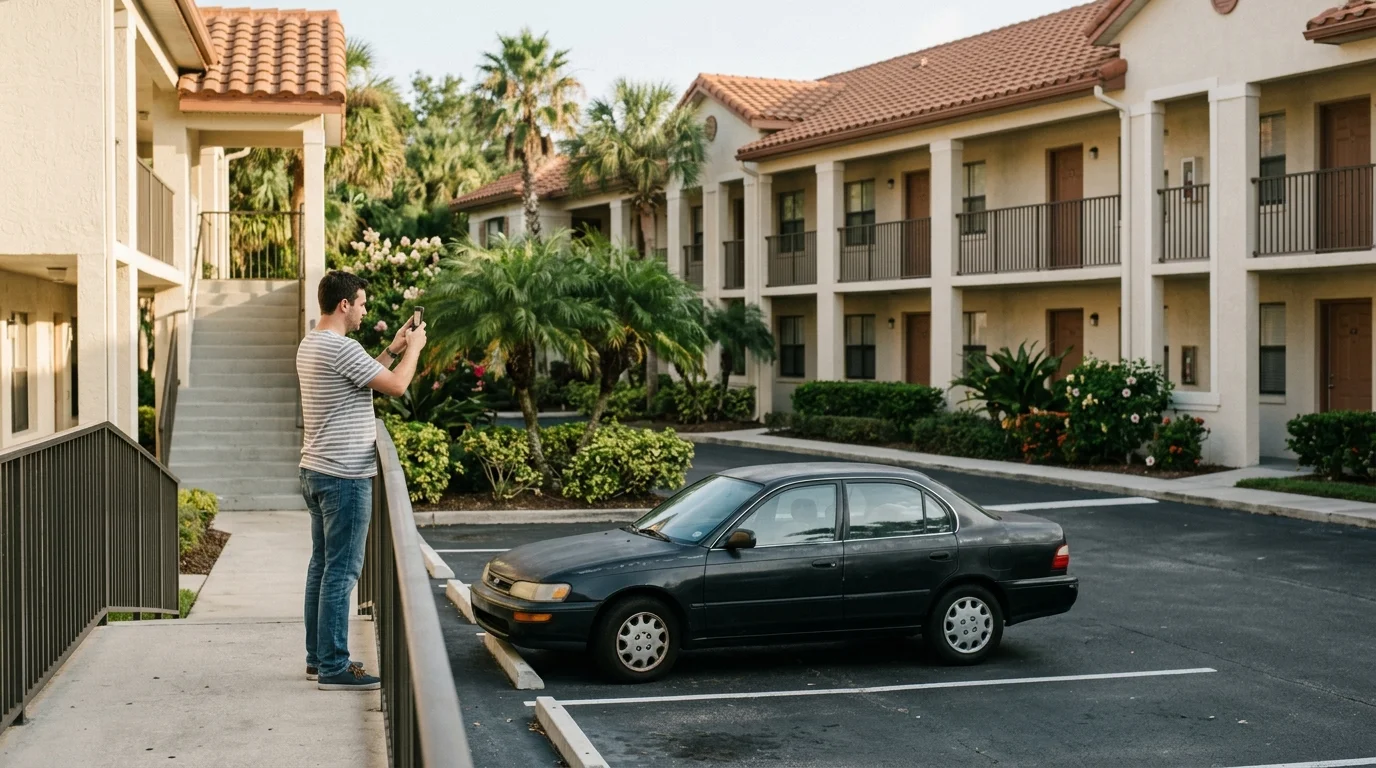
Someone is in your numbered Orlando parking space, and you need it back. Photograph the vehicle and space, then contact whoever your lease, association documents, or posted rules name for parking enforcement. Don’t order a tow yourself unless those documents or an authorized property representative confirm you may.
Document the space before anyone moves the car
Start with clear photos from several angles. Capture the entire vehicle, its license plate, the parking-space number, and nearby building markers. Take a wider photo showing where the space sits within the property.
Record the date and time. Note when you first saw the vehicle and when you checked again. If your community uses permits, decals, hangtags, or an app, save proof that your permit was active. Keep a copy of any parking assignment shown in your lease or resident portal.
Photograph nearby parking signs as they appeared that day. Include the whole sign and enough background to show its location. If several driveways enter the property, document the sign closest to your entrance.
This record helps the property manager understand what happened. It also reduces confusion if the other driver leaves before staff responds. Don’t touch the vehicle, block it in, or attempt to move it yourself.
Check whether the car belongs to a guest or another resident. Your community may have a procedure for contacting that person without sharing private information. A calm message through the leasing office can sometimes solve the problem before towing enters the picture.
Keep your description factual. Say that an unfamiliar car occupies the space assigned to your unit. Don’t accuse the driver of theft, trespassing, or another offense you can’t confirm.
Assigned parking systems vary across Orlando apartment communities. A numbered curb space near Lake Nona may follow different rules than a garage space near International Drive. Your photos and written parking documents provide the best starting point.
Check who has authority to order the tow
An assigned space doesn’t automatically tell you who can authorize removal. The answer may appear in your lease, parking addendum, condominium documents, or community rules. Look for language covering unauthorized vehicles, resident requests, guest permits, and after-hours enforcement.
Apartment residents should contact the leasing office, property manager, or parking contact named in their documents. Ask one direct question: “Who is authorized to request a tow from my assigned space?” Get the answer in writing when possible.
Condominium properties may use a different approval path. Check the association rules and any parking policy issued to owners or tenants. The unit owner, association manager, board representative, or another designated person may control the process. The correct person couldn’t be confirmed for every Orlando condominium, so don’t rely on a general rule.
Tell the authorized representative exactly what you documented. Provide the space number, vehicle description, plate, and time observed. Ask whether staff must inspect the space before contacting an operator.
If the posted towing company tells you to request removal directly, confirm that procedure against your property documents. A company name on a sign doesn’t, by itself, explain what authority a tenant has. The operator may need approval from the property’s designated representative.
Quick Tow Orlando connects callers with independent operators, but it doesn’t decide who controls a parking space. Our private-property towing service can help after the proper representative confirms the request.
Don’t sign another person’s name or describe yourself as the property owner. Don’t promise payment or accept responsibility for charges without understanding the property’s procedure. If the documents are unclear, wait for written direction from management or the association.
This is a practical parking process, not legal advice. A lawyer can advise you when ownership, lease rights, or towing authority is disputed.
Why apartment rules and public streets differ
A marked apartment or condominium space is usually handled through the property’s parking process. A curb on a public street follows the rules of the government controlling that street. Your lease may assign a space inside the complex, but that document doesn’t identify who controls nearby public pavement.
First, confirm the vehicle’s exact location. Note whether it’s inside a gated lot, in a private garage, along an internal drive, or beside a public street. Property boundaries aren’t always obvious from paint or landscaping.
Don’t assume every address labeled “Orlando” uses the same contact route. The Orlando metro includes the City of Orlando, unincorporated Orange County, Winter Park, Kissimmee, Sanford, and other local governments. Check the property address and the current government guidance for that location.
For a public-street complaint, use the current nonemergency parking or law-enforcement contact published by the government responsible for the street. We couldn’t confirm one contact route that applies to every Orlando metro address. Don’t call a private towing operator and ask for direct removal from a public street unless the responsible agency directs that process.
An apartment manager may address a private lot but lack authority over the adjacent street. Likewise, a parking enforcement office may handle a public curb but not settle a lease dispute inside an apartment complex.
Keep the assigned-space problem separate from a blocked driveway. A vehicle across a driveway presents a different location and access issue. Our guide to a car blocking your driveway in Orlando explains the steps for that situation.
If you’re unsure about the boundary, ask management for a site map or written clarification. You can also check the parcel and roadway information published by the relevant local government. Don’t guess based only on where the curb begins.
What signage may change on private property
Florida’s private-property towing law sets notice requirements for towing without the vehicle owner’s consent. Under Florida Statute 715.07, property owners generally must post notices before such towing. The law has exceptions for single-family residences and situations involving personal notice.
The required sign features include:
- “Tow-away zone” text in letters at least four inches high
- Light-reflective lettering on a contrasting background
- The towing company’s name and current telephone number
- Permanent installation between three and six feet above ground
The signs must be maintained for at least 24 hours before towing occurs. Placement calls for one sign per 25 feet of lot frontage or a sign at each driveway access point, within 10 feet of the road.
These rules apply to towing from private property without the vehicle owner’s consent. They don’t tell you whether your lease permits you to order an assigned parking spot towing job. Read the sign together with your parking agreement and management’s instructions.
Our guide to Florida private-property towing sign requirements explains what to photograph and review. Take both close and wide images before the vehicle moves.
A missing, damaged, hidden, or outdated-looking sign doesn’t give you authority to remove the car. Document what you see and ask the property representative or operator which authorization procedure applies. If a specific rule can’t be confirmed, request the current policy in writing.
If your own vehicle gets removed during the dispute, switch from enforcement to retrieval. Florida law requires release within one hour of the owner’s request. The vehicle owner may inspect it before accepting it, and the operator can’t require a no-release or waiver clause as a redemption condition. Read our guide to your rights after an Orlando tow before visiting the storage facility.
Where to turn when the property manager is unavailable
Start with the contact routes already provided by the property. Check your lease, parking addendum, resident portal, lobby notices, gate instructions, and posted towing signs. Look for a designated after-hours management or parking contact.
Send a written message even if nobody answers immediately. Include the space number, vehicle description, plate, first observed time, and photos. Ask for confirmation that the space is assigned to you and instructions for authorized removal.
If security staff or a parking vendor is present, ask them to follow the property’s written procedure. Don’t ask them to improvise. Record the name or role of the person you contacted and the time of the conversation.
You can call the towing company listed on a valid property sign to ask about its process. Explain that management is unavailable. Ask what authorization it requires, but don’t treat the call as permission to order the tow.
When no authorized person can be reached, use a legal temporary parking option if one is available. Save receipts or messages connected to the disruption, but don’t assume the property or vehicle owner must reimburse you. That outcome depends on documents and facts we can’t confirm.
For an address outside City of Orlando limits, confirm the current towing process with the government responsible for that location. Local rules and contact paths may differ across the metro.
If a tow already occurred and you believe the operator acted improperly, begin with the business manager or owner. Orange County Consumer Protection accepts and investigates towing complaints. It doesn’t provide legal advice, represent consumers, or force a particular resolution.
Keep the immediate goal simple: document the space, find the authorized decision-maker, and follow the written process. That protects you from turning one parking problem into a second dispute.
When to call us
Call after the property’s authorized representative confirms that an independent tow operator may remove the vehicle. Quick Tow Orlando connects callers with independent towing operators serving the Orlando metro.
Call us at (321) 321-9797.