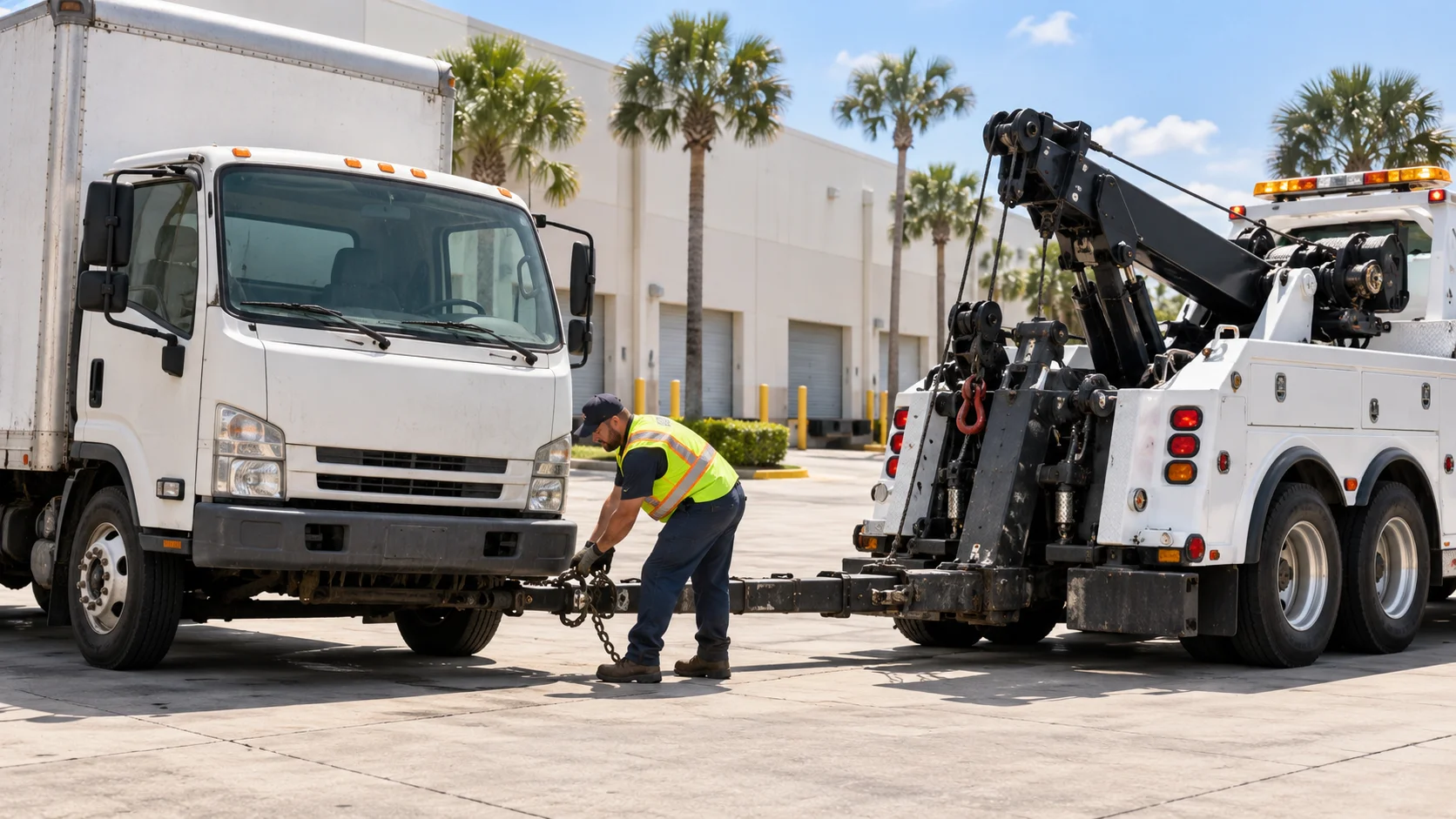
Delivery truck towing in Orlando starts with accurate information from the scene. A dispatcher needs the truck’s location, condition, cargo details, and available clearance before connecting the driver with an operator.
That preparation matters across Orlando’s commercial corridors. A breakdown near the airport presents different access problems than one at a Winter Park storefront or an International Drive loading dock.
Protect the loading area or roadside scene
Start by identifying exactly where the delivery truck stopped. Don’t settle for a business name or broad road description. Ask for the street address, property entrance, nearby cross street, and the truck’s position within the site.
A driver at a warehouse should describe the correct gate or loading area. Airport-area facilities may have several entrances and controlled access points. Retail centers often separate loading traffic from customer parking. That detail helps an operator approach the truck from the usable side.
For a roadside breakdown, confirm whether the truck is fully outside the travel lane. Note nearby ramps, intersections, barriers, and narrow shoulders. If the driver is near I-4, SR 408, SR 417, SR 429, or the Turnpike, record the direction of travel and the nearest exit or marker.
The driver shouldn’t stand between the truck and moving traffic. Hazard lights can make the disabled vehicle more visible when they’re working. Emergency conditions, blocked travel lanes, injuries, smoke, or leaking material need the appropriate emergency response first.
Dispatch can also review FL511 traffic and incident alerts when a breakdown affects a major road. That doesn’t replace the driver’s description. It can help dispatch understand nearby closures or access problems.
Florida’s Move Over law protects stopped tow trucks displaying amber lights. On a multilane road, approaching drivers must leave the closest lane when it’s safe. On a two-lane road, they must reduce speed as the statute directs. The delivery driver should still remain in a protected location whenever possible.
Identify the truck without guessing its weight
“Delivery truck” can describe several different vehicles. It might mean a cargo van, step van, box truck, refrigerated vehicle, pickup-based delivery unit, or another commercial truck. The correct towing plan depends on the actual vehicle, not its route or company use.
Ask the driver for the year, make, model, and body style. Get the unit number if the fleet uses one. Then request a clear photo of the full truck from each side. Photos of the front, rear, wheels, and identification labels can answer questions that a hurried verbal description misses.
Don’t ask the driver to estimate the truck’s weight. Instead, look for the manufacturer label or fleet record showing the gross vehicle weight rating. Also confirm whether the truck is empty, partly loaded, or carrying its normal delivery load. The operator can use those details to select a suitable towing method.
Record the truck’s overall condition. Ask whether the engine runs, the transmission shifts, and the steering responds. Confirm whether the parking brake releases. Note if the keys are present and whether the driver can access the cab.
Those answers don’t diagnose the breakdown. They describe what the operator may encounter during loading. Avoid guesses such as “the transmission is gone” or “it only needs a jump.” Describe the symptoms instead: the engine won’t start, the truck won’t move, or a warning appeared before it stopped.
Some delivery vehicles fall within heavy-duty towing service, while others need a different approach. Quick Tow Orlando shares the available details with a local operator. That operator determines what equipment fits the actual vehicle and scene.
Describe cargo, wheel damage, and attachments
Cargo changes the conversation even when dispatch doesn’t know its weight. Ask what the truck carries, how the load is secured, and whether anything shifted during the breakdown. Confirm whether the cargo is ordinary freight, refrigerated goods, liquids, fragile items, or materials requiring special handling.
Don’t open sealed freight or move cargo without fleet approval. Dispatch should decide whether the load stays with the truck, transfers to another vehicle, or needs separate attention. The tow operator needs to know that decision before moving the disabled unit.
A partly completed route can create added constraints. The truck may hold several customers’ goods, return items, delivery carts, or loose containers. Tell the operator about anything that could roll, spill, tip, or contact the cargo body during loading.
Wheel and suspension damage also needs a precise description. Ask whether every tire is inflated and attached. Record any wheel pointing at an unusual angle. Note visible axle damage, a low corner, dragging parts, or a truck resting against a curb. Photos should show the damaged area without placing the driver in traffic.
If the truck was involved in a collision, share that immediately. A damaged delivery body, displaced axle, or truck outside the paved surface may require accident recovery and winch-out support. The goal is to describe the scene, not choose the recovery method remotely.
Attachments matter too. Report liftgates, refrigeration units, roof equipment, ramps, steps, trailer hitches, racks, and low body panels. Confirm whether a liftgate is fully raised and secured. If it won’t move, don’t force it. Tell the operator its exact position.
A loaded box truck raises some additional concerns. Our guide to towing a loaded box truck explains how load position and body condition affect the call.
Check clearance at pickup and delivery
A suitable tow vehicle still needs room to reach and handle the truck. Measure or verify access at both ends of the trip. Pickup clearance alone isn’t enough.
At a warehouse, confirm the gate width, overhead clearance, turning space, and surface condition. Note security checkpoints, locked gates, parked trailers, loading canopies, and tight rows between buildings. Ask whether staff can move other vehicles before the operator arrives.
For a store delivery, inspect the loading zone and its exit path. Alleys behind Orlando businesses may leave little turning room. Parking structures can add height limits, sharp ramps, and low overhead fixtures. Don’t assume a tow vehicle can enter because the delivery truck entered earlier.
The truck’s stopped position also matters. Tell the operator whether it faces a wall, sits against a dock, blocks a bay, or rests on a slope. Confirm which end is accessible. Mention wheel stops, bollards, curbs, landscaping, soft ground, and drainage areas.
Send current photos when possible. One wide photo should show the entire truck and surrounding space. Additional photos can show the approach, overhead obstacles, damaged wheels, and the available exit. Avoid close images that hide the wider layout.
Dispatch should also ask who controls the property. A facility manager or security team may need to open a gate or approve access. Record the contact’s name and where the operator should check in. Don’t promise that site staff will be present unless they’ve confirmed it.
For a broader preparation list, review what to have ready when calling a tow truck. Commercial calls need the same basics, plus cargo and clearance details.
Confirm a destination that can receive the truck
Don’t send a disabled delivery truck toward an unconfirmed destination. The repair shop, fleet yard, dealer, or secure lot must be able to receive that specific vehicle.
Ask the destination whether it accepts the truck’s size and type. Describe the delivery body, cargo status, visible damage, and reported symptoms. A shop that handles passenger vehicles may not have suitable access or space for a commercial unit.
Confirm the full address and correct entrance. Orlando commercial properties often have separate customer, service, and freight entrances. A street address may lead to the wrong gate. Get written directions when the receiving area sits behind another building or inside a larger industrial complex.
Dispatch should verify access for the expected arrival period. Ask about gates, security procedures, key drops, and after-hours placement. Don’t assume a closed facility allows vehicles to be left outside. Get clear authorization from someone responsible for the property.
The destination also needs enough unloading space. Ask whether parked vehicles, service bays, or delivery traffic could block the operator. Report slopes, gravel, soft shoulders, narrow drives, and overhead restrictions. Share the receiving contact with the towing operator when authorized.
If the truck carries cargo, decide who takes responsibility for it after delivery. The repair facility may accept the vehicle without accepting the freight. Refrigerated or time-sensitive cargo may need a separate fleet plan. Quick Tow Orlando doesn’t store cargo or operate a repair facility. We connect callers with independent towing and roadside operators serving the Orlando Metro.
Before ending the request, repeat the pickup point, destination, truck details, cargo condition, damage, clearance, and site contact. A short confirmation can catch an incorrect entrance or incomplete address before the operator starts the trip.
When to call us
Call when a disabled delivery truck can’t move safely, has wheel damage, needs recovery, or requires transport to a confirmed destination. Quick Tow Orlando takes calls 24/7 and connects callers with local independent operators.
Call us at (321) 321-9797.