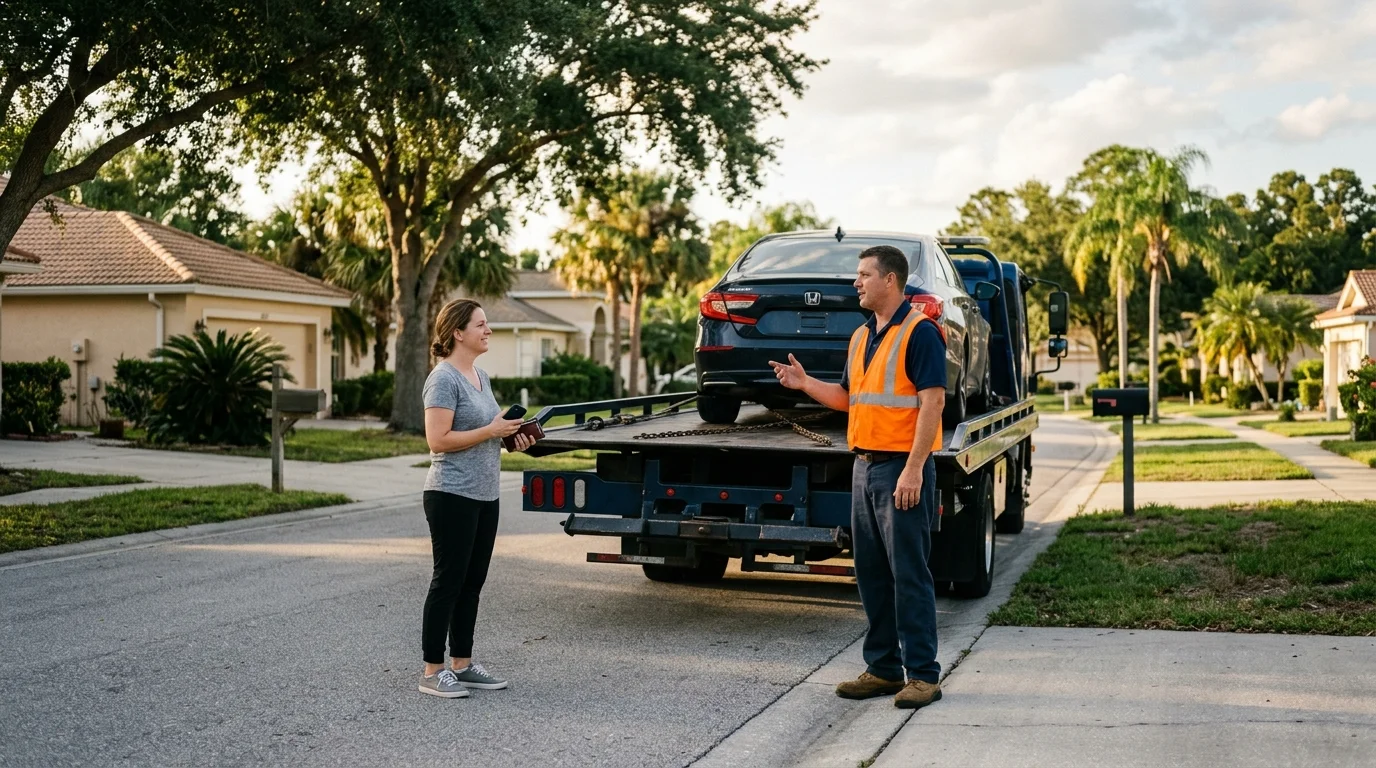
A tow operator has loaded your car, and the payment screen is open. Plenty of people ask do you tip tow truck drivers, and you can, but you don’t have to. In Orlando, a tip is optional thanks, not part of the required towing fee.
Do you tip tow truck drivers: the honest answer
We couldn’t confirm any Orlando, Orange County, or Florida rule requiring a towing gratuity. The towing bill covers the service. A tip is a separate choice you make after the job.
That remains true whether the driver moved a disabled car or provided roadside help. It also applies when a private-property tow ends at a storage yard. You don’t owe a tip simply because someone presents a payment screen or cash box.
The circumstances can still shape your decision. You might want to recognize careful communication, patience, or thoughtful handling. You can also skip the tip without treating the driver unfairly. Paying the required bill satisfies your financial obligation.
Keep the towing charge and gratuity separate in your mind. First, confirm what service was ordered and what the operator charged. Then decide whether you want to add a personal thank-you. Don’t let that choice distract from checking the invoice.
This distinction matters when you’re already stressed. A breakdown on I-4 or SR 408 can leave you focused on getting home. An impound release can feel even more tense. Neither situation creates a tipping requirement.
If a driver suggests that a tip is mandatory, ask for clarification. Find out whether the amount is actually part of the towing charge. Request an itemized receipt before paying anything you don’t understand. A voluntary tip shouldn’t be presented as an unexplained fee.
The jobs where drivers say it lands differently
Some towing jobs feel routine from the customer’s side. Others involve bad weather, tight access, damaged wheels, or a frightened passenger. Those circumstances may make a personal thank-you feel more appropriate. They still don’t turn it into a required payment.
Consider the parts of the interaction you can actually observe. Did the driver explain what would happen before loading? Did they listen when you described a low bumper, locked steering, or damaged tire? Did they handle the conversation calmly while you worked out a destination?
Those details can guide your choice better than a tipping formula. The type of truck alone shouldn’t decide it. Neither should the length of the invoice. Focus on how the operator handled your vehicle and communicated with you.
The same principle applies to roadside assistance. A battery jump, spare-tire change, or lockout may prevent a tow altogether. Tipping remains optional if a private operator provides that help.
Central Florida drivers also have another roadside resource. FHP Road Rangers provide certain roadside services without charging the motorist. They can help with a spare tire, jump start, limited fuel, or lane clearing. They don’t tow vehicles away. If transport is needed, FHP calls a private towing operator at the motorist’s expense.
Don’t confuse a difficult setting with permission for surprise charges. Summer rain, a crowded garage, or a shoulder near SR 417 may complicate the work. The operator should still explain the required charge. Your decision about a tip comes afterward.
Cash or card, and why that question has a legal edge here
Payment rules affect the towing charge, even though they don’t create a tipping rule. Florida law requires towing-storage operators to accept at least two of three payment categories. Those categories cover traditional payment, bank cards, and electronic payment methods.
Orange County has stricter requirements when its towing ordinance governs. The operator must accept cash, money orders, cashier’s checks, and major debit or credit cards. The county rule also bars a card surcharge. Cash rounding must favor the customer.
Orange County Chapter 35 is the verified schedule for unincorporated county trespass and nonconsensual tows. A city may enact its own schedule inside its limits. City of Orlando dollar figures are not restated here because they were not independently verified for this article. The pickup point decides which local rate system applies, not where the yard sits.
These payment protections cover towing and storage charges. They don’t require an operator to accept a gratuity through every payment method. A card terminal also doesn’t prove that a gratuity is expected. Its tip prompt may simply be part of the payment software.
If you want to tip by card, ask whether the operator allows it. If you prefer cash, confirm that the business permits drivers to accept it. Don’t assume either method is available for gratuities just because it’s available for the towing charge.
Ask for a receipt that keeps the required bill clear. Any optional amount you choose should remain recognizable as your choice. That separation helps if you later need to question a towing or storage charge.
What the fee you already paid is supposed to cover
Orange County Chapter 35 is the verified schedule for the trespass and nonconsensual work it covers. It does not set a tip. It also does not set the price of a tow you called yourself.
Do not treat a tip as payment for a line item the county ordinance already bars on a regulated bill. A customer-called tow is consensual, so confirm the operator’s total before agreeing to service. Quick Tow Orlando states the quoted total before connecting you with an operator.
Outside unincorporated Orange County, a city may have its own schedule. Our guides explain how Orlando towing costs work and how towing fees are regulated in Florida.
Private-property towing has another legal layer. Florida Statute 715.07 covers signs, authorization, police notification, and vehicle returns during a tow. We couldn’t confirm any tipping requirement in that statute.
The thing operators say they would rather have
No single answer can represent every tow operator. What you can reliably offer is clear information, a safe working area, and prompt decisions. Those things help the operator understand the vehicle and complete the requested service.
Start with an exact location. Share the road, direction of travel, nearby exit, or parking-garage level. Describe the vehicle and visible damage. Mention locked wheels, missing keys, low clearance, or a trailer if any apply. If you don’t know something, say so instead of guessing.
Confirm the destination before the operator starts loading. Make sure the location can receive the vehicle. Keep personal items, children, and pets away from the loading area. On a highway shoulder, follow directions from the operator or responding authorities.
Payment clarity also helps. Ask what the quoted total covers before an operator is sent. Confirm the payment method and request a receipt. If the final charge differs from what you were told, ask for an explanation before considering any optional gratuity.
A direct thank-you carries no billing confusion. If you also want to tip, ask whether the operator accepts gratuities. If you don’t want to tip, don’t let a screen prompt or awkward pause pressure you.
Poor service doesn’t need a gratuity to make the interaction end. Keep the invoice and note any charge you couldn’t resolve. Compare it with the rules governing the tow’s pickup location. The city and county systems aren’t interchangeable.
When to call us
A disabled car on I-4, SR 408, or a busy Orlando shoulder isn’t the place to attempt work you can’t handle safely. Dispatch runs Monday to Friday, 8 a.m. to 10 p.m., and we connect callers with local operators for towing or roadside help. Call us at (321) 321-9797.