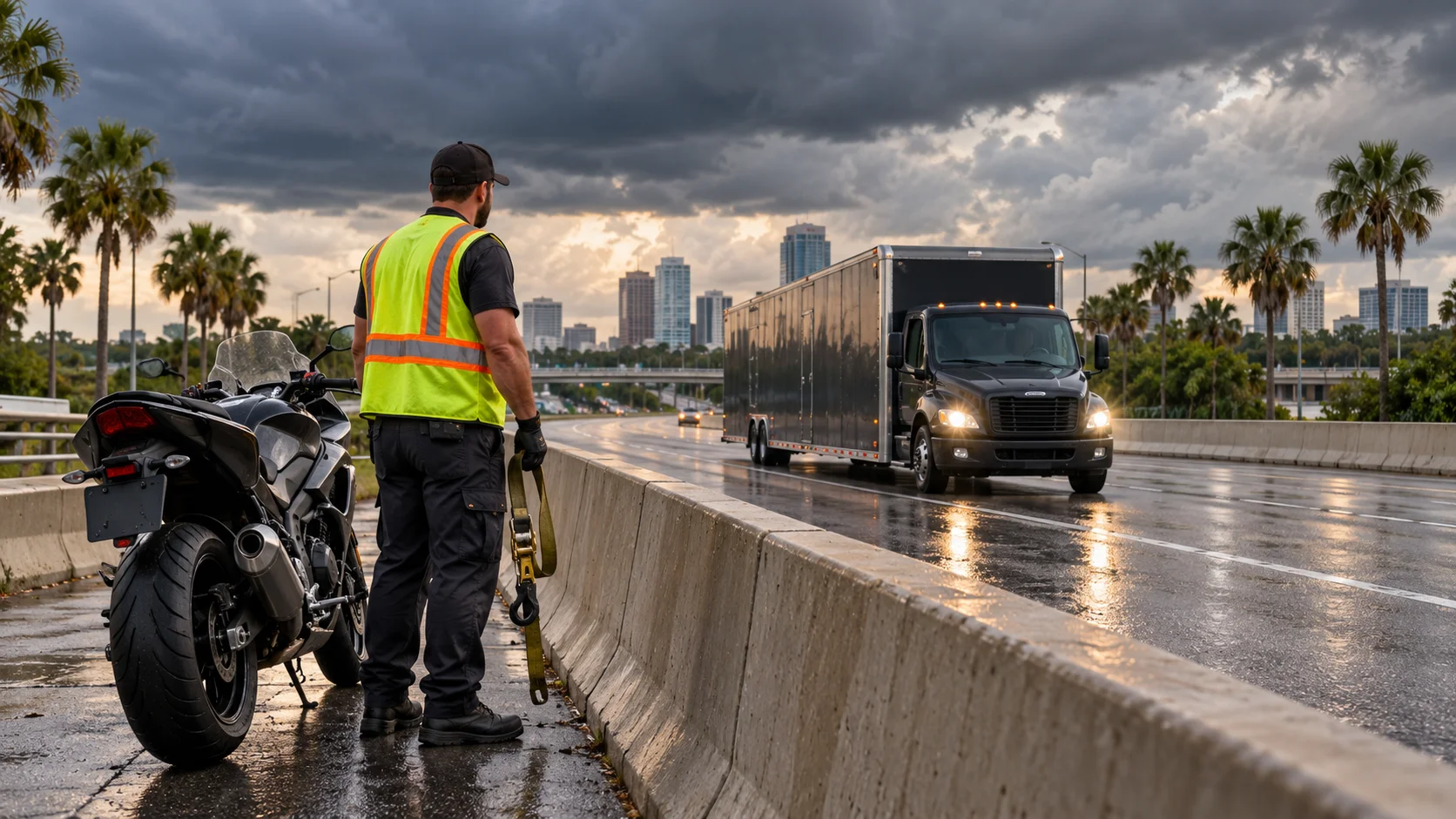
When your motorcycle stops on I-4, your first decisions matter. Move away from traffic if you safely can, identify your exact location, and arrange transport with a destination already chosen.
A request for motorcycle breakdown towing in Orlando goes more smoothly when the operator receives accurate details. Your direction of travel, nearest interchange, bike condition, and steering status all help define the job.
Get yourself away from moving traffic
Protect yourself before making calls or examining the motorcycle. If the bike still moves under its own momentum, guide it toward the shoulder only when that path is clear. Don’t cross active lanes or stand beside the bike where traffic passes close.
Once stopped, get as far from moving vehicles as conditions allow. A barrier can offer separation, but don’t climb over one without checking the other side. There may be a slope, drainage area, water, or another hazard beyond it. Keep your helmet on if you’re still exposed near traffic.
If you’re stranded in an active lane, can’t reach a safer position, or face an immediate danger, call 911. Give the direction of travel and the nearest landmark you can identify. Don’t try to push a heavy or damaged motorcycle through live traffic.
Florida’s Move Over Law covers disabled vehicles displaying hazard lights. Drivers approaching a covered roadside vehicle must change out of the closest lane when safely possible on a multilane highway. That rule helps, but it doesn’t make an I-4 shoulder risk-free.
Avoid standing between the motorcycle and approaching traffic. Don’t sit on the bike while waiting. If another vehicle strikes it, the bike can move without warning.
Bad weather changes the situation quickly. Orlando rain can reduce visibility and make painted pavement slick. Focus on your own position, not protecting the motorcycle from rain. The bike can be recovered after you’re safely separated from traffic.
For a broader highway safety guide, read what to do after breaking down on I-4.
Share your direction and nearest interchange
“I’m on I-4 in Orlando” isn’t precise enough for a useful request. I-4 runs through several parts of the metro, with traffic moving in both directions. Start with eastbound or westbound, then name the nearest interchange.
Useful references include International Drive, Sand Lake Road, Kirkman Road, SR 408, downtown Orlando, Lee Road, and the Maitland area. Only name a landmark you can identify confidently. Don’t guess at an exit or road name.
Open your phone’s map while you’re safely away from traffic. Drop a pin at your current position and copy the location. If the map shows coordinates, keep them available. A screenshot can help if your signal becomes unreliable or the map refreshes.
Explain which side of the highway holds the motorcycle. Say whether it’s on the right shoulder, left shoulder, an exit ramp, or beyond the end of a ramp. Mention whether a concrete barrier, guardrail, grass strip, or narrow shoulder affects access.
Your recent route can also narrow the location. For example, say you passed SR 408 and were heading toward downtown. That’s more useful than naming a neighborhood several miles away.
Don’t walk along I-4 looking for a sign unless your current position is unsafe. Look from where you’re waiting. A nearby overpass, visible building, ramp split, or map pin may provide enough detail.
If another rider is with you, have one person manage location details. The other person can watch traffic and changing conditions. Keep both people away from the motorcycle if reaching it requires stepping near an active lane.
You can also review 24/7 emergency towing options when the motorcycle can’t remain where it stopped. The Quick Tow Orlando request line is open 24/7 and connects riders with independent local operators.
Describe the motorcycle before dispatch
The operator needs more than the motorcycle’s make and color. Share the model if you know it, along with any luggage, accessories, or modifications that change its shape. Mention side cases, a top case, a windshield, or another large attachment.
State whether you have the key. Explain whether the steering is locked and whether the lock appears damaged. Don’t force the handlebars or ignition while you’re beside moving traffic.
Report what happened just before the bike stopped. It may have lost power, developed a tire problem, made an unusual sound, or been involved in a collision. Describe what you observed without diagnosing the cause. A clear symptom is more useful than a confident guess.
Tell the request line about visible damage. Note whether the motorcycle is upright or lying down. Identify bent parts, detached pieces, or obvious contact with a barrier. If anything appears to be leaking, report its location and appearance without touching it.
The condition of both tires matters. Say whether either tire looks flat, separated, cut, or pushed away from its normal position. Also mention whether a wheel appears blocked. Don’t try rolling the motorcycle just to test it when the shoulder is narrow or the bike feels unstable.
Explain the ground around the motorcycle. A paved shoulder differs from grass, soft soil, a slope, or a confined ramp area. Mention nearby barriers and limited working space.
Photos can document the bike’s position and visible condition, but take them only from a safe location. Don’t step toward traffic for a better angle.
Our motorcycle towing service page explains how to request an Orlando motorcycle tow. Before arranging transport, you can also review what to ask before a motorcycle tow.
Decide whether roadside help is appropriate
A roadside service may fit some breakdowns, but location comes first. Work that might be manageable in a parking lot may be unsafe beside I-4. The narrowness of the shoulder, traffic exposure, weather, and motorcycle damage all affect that decision.
Describe the symptom and let the operator determine whether roadside help is suitable. Don’t begin repairs while waiting unless you’re in a secure place and know the work can be done safely. This isn’t the moment to remove panels, work near a hot engine, or handle a damaged tire beside traffic.
A tow is usually the clearer request when the bike can’t roll, the steering is locked, or visible damage makes its condition uncertain. Transport also makes sense when the motorcycle stopped in an exposed position or needs professional inspection before it’s ridden again.
If the motorcycle starts again, don’t assume the original problem has cleared. Consider where it stopped, what warning signs appeared, and whether you trust it for the next part of the ride. An intermittent issue can leave you stranded again in a worse location.
Tell the request line if another service has already been contacted. Also say whether law enforcement, highway personnel, or another responder is present. Follow any directions they give about where you should wait or whether the motorcycle must be moved.
Don’t accept an unplanned repair from an unknown person who stops beside you. You’re exposed, distracted, and dealing with valuable property. Keep your phone, wallet, keys, and riding gear with you.
Motorcycle roadside assistance in Orlando isn’t one fixed type of job. The bike’s condition and roadside position determine whether limited help or transport is appropriate.
Choose a destination that can receive the bike
Choose the destination before the motorcycle is moved. A repair shop, dealership, home, or secure storage location may work, but access must be confirmed. Don’t assume a closed business accepts unattended motorcycles.
Call the destination yourself. Confirm that it accepts your motorcycle and can receive it when the operator arrives. Ask where the bike should be placed and whether someone must be present. If the entrance uses a gate, garage, loading area, or property access code, share those details.
Be specific about the address. Orlando-area roads can share similar names, and businesses may have several locations. Check the full street address in your map rather than relying on a saved contact name.
Think beyond the nearest destination. The closest shop may not work on your motorcycle’s make or the type of problem you described. A farther destination may create another transport decision, so confirm service before committing.
If you’re traveling through Orlando, consider how you’ll leave the destination. You may need a ride, lodging, or a safe place to wait. Keep your helmet, documents, medication, phone charger, and other personal items with you rather than leaving them attached to the motorcycle.
Tell the request line if the destination has tight access, covered parking, a steep driveway, or a gate. Mention whether the final location is in downtown Orlando, near International Drive, around Winter Park, or farther toward Kissimmee or Sanford.
A companion can check FL511 traffic and incident alerts while you handle the destination. Don’t study traffic maps while standing close to moving vehicles.
Before the motorcycle leaves, confirm the destination with the operator who arrives. That prevents confusion when a shop name differs from its map listing or has more than one entrance.
When to call us
Call when your motorcycle can’t be ridden safely, needs transport, or remains exposed near I-4 traffic. Quick Tow Orlando takes calls 24/7 and connects riders across the Orlando metro with independent towing and roadside operators. Call us at (321) 321-9797.