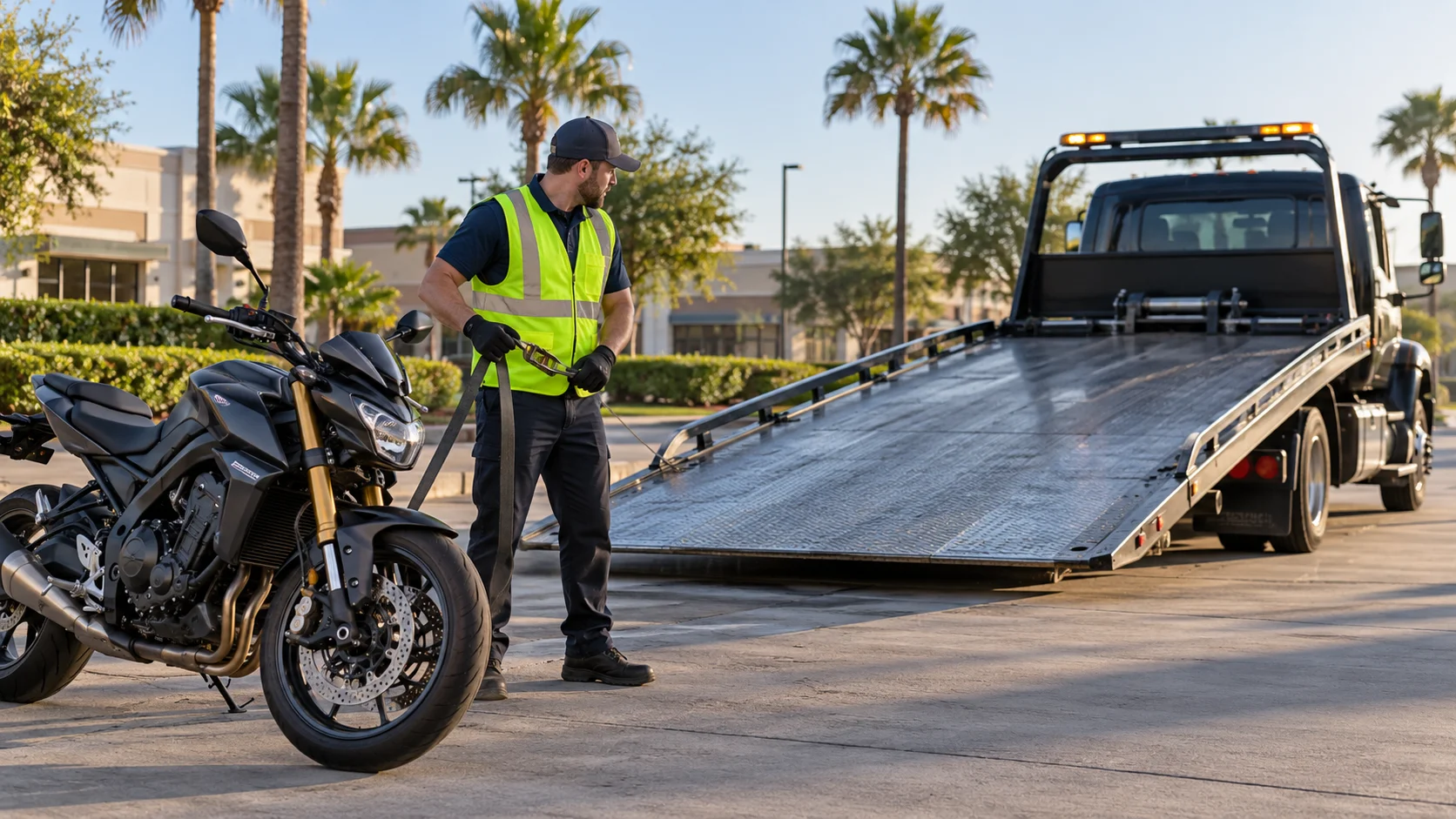
A motorcycle breakdown in St. Cloud can leave you exposed beside fast traffic. Move away from danger, identify your exact location, and avoid handling the bike if its condition is uncertain.
Get the rider away from moving traffic
Your safety comes before the motorcycle. If the bike is already off the roadway, leave it there. Don’t step into traffic to inspect a tire, collect a loose part, or take photographs.
Move behind a solid barrier when one is available. Otherwise, wait well away from active lanes. Stand where approaching drivers can see you without placing yourself near their path. On a dark road, avoid waiting beside the bike if that puts you close to traffic.
US 192 has busy commercial stretches, turning traffic, and frequent driveway entrances. Narcoossee Road can also carry traffic moving at very different speeds. A motorcycle near an intersection or driveway may be difficult for drivers to notice. Choose a waiting position that keeps you clear of both through lanes and turning vehicles.
Don’t sit on the motorcycle while waiting. A stopped bike offers little protection if another vehicle leaves its lane. Keep children, passengers, and pets away from the roadway as well.
If the motorcycle is blocking a travel lane, tell the appropriate emergency authority where it is. Don’t attempt to move it through traffic when doing so could expose you to approaching vehicles. An injury, fuel leak, fire, or immediate collision risk also needs emergency help, not ordinary roadside service.
You can review FL511 traffic and incident alerts from a safe location. That may help you describe nearby closures or unusual traffic conditions. It doesn’t replace reporting an immediate hazard.
For a breakdown that isn’t creating an emergency, our emergency towing connection service can route the details to a local operator.
Share the nearest US 192 or Narcoossee Road marker
“St. Cloud” alone doesn’t give an operator enough information. Share the road name, direction of travel, and the nearest visible cross street. Add a business entrance, subdivision entrance, or parking area when it helps distinguish your location.
If you’re near US 192, say whether you’re eastbound or westbound. Describe which side of the nearest intersection you’ve reached. A location pin from your phone can help, but pair it with plain-language directions. Pins can land across a divided road or behind a building.
Narcoossee Road requires the same care. State your direction and the closest confirmed cross street. Don’t guess at an address you can’t see. If you entered a parking lot, explain which entrance you used and where the motorcycle sits within the property.
Residential pickups need more detail. Give the street address, gate instructions, and a safe place where the operator can meet you. Mention narrow streets, parked cars, low branches, or a blocked driveway. Don’t claim that a particular truck can enter until the operator reviews those conditions.
Useful location details include:
- The road or property name
- Your direction of travel
- The nearest confirmed cross street
- A phone-generated location pin
- The bike’s position relative to traffic
- Any gate, garage, or access restriction
Stay in the safe location you selected. Don’t walk along US 192 or Narcoossee Road looking for a better marker. Use visible signs and your phone’s map instead.
A car breakdown on this corridor raises some different concerns. Our guide to a breakdown on US 192 in St. Cloud covers that separate situation.
Describe the motorcycle and visible condition
The operator needs to know what’s being collected before heading your way. Start with the motorcycle’s make, model, approximate size, and color. Say whether it’s a standard motorcycle, scooter, trike, or another configuration. Don’t assume those vehicles can be handled identically.
Next, describe what you can see without touching damaged parts. Report whether the motorcycle is upright, resting on its stand, or lying on its side. Mention crash damage, leaking fluid, loose bodywork, or parts touching the pavement.
Tire condition matters. Say whether either tire appears flat, shredded, separated from the rim, or unable to roll. Don’t try to inflate, rotate, or reposition a damaged wheel beside traffic. A wheel that looks intact may still have damage you can’t see.
Tell the operator whether the steering is locked. Also say whether you have the key. If the key is missing or broken, state that clearly. Don’t force the handlebars or ignition. The operator can use those details when deciding how to approach the motorcycle.
Point out existing scratches, bent pieces, cracked panels, and luggage attached to the bike. Take clear photographs from a safe position when possible. Include both sides, the wheels, and the visible damage. Those images create a record of the bike’s condition before transport.
Remove loose personal items only when you can do so safely. Don’t disassemble accessories or attempt loading work yourself. If saddlebags, a top case, or aftermarket equipment can’t be secured, tell the operator.
Our guide on what to ask before a motorcycle tow explains which bike and access details deserve attention before transport begins.
Decide whether roadside help is appropriate
Some problems may call for roadside help. Others make motorcycle towing the safer choice. The decision depends on what failed, where the bike stopped, and whether anyone can assess it without working near traffic.
A simple no-start condition in a quiet parking area differs from a damaged bike beside US 192. Tell the operator what happened before the motorcycle stopped. Useful details include unusual sounds, warning lights, lost power, a flat tire, storm exposure, or contact with a curb.
Don’t diagnose a mechanical or electrical failure from the shoulder. Also avoid repair attempts near moving traffic. Even a familiar task becomes risky when drivers pass close by or visibility is poor.
Request towing when the motorcycle won’t roll normally, has visible crash damage, or can’t be controlled safely. A locked steering system, damaged wheel, fluid leak, or missing key can also change the plan. Share those facts before an operator travels to the scene.
If the bike starts again, that doesn’t prove it’s safe to ride. Warning lights, damaged tires, steering changes, or leaking fluid need proper evaluation. When you’re uncertain, choose transport to a place that can inspect the motorcycle.
Our motorcycle towing service connects St. Cloud riders with independent local operators. Quick Tow Orlando takes the request and passes along the pickup, motorcycle, and destination details. The operator confirms whether the requested job fits the bike’s condition and access needs.
An interstate stop presents different hazards from a surface-road breakdown. See our separate guide for a motorcycle breakdown on I-4 if that’s where the problem occurred.
Choose a destination that can receive the bike
Pick the destination before requesting transport when you can. A repair shop, dealership, home, or secure storage location may work. The right choice depends on the motorcycle’s condition and who can accept it.
Call the destination directly before the tow. Confirm that it accepts your motorcycle type and can receive it when you arrive. Ask where the operator should place the bike. Don’t rely on an old listing or assume an after-hours drop is allowed.
A closed shop can create a second problem. The operator may reach a locked gate with nowhere authorized to leave the motorcycle. If the business won’t be open, ask whether it has a documented after-hours process. Get the instructions from that destination, not from an unrelated online review.
For a home delivery, consider access. Tell the operator about gates, steep driveways, loose surfaces, tight turns, garages, and parked vehicles. Decide where the motorcycle can remain without blocking a sidewalk, street, or shared entrance.
Also confirm who will meet the operator. If someone else is receiving the bike, share that person’s name and contact details with permission. Make sure the recipient knows the motorcycle’s condition and expected placement.
Don’t leave valuables, documents, or unsecured riding gear on the motorcycle. Remove what you can safely reach. Photograph the bike and attached luggage before transport.
When calling, have both addresses ready. Include the shop name, receiving instructions, and any access limits. If you haven’t chosen a destination, say so. Quick Tow Orlando can still record the breakdown details, but the receiving location must be settled before the transport plan is complete.
When to call us
Call when the motorcycle can’t be ridden safely, won’t roll normally, or needs transport from a dangerous location. Quick Tow Orlando connects riders with independent towing operators across the Orlando Metro, including St. Cloud, and the request line is open 24/7. Call us at (321) 321-9797.