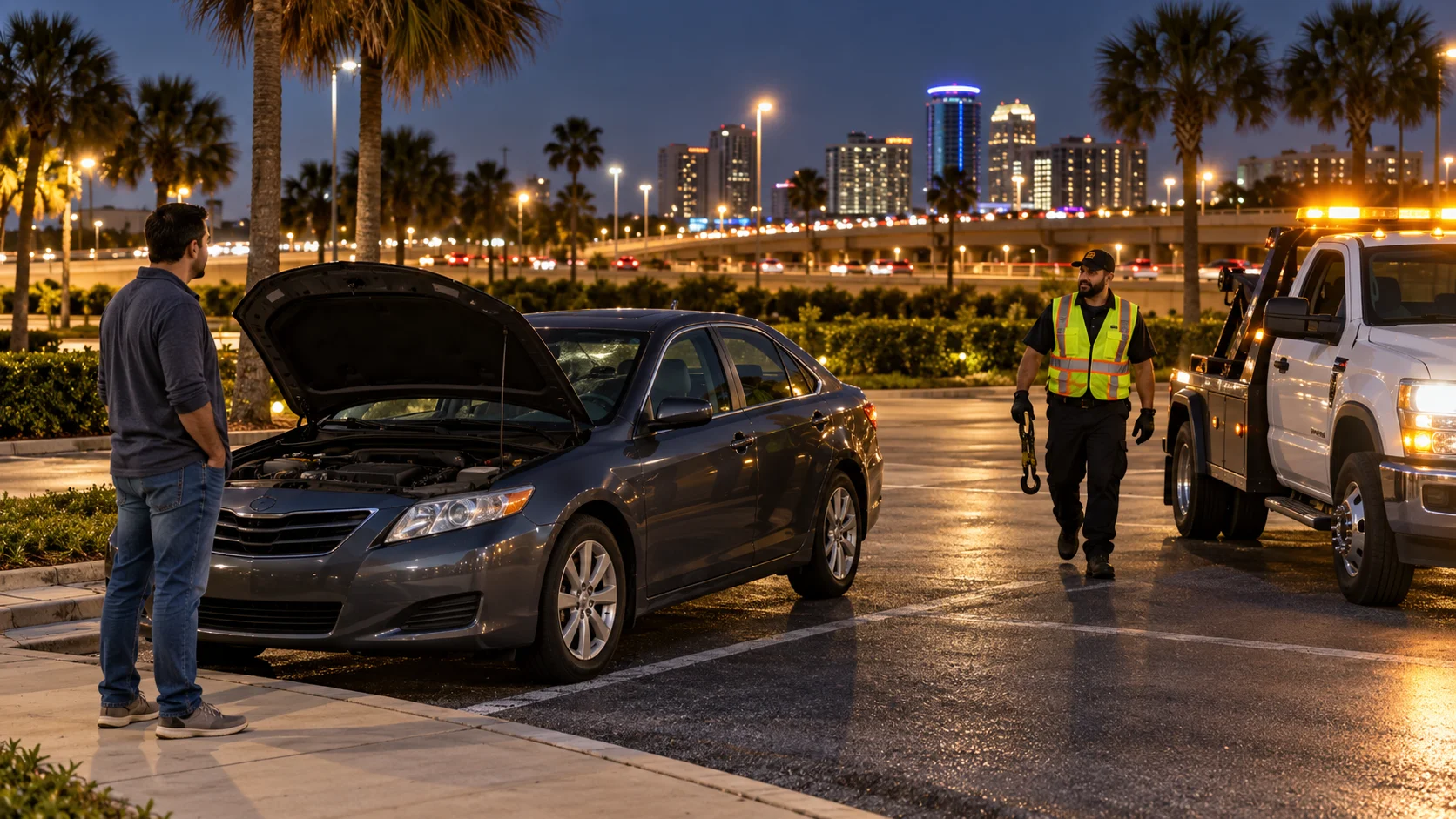
A dead battery, flat tire, lockout, or empty tank can stop your plans. If you’re searching for 24 hour roadside assistance near me, first get somewhere safe. Then request the specific help your vehicle needs.
Quick Tow Orlando’s request line is open 24/7. We connect Orlando Metro drivers with independent local towing and roadside operators. The right request starts with your location, vehicle, problem, and access conditions.
Get away from moving traffic first
Your safety comes before the battery, tire, or missed appointment. Move the vehicle out of a travel lane if it still operates safely. Look for a parking lot, service area, or wide shoulder away from traffic.
Turn on the hazard lights. Set the parking brake once you stop. Don’t stand between your car and moving vehicles. Avoid checking a roadside tire where passing traffic leaves little working room.
A breakdown on I-4, SR 408, or SR 417 needs extra care. Tell the operator which road you’re on and your direction of travel. Include the nearest exit, interchange, or visible landmark. “I-4 westbound near the SR 408 interchange” is far more useful than “somewhere downtown.”
Florida’s Move Over law covers disabled vehicles displaying hazard lights. On a multilane road, approaching drivers must leave the closest lane when safely possible. That legal protection doesn’t make a narrow shoulder a safe repair area.
Call emergency services when the vehicle blocks traffic or anyone faces immediate danger. The same applies after a crash involving injuries, fire, smoke, or leaking fluids. Roadside service isn’t a substitute for emergency response.
In an Orlando parking area, stay near a lit, public location when possible. Tell someone where you are. Keep your phone available because the operator may need clarification about your car or entrance.
Decide which roadside service the car needs
Roadside assistance handles problems that may be solved where the vehicle stopped. The goal is to identify the likely service before an operator heads your way. That helps avoid sending equipment that doesn’t match the problem.
Ask for a jump start when the engine won’t crank and the battery appears weak. Share whether the lights work, whether you hear clicking, and whether the car has been sitting. A jump may not solve a failed starter, damaged charging system, or deeper electrical problem.
For a flat tire, check whether the vehicle has an inflated spare. Tell the operator if there are two damaged tires, a missing wheel-lock key, or visible wheel damage. Don’t attempt a tire change beside fast traffic or on unstable ground. Our roadside assistance service can connect you with an operator for the situation.
For a lockout, explain whether the keys are visible inside. Mention if a child, vulnerable adult, or pet is trapped in the vehicle. Treat immediate danger as an emergency instead of waiting for routine lockout help.
For an empty tank, identify the fuel type before requesting delivery. Don’t guess between gasoline and diesel. An electric vehicle with an empty battery may need transport unless a suitable charging option can be confirmed.
If you don’t have a roadside membership, help may still be available. Read our guide to same-day roadside assistance without membership for the details to gather before calling.
Share your exact Orlando location and access
A precise location can prevent confusion across Orlando’s layered roads, garages, and large parking areas. Start with the full street address when you have one. Then add details that distinguish your actual stopping point.
On I-4, SR 408, or SR 417, give the road name and travel direction. Add the nearest exit, ramp, toll plaza, or crossroad. Don’t rely only on a dropped map pin. A pin can land on the wrong side of a divided highway or beneath an overpass.
In downtown Orlando, identify the garage name, level, row, and entrance used. Tell the operator about posted height limits before equipment enters. Underground and covered garages may require a different approach than an open parking lot.
Large properties around International Drive and Lake Nona also need context. Name the business, building, or parking section closest to the car. If you’re behind a gate, explain how authorized service vehicles can enter. Don’t send a gate code through an insecure public message.
Share the vehicle’s make, model, color, and approximate size. Mention a trailer, roof load, lowered suspension, damaged wheel, or locked steering. Tell the operator whether the car rolls, steers, and shifts into neutral.
Check your map app’s location label against what you can see. Street names and garage entrances matter more than a nearby business appearing on the map. If you moved after making the request, report the new location before the operator arrives.
Keep your phone charged when possible. Reduce screen brightness and close unused apps. The operator may need to confirm the correct entrance or distinguish your car from others nearby.
Know when roadside help becomes a tow
Some problems look minor but can’t be corrected safely where the car stopped. A failed jump start is one common example. The battery may not be the only issue, and repeated attempts won’t repair a starter or charging failure.
A tire problem may also require towing. That includes multiple flat tires, a damaged wheel, no usable spare, or stuck lug hardware. Sidewall damage and collision damage shouldn’t be treated as routine air loss.
Stop driving when the vehicle shows signs of a serious mechanical problem. Smoke, strong burning odors, leaking fluid, severe overheating, or grinding noises call for caution. Don’t restart a vehicle when doing so could worsen the damage.
A tow is also the better choice when roadside work lacks safe space. Narrow shoulders, blind curves, active traffic lanes, and unstable surfaces expose everyone nearby. Moving the vehicle to a repair facility can be safer than attempting work beside the road.
Quick Tow Orlando can connect you with 24/7 emergency towing when an on-site fix isn’t suitable. Tell the request line what happened and what the vehicle is doing now. The operator can determine what equipment the job requires.
Roadside assistance and towing serve different urgent needs. Our guide to 24-hour towing in Orlando focuses on vehicles that already need transport. This page helps you decide whether a smaller roadside service may solve the problem first.
After a collision, don’t assume the car is safe to drive because it starts. Hidden tire, steering, suspension, or fluid damage may make transport the safer decision.
Confirm the destination before dispatch
If the car may need towing, decide where it should go before the truck rolls. A repair shop, dealership, tire store, home address, or secure parking location may work. The right choice depends on the vehicle’s condition and who can receive it.
Confirm that the destination accepts the vehicle. Check its current intake instructions and after-hours process directly. Don’t leave a disabled car outside a closed business without permission and a clear key-transfer plan.
If you’re considering towing the car home, access matters. Tell the operator about narrow driveways, apartment gates, parking decks, soft ground, or neighborhood restrictions. Roadside plans and vehicle warranties have different terms, so towing from home can’t be assumed. Check the current contract before authorizing service.
The cheapest option also can’t be identified without the job details. Distance, vehicle condition, access, and required equipment can affect the total. Review any existing insurance, roadside membership, credit card benefit, or manufacturer plan. Then compare what each option actually covers.
We couldn’t confirm current Kia or AAA coverage terms from the approved sources for this page. Don’t assume either service is free or less expensive. Check the current agreement tied to your vehicle, membership, or account.
Before authorizing service, confirm the destination and full price with the operator. Explain if the vehicle can’t roll, steer, or shift into neutral. Ask what payment methods the operator accepts and what happens if the destination can’t receive the car.
Keep the destination contact information available. A clear plan prevents the vehicle from reaching a locked gate or an unprepared repair shop.
When to call us
Call when a jump start, tire change, lockout, or fuel problem can’t be handled safely yourself. Call as well when the vehicle needs towing from an Orlando road, garage, home, or parking area. Call us at (321) 321-9797.