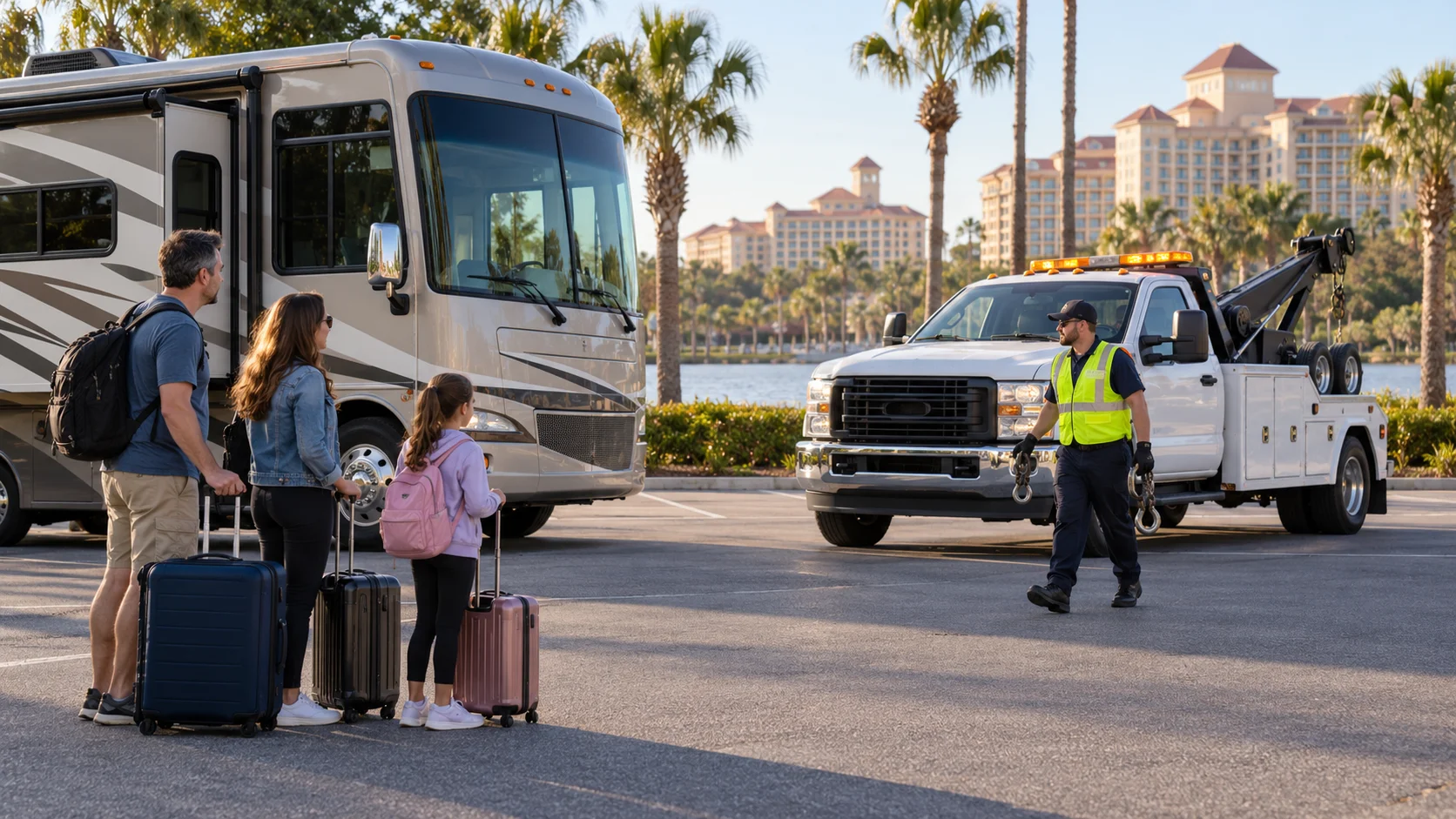
An RV breakdown near Lake Buena Vista can disrupt an entire travel day. Start by protecting everyone, then collect the details needed for the right operator and equipment.
RV towing in Lake Buena Vista takes more planning than a standard car tow. The operator needs the RV type, its condition, nearby access points, attached equipment, and an approved destination.
Protect passengers before checking the RV
Move passengers away from traffic before inspecting the RV. Keep children and pets together with a responsible adult. Don’t stand between the RV and moving vehicles.
If the RV stopped on I-4 or SR 535, remain aware of nearby traffic. Don’t step into a travel lane to examine a tire or hitch. Move to a safer position when that’s possible without driving a damaged vehicle farther.
Turn on the hazard lights if they still work. Make yourself visible, but don’t place people in traffic to guide other drivers. If there’s smoke, fire, leaking fuel, or an immediate danger, move everyone away and contact emergency services.
A resort parking area creates different concerns. The RV may be near buses, delivery vehicles, pedestrians, or parking entrances. Gather passengers somewhere clear of the recovery area. Don’t let anyone wait beside the wheels, hitch, or rear overhang.
Before requesting help, make a quick condition check from a safe place. Note whether the RV starts, steers, brakes, or rolls. Look for a flat tire, damaged wheel, hanging component, or fluid beneath the vehicle. Don’t crawl under it.
A roadside repair may be possible in some situations. Other failures require RV and trailer towing. Share what you can see without diagnosing the cause. “The right rear tire is flat” helps more than guessing that an axle failed.
If you’re unsure whether the RV should move, leave it parked. An operator can review the condition and discuss the next step.
Share the nearest road or resort access point
“Near Lake Buena Vista” covers too much ground for a useful pickup location. Give the road, travel direction, entrance, parking area, or visible access point.
On I-4, identify your direction of travel. Share the nearest exit or another location shown on your map. If you’re on SR 535, name the closest cross street or driveway. A dropped map pin can help confirm the position.
Inside a resort area, the street address may lead to the main entrance. Your RV could be several turns away. Describe the exact parking section, check-in lane, service drive, or building side where you stopped. Avoid relying only on a resort name.
Tell the request line about anything affecting entry. Examples include a gate, narrow turn, covered arrival lane, parking booth, low tree branches, or a crowded loading area. Don’t estimate clearances. Report posted measurements exactly when you can read them safely.
Ask resort staff where a recovery vehicle should enter. Don’t assume the guest entrance will work for a larger vehicle. Staff may also direct passengers to a safer waiting place. Any property-specific access rule should be confirmed with that property.
If the RV blocks an active lane or entrance, say so immediately. Also explain whether another vehicle can approach its front, rear, and driver’s side. Photos can document the surrounding space, but take them only from a safe position.
Drivers stopped on I-4 can review FL511 traffic and incident alerts. Don’t walk along the roadway to find a marker. Use your phone’s location tools and visible landmarks instead.
Exact access details prevent a second search after the operator reaches the general area.
Describe the RV and attached equipment
Start with the RV category. Tell the request line whether it’s a motorhome, travel trailer, fifth wheel, camper, or another configuration. If it’s towable, explain whether the tow vehicle is still attached.
Provide the make, model, and model year when available. Share the overall length and weight only from reliable records. The registration, manufacturer label, or owner’s manual may contain helpful specifications. Don’t guess.
For a motorhome, report the number of axles and visible wheel arrangement. Mention whether the steering wheels are straight. Explain if the transmission won’t shift, the parking brake won’t release, or the suspension appears lowered.
For a travel trailer, describe the hitch type and current connection. Say whether the tongue jack, stabilizers, safety chains, electrical cable, or breakaway cable are damaged. Don’t disconnect a trailer beside moving traffic.
Attached equipment can change the job. List anything mounted or connected to the RV, including:
- A second vehicle
- A tow dolly
- Bicycles or storage racks
- A rear cargo carrier
- A generator compartment
- Slide-outs that won’t retract
- Leveling equipment that won’t raise
- Loose awnings or exterior panels
Mention collision damage, blown tires, wheel damage, or parts touching the pavement. Also report whether the RV left the paved surface. A recovery from soft ground is different from moving a vehicle that rolls freely.
Some RVs may require an operator equipped for heavy-duty towing. The correct setup depends on the actual RV, its condition, and the available working space. Quick Tow Orlando connects travelers with independent towing and roadside operators. The pros in the network are licensed and insured.
For a broader preparation checklist, read what to do when your RV breaks down.
Plan for passengers, pets, and luggage
A tow operator may not be able to transport everyone traveling in the RV. Confirm passenger arrangements before the vehicle leaves. Don’t assume adults, children, pets, and luggage can ride with the operator.
Count every traveler. Include infants and anyone who needs mobility assistance. Tell the request line if a wheelchair, medical device, child seat, or other essential item is aboard.
Choose one adult to manage the tow details. Another adult can supervise children, pets, and bags. This keeps the recovery area clearer and reduces missed information.
Separate what travelers need immediately. Gather identification, medications, phones, chargers, wallets, travel documents, keys, and weather-appropriate clothing. Keep these items with the passengers.
Don’t empty the entire RV beside the roadway. Focus on personal necessities and anything required at the next stop. Secure loose objects that will remain inside, but enter the RV only when it’s safe.
Pets need a separate plan. Use their normal leash, harness, or carrier. Keep them away from traffic and recovery equipment. Confirm that the passenger vehicle or lodging option will accept them. Don’t leave a pet inside an unoccupied RV without confirming the plan.
If you’re traveling with another vehicle, decide whether it can carry the group and luggage. If it’s attached to the RV, tell the operator before disconnecting anything. The operator may need to inspect the setup first.
Tourists may also be managing tickets, lodging, or a rental vehicle. The same passenger-first planning applies during a rental-car breakdown near Orlando theme parks.
Before departure, check the seating area, exterior compartments, and ground around the RV. Make sure essential belongings haven’t been left in the parking area.
Choose a destination that can receive the vehicle
Don’t send an RV toward a destination until that location agrees to receive it. A repair shop may handle certain vehicles but not your RV type, size, damage, or drivetrain.
Call the destination directly. Describe the RV using the same details given to the request line. Explain whether it runs, rolls, steers, or has collision damage. Mention any trailer, tow vehicle, or attached equipment.
Ask whether the destination can accept the RV today. Confirm the correct entrance and where the operator should leave it. If the business will be closed, ask whether it permits after-hours delivery. Get instructions from that business rather than assuming.
A resort parking area isn’t automatically an appropriate tow destination. Confirm permission with the property. Ask where a disabled RV may be placed and whether someone must meet the operator. Quick Tow Orlando can’t confirm a resort’s current rules for that property.
The nearest automotive shop may not work on motorhomes or trailers. A tire business may not handle the affected wheel or vehicle configuration. A storage location may not accept a disabled RV. Ask specific questions before choosing.
Share the confirmed destination name and address with the request line. Also provide the receiving contact and any entrance instructions. Check that the destination address matches the correct branch.
If no destination is ready, say so. The operator may discuss available choices, but the receiving business still needs to approve the vehicle. Don’t let schedule pressure turn an uncertain destination into another stranded stop.
Keep the RV keys and destination information accessible. If someone else will meet the operator, share that person’s name. Clear handoff details matter when passengers leave separately.
When to call us
Call when the RV can’t safely continue, roadside repair isn’t appropriate, or its size and condition require planned recovery. Quick Tow Orlando takes calls 24/7 and connects travelers with local towing and roadside operators.
Call us at (321) 321-9797.