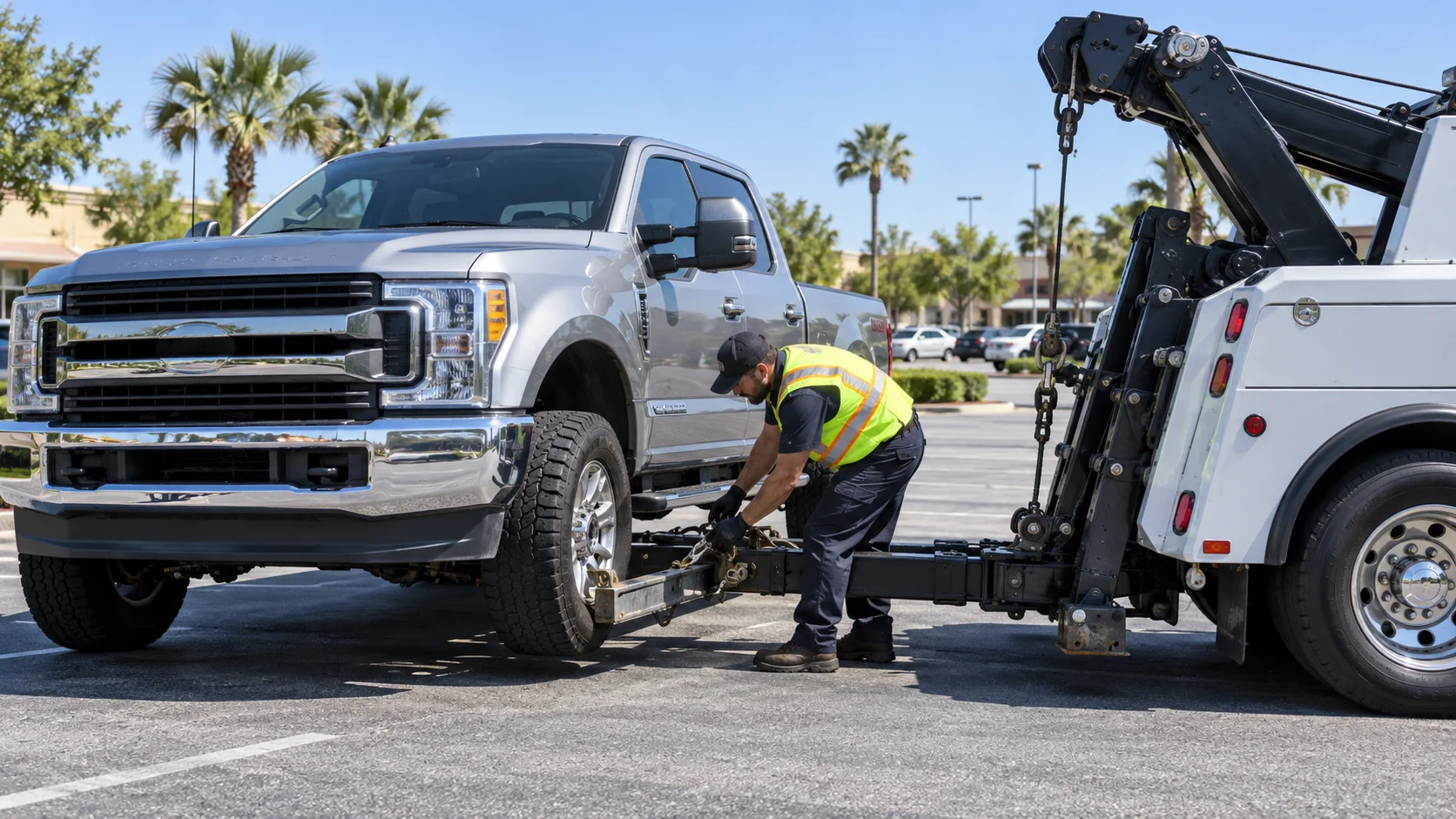
A regular tow truck may or may not suit a large pickup. The “1 1/2-ton” label alone doesn’t settle that decision. If you’re searching for a 1 1/2 ton tow near me, share the truck’s exact configuration before an operator is sent.
That matters across Orlando, from an I-4 shoulder to a Lake Nona jobsite. Cargo, attachments, damage, and access can change the required towing setup.
Identify the pickup without guessing its weight
Start with information you can read directly from the pickup. Give the year, manufacturer, model, cab style, and bed length. Tell the call taker whether it has single or dual rear wheels. Also mention whether it uses two-wheel, four-wheel, or all-wheel drive, if known.
Don’t estimate the pickup’s weight from its badge or informal class. A “1 1/2-ton” description doesn’t identify every part of its configuration. It also doesn’t show what has been added since the truck left the factory.
The vehicle identification number can help when trim details aren’t clear. You may also find useful specifications on the door-area label. Read the information as printed. Don’t calculate a loaded weight or guess what an abbreviation means.
Photos can prevent confusion. Take one from each corner when it’s safe. Include the cab, bed, rear wheels, and any visible attachments. A close photo of the vehicle label may also help. Keep plate characters and personal information out of images shared unnecessarily.
For a modified pickup, list changes you can see. Examples include a service body, lift components, oversized tires, utility compartments, or a replacement bed. Don’t claim a modification changed the truck’s weight by a certain amount. The operator can review the configuration without relying on an unsupported figure.
A dually needs its own details too. Our guide to towing a dually pickup explains why rear-wheel configuration deserves attention. Quick Tow Orlando connects callers with independent operators serving the Orlando Metro. The operators in this network are licensed and insured.
Describe cargo and attached equipment
Tell the call taker what’s in the cab, bed, and exterior compartments. A pickup that looks empty from one side may carry tools, materials, tanks, or machinery elsewhere. Describe the contents plainly without estimating their combined weight.
If you have shipping documents or equipment specifications, keep them available. Those records are more useful than a visual guess. Tell the operator when no reliable cargo weight can be confirmed. The operator can then decide what additional information is needed.
Report everything attached to the pickup. That includes a trailer, fifth-wheel connection, gooseneck equipment, ladder rack, crane, plow, generator, toolbox, or mounted service unit. Say whether an attachment can be removed. Don’t disconnect heavy equipment beside traffic unless a qualified person directs the work.
A trailer creates a separate question. Give its type, cargo, wheel condition, and current angle. Say whether the pickup and trailer remain aligned. The operator may need to plan for both units instead of treating them as one ordinary tow.
The same configuration-first approach applies to commercial vehicles. Our article about a loaded box truck needing heavy-duty towing shows why visible size tells only part of the story.
Remove loose personal items only when you can do so safely. Secure nothing by climbing beneath the pickup or entering an exposed traffic lane. On I-4, SR 408, SR 417, SR 429, or Florida’s Turnpike, your location and traffic exposure should be part of the initial call. You can also review FL511 traffic and incident alerts before choosing a safer approach.
Share wheel damage and current road position
Explain what happened and what the pickup does now. Does it start? Can it roll? Does the steering respond? Is the transmission stuck in park? Give observations, not a diagnosis.
Report every visibly damaged wheel or tire. Mention a wheel leaning at an unusual angle, a tire separated from its rim, or parts touching the pavement. Tell the operator about leaking fluid, hanging components, collision damage, or a suspected axle problem. Don’t crawl under the pickup to inspect it.
The road position matters just as much as the damage. Say whether the truck is:
- Fully inside a parking space
- On a paved shoulder
- Blocking a travel lane
- Facing into traffic
- Down an embankment
- Stuck in mud, sand, or soft ground
- Pressed against a curb, barrier, or another vehicle
Share the direction of travel and the nearest safe landmark. On divided roads, specify the correct side. “Westbound SR 408 near an exit” is more helpful than a nearby business located across the highway.
Turn on the hazard lights if they work. Stay away from moving traffic. Florida’s Move Over Law covers tow trucks displaying amber lights. On multilane roads, approaching drivers must vacate the nearest lane when safely possible. On two-lane roads, specific speed reductions apply.
A pickup resting off pavement or damaged after a collision may require more than transport. Review accident recovery and winch-out service when the vehicle must first be repositioned. The operator will still need the pickup’s configuration and exact resting position.
Check access at pickup and delivery
A suitable towing vehicle still needs enough working space. Describe both the pickup location and the destination before the operator heads out. A wide commercial lot near International Drive presents a different access problem than a Winter Park parking structure.
At the pickup point, mention gates, height restrictions, narrow turns, low branches, loading docks, soft shoulders, and parked vehicles. Say whether an entry gate needs a code or property approval. If the truck is underground, identify the level and exit route. Don’t assume every towing setup can enter a confined garage.
Measure nothing from an active lane. If a posted clearance sign is visible from a safe position, read it exactly. Don’t estimate overhead clearance from memory. Photos of the entrance, turns, and disabled pickup can help the operator assess the route.
Jobsite access needs similar detail. Tell the call taker about dirt approaches, standing water, loose ground, construction barriers, or locked entrances. Orlando-area rain can change the pickup location between scheduling and arrival. Report current conditions instead of describing what the site usually looks like.
Confirm that the delivery location will accept the pickup. Provide the business name, street address, entrance, and after-hours instructions you received from that location. Quick Tow Orlando can’t confirm another facility’s access rules or availability. Contact the destination directly when those details remain unclear.
Also check whether the disabled pickup can be placed where repairs or unloading may occur. A tight residential driveway in Kissimmee may leave little room for positioning. A Sanford fleet yard may use a separate entrance for large vehicles. Clear instructions reduce avoidable changes at the delivery point.
Let the operator select the towing setup
Don’t request a specific towing method based only on what worked for another pickup. A wheel-lift, carrier, or heavier towing unit may each fit different circumstances. The operator should make that selection after reviewing the vehicle, cargo, damage, and access.
When you call, give the details in a simple order:
- Exact pickup location and road position
- Year, manufacturer, model, and visible configuration
- Single or dual rear wheels
- Cargo and permanently mounted equipment
- Trailer or other attached equipment
- Wheel, axle, steering, or collision damage
- Pickup and destination access limits
Mention any detail that remains unknown. “Cargo weight isn’t confirmed” is better than an invented number. If the condition changes, report it. A truck that starts rolling, sinks farther into soft ground, or begins leaking fluid may require a revised plan.
Ask what information the operator still needs. You can also ask how the pickup should be prepared and whether loose cargo must be removed. The full price depends on the actual job and should be confirmed with the operator before the truck rolls. Quick Tow Orlando doesn’t publish a rate card.
Our heavy-duty towing service covers requests involving large pickups and commercial vehicles across the Orlando Metro. Quick Tow Orlando takes calls 24/7 and passes the job details to a local operator. That operator evaluates the requested move and selects the towing setup.
Stay focused on configuration, not the informal ton label. Good information helps the operator plan for the pickup that’s actually disabled.
When to call us
Call when a large pickup won’t move safely, has wheel damage, carries cargo, or sits in a difficult position. Don’t attempt an improvised tow when the vehicle’s condition or required setup remains unclear. Call us at (321) 321-9797.