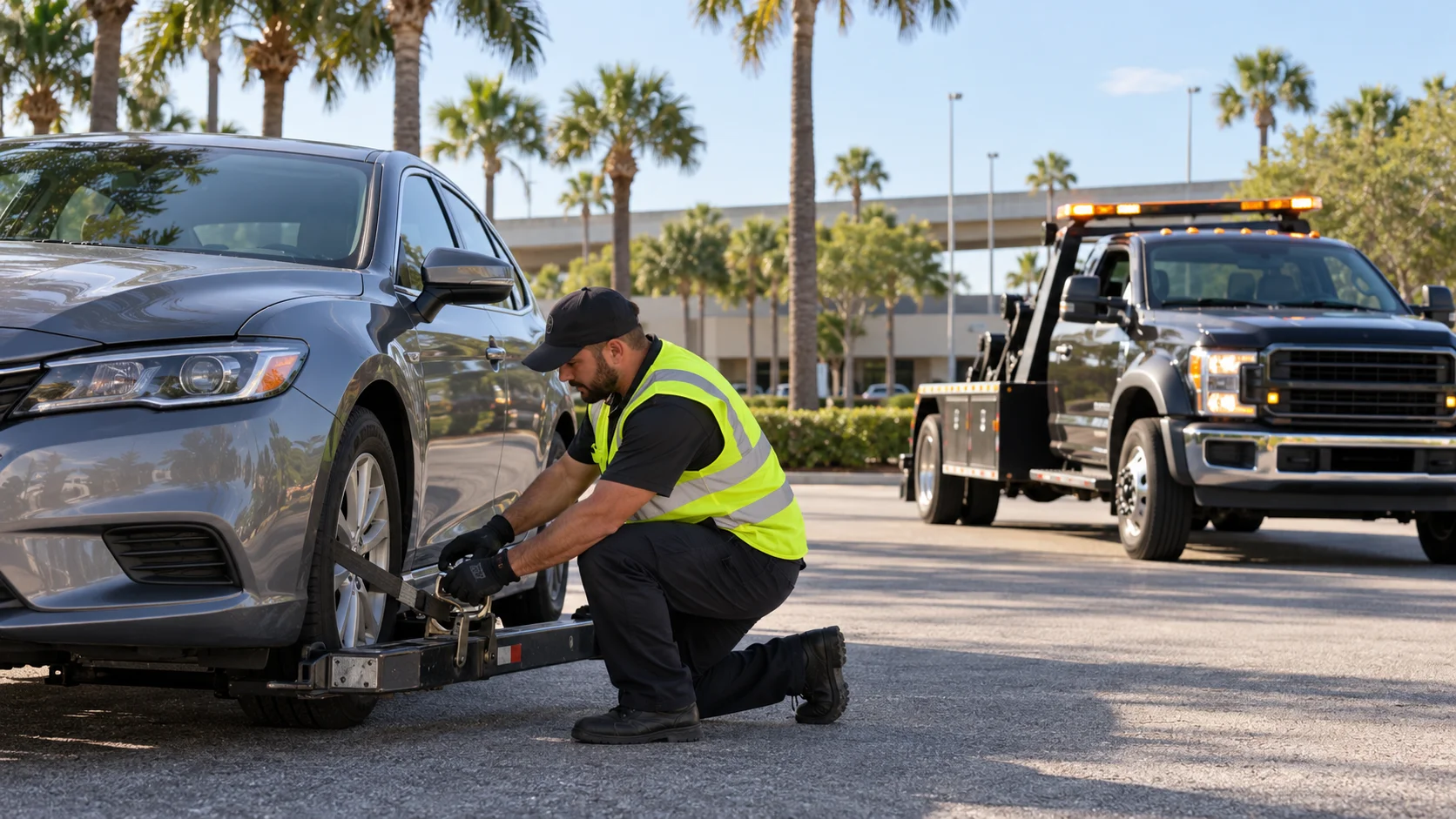
A car breakdown near I-4 or SR 436 needs two decisions first. Get away from moving traffic, then identify exactly where the car stopped. Once the scene is safer, you can decide between roadside help and a tow.
Get clear of traffic before checking the car
Your first task isn’t finding the mechanical problem. It’s reducing your exposure to traffic.
If the car still moves normally, look for a safe paved area. That might be a parking lot, office entrance, or another space away from travel lanes. Don’t force the car farther if steering, braking, or wheel movement feels wrong.
Turn on the hazard lights. Florida’s Move Over law covers disabled vehicles displaying hazard lights. Drivers on multilane roads must leave the closest lane when safely possible. Different speed rules apply on two-lane roads.
A shoulder isn’t the right place for a detailed inspection. Don’t stand beside the traffic-facing side of the car. Avoid opening the hood if that places you near a live lane.
Stay belted inside if leaving the vehicle would expose you to traffic. If there’s smoke, fire, leaking fuel, or another immediate danger, move away without crossing active lanes. Contact emergency services when the scene presents an immediate threat.
Tell passengers what you’re doing before anyone opens a door. Keep children and pets contained. Gather only what you’ll need, such as your phone, keys, and identification.
A breakdown inside a shopping or office area may feel less urgent. Moving vehicles still create risk there. Choose a visible paved spot that doesn’t block an entrance, fire lane, or loading area. Once everyone is clear, request emergency towing if the car can’t continue safely.
Share your direction and nearest I-4 or SR 436 marker
“Near I-4 in Altamonte Springs” covers too much ground for an operator. The useful details are direction, road, nearest ramp, and where the car sits.
Start with the road and travel direction. Say whether you were traveling east or west on SR 436. If you stopped on I-4, provide your direction before mentioning a nearby exit. Don’t rely only on where you intended to go.
Next, describe the car’s position. It may be on the right shoulder, beside a ramp, or inside a nearby parking area. If you reached a shopping or office property, provide the business name shown on your map. Add the entrance or side of the property when possible.
A phone map pin can help, but send context with it. GPS may place the marker on the wrong side of I-4 or SR 436. A useful message might say, “The pin is close, but I’m in the paved lot east of the ramp.”
Look for details the approaching operator can recognize safely:
- Your direction of travel
- The nearest I-4 ramp or SR 436 intersection
- The parking lot entrance you used
- Your vehicle’s color, make, and model
- Whether the hazards are flashing
- Any gate, garage, or height restriction
You can also review live traffic and incident alerts from FL511. Don’t walk along the road searching for a marker. Use your map, visible surroundings, and the route you just traveled.
Our broader I-4 breakdown guide covers situations where the car remains on the interstate.
Decide whether roadside help can solve the problem
The safest service depends on what happened and where the car stopped. You don’t need to diagnose the failure beside the road.
Describe the symptom without guessing at the cause. Useful descriptions include “the engine turns but won’t start,” “one tire is flat,” or “the key is locked inside.” Also mention warning lights, unusual sounds, smoke, smells, or fluid beneath the car.
Some situations may fit roadside assistance. Examples include a possible dead battery, a lockout, an empty fuel tank, or a flat tire with a usable spare. The operator still needs the full situation before deciding what service is appropriate.
A tow is usually the better request when the car can’t move safely. The same applies when the problem involves steering, brakes, damaged wheels, collision damage, or repeated stalling. Don’t restart or drive the car merely to test whether it can reach the next parking lot.
Location also affects the choice. A simple roadside task may be unsafe beside active I-4 traffic. Tell the call line if the vehicle is on a narrow shoulder, ramp, travel lane, or exposed roadside area. The operator can evaluate the access information before accepting the job.
FDOT publishes current information about its Road Rangers program. Check that official page for program details and current contact instructions.
Quick Tow Orlando connects drivers with independent towing and roadside operators. The request line takes calls 24/7. Your vehicle details and location help match the request with an appropriate local operator, but they don’t replace an on-scene assessment.
If you’re comparing help outside standard business hours, our guide to 24-hour towing in Orlando explains what information to prepare.
Describe how the car rolls, steers, and brakes
The operator needs more than the car’s make and model. Explain whether it can roll, steer, and brake.
Start with its current position. Is it facing forward in a parking space? Is it angled against a curb? Is the front or rear blocked by another vehicle, wall, landscaping, or traffic? Mention tight turns, parking structures, gates, and low overhead clearance.
Then describe how the car behaves:
- Does it shift into neutral?
- Does the steering wheel turn?
- Does the brake pedal respond normally?
- Are any wheels locked, bent, or pointing differently?
- Is a tire flat or separated from the wheel?
- Is the parking brake stuck?
- Are the keys available?
Answer only what you can confirm safely. Don’t crawl beneath the car or stand in traffic to inspect a wheel. “I can’t safely check” is useful information.
The operator also needs to know the vehicle type. Identify whether it’s a sedan, pickup, SUV, motorcycle, van, or another vehicle. Mention all-wheel drive, very low clearance, modifications, or an electric or hybrid drivetrain if known. These details can affect the equipment selected for the job.
If the car stopped after an impact, say so clearly. Mention visible body damage, deployed airbags, or fluid on the pavement. Don’t attempt to pull loose parts away from moving traffic.
Also report anything affecting access. A car parked nose-first against a curb presents a different setup from one beside an open drive aisle. A locked steering wheel or missing key matters even when the car appears undamaged.
Clear descriptions prevent avoidable surprises. They also let the operator determine whether the requested movement fits the equipment available. The driver who arrives will still inspect the vehicle before loading or moving it.
Choose an Altamonte Springs destination that can receive it
Pick the destination before the operator begins moving the car. A complete address is better than “the nearest shop.”
You might choose a repair facility, dealership, home, or another lawful parking location. The right choice depends on who can accept the vehicle and what happens after it arrives. Quick Tow Orlando doesn’t diagnose the car or select a repair business for you.
Call the destination first when possible. Confirm that it can receive the vehicle, especially outside its normal business hours. Ask where a disabled car should be placed and whether someone must meet the operator. Don’t assume a locked lot accepts unattended drop-offs.
Share these details with the call line:
- Destination name and full address
- Correct entrance or service drive
- Contact name, if someone is meeting the car
- Instructions provided by the destination
- Whether you’ll ride separately
- Whether the vehicle has keys
If you haven’t chosen a destination, say that early. You can discuss the situation before the operator accepts the request. Don’t direct the car to an unfamiliar shopping center or office property without permission. Private lots may restrict parking or vehicle storage.
Think about access at both ends. A steep driveway, narrow gate, underground garage, or crowded service lane can affect the move. Mention those conditions before the truck rolls.
Remove essential personal items when it’s safe. Keep your identification, medication, work equipment, and house keys with you. Don’t delay beside traffic to empty the entire vehicle.
Finally, confirm the destination aloud. Altamonte Springs sits among several Orlando Metro routes and communities, so a business name alone may cause confusion. A full address and entrance description give the operator a clear endpoint.
When to call us
Call when the car can’t continue safely, roadside help may be needed, or the vehicle requires transport from I-4, SR 436, or an Altamonte Springs parking area. Quick Tow Orlando connects your request with an independent local operator. Call us at (321) 321-9797.