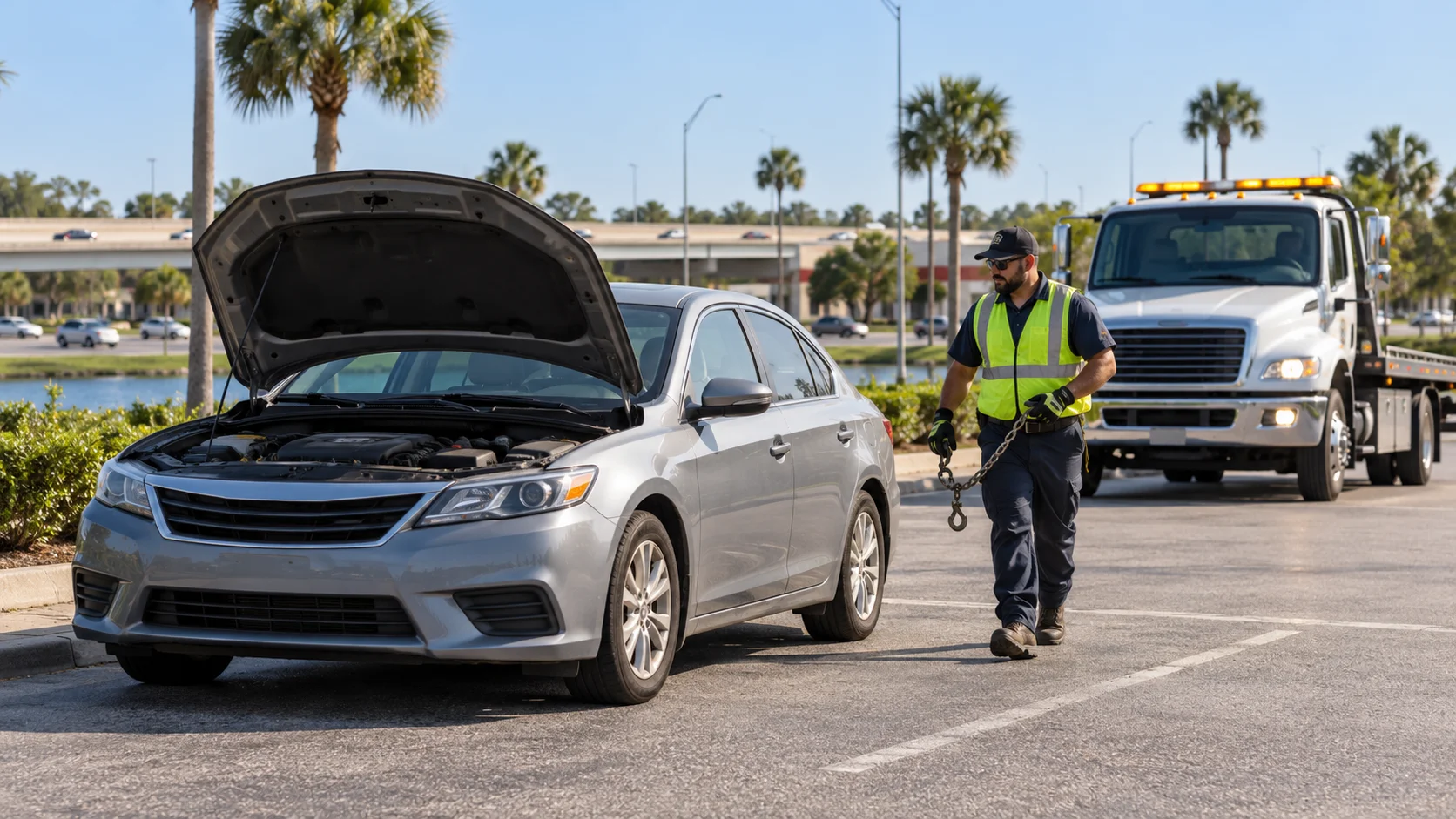
A breakdown around Sanford can turn stressful within seconds. Your first decisions are simple: get away from moving traffic, identify your location, and decide whether the car needs roadside help or a tow.
A car breakdown near I-4, US 17-92, SR 46, or downtown Sanford requires clear location details. Quick Tow Orlando can take your details and connect you with an independent local operator.
Get clear of traffic before checking the car
Your safety comes before finding the mechanical problem. If the car still moves, look for a safe paved area away from active lanes. Don’t stop suddenly to inspect a warning light when the car can reach a safer position.
Turn on the hazard lights. Set the parking brake after stopping. Before opening a door, check the traffic beside the car. Passing vehicles may be much closer than they appear.
A shoulder isn’t a repair area. Don’t stand beside the car or work near an active lane. Avoid stepping into traffic to photograph damage, examine a tire, or wave down another driver. Keep children and pets controlled and away from the roadway.
Whether you should remain inside depends on the scene. Consider traffic, smoke, fire, leaking fluid, vehicle stability, and nearby barriers. If staying inside appears safer, keep your seat belt fastened. If the car presents an immediate danger, move everyone to a safer location and call 911.
Florida’s Move Over Law covers disabled vehicles displaying hazard lights. On highways with multiple lanes in the same direction, approaching drivers must leave the nearest lane when they can do so safely. That legal protection doesn’t make the shoulder risk-free.
Don’t attempt to push the car beside I-4. Don’t crawl underneath it. If the vehicle is partly blocking a travel lane, tell emergency services and the towing operator immediately. For more highway-specific guidance, read what to do after breaking down on I-4.
Share your direction and nearest I-4 or US 17-92 marker
“Near Sanford” isn’t enough for an operator to find you. Sanford covers several different roadway settings. A driver near I-4 needs different directions than someone parked near downtown Sanford.
Start with the road name and direction of travel. Say whether you were traveling east, west, north, or south. If you recently left I-4, explain which road you entered. Mention SR 46, US 17-92, or downtown Sanford only when it helps narrow the location.
Next, share the nearest visible marker. Useful details include:
- An exit or mile marker
- A cross street
- A business name visible from your location
- A parking-lot entrance
- A bridge, ramp, or overpass
- Your phone’s map pin or coordinates
Read road signs exactly as they appear. Don’t guess at an exit number or travel direction. If you aren’t sure, say that. A shared map pin may be more useful than an uncertain description.
Also explain where the car sits relative to traffic. Say “right shoulder,” “parking lot,” “ramp,” or “partly in a lane.” Note any gate, median, low clearance, narrow entrance, or locked parking area. These details help the operator understand the pickup point.
Your phone’s map may place the pin on I-4 even when you’re on a nearby frontage road or ramp. Zoom in and compare the pin with your surroundings. If the map and signs disagree, share both details.
Keep your phone available after requesting help. Conditions can change, and the operator may need a safer meeting point. The Quick Tow Orlando request line is open 24/7 for drivers across the Orlando Metro.
Decide whether roadside help can solve it
Some breakdowns may be handled where the car stopped. Others require transport. You don’t need to diagnose the failure yourself. Describe what happened and let the operator assess the service request.
Start with the car’s immediate condition. Does the engine start? Are the lights working? Is one tire visibly flat? Did the car run out of fuel? Are the keys locked inside? Those observations help separate roadside assistance from a towing request.
Roadside help may fit a straightforward jump-start, lockout, fuel delivery, or spare-tire change. The scene must also allow the work to happen safely. A service that’s practical in a downtown Sanford parking space may not be appropriate beside moving I-4 traffic.
Request towing when the car can’t be handled safely where it sits. Towing may also make sense when there’s collision damage, steering trouble, brake trouble, more than one damaged tire, or uncertainty about the vehicle’s condition. Smoke, strong fuel odors, leaking fluid, or severe damage call for extra caution. Don’t restart the car merely to test it.
Tell the operator what you saw, heard, and felt before stopping. Avoid declaring that the battery, alternator, transmission, or fuel pump failed. Similar symptoms can have different causes.
If you’re unsure, explain that too. Quick Tow Orlando can pass the details to an independent operator who can discuss the suitable response. Our emergency towing service page explains how to request transport when roadside help isn’t enough.
Describe how the car rolls, steers, and brakes
The operator needs more than the vehicle’s make and model. How the car moves determines how it can be loaded and transported.
Say whether the car rolls freely. Mention if it’s stuck in park, a wheel won’t turn, or a tire has separated from the rim. Don’t force the shifter or drag the car into a different position.
Describe the steering next. Is the steering wheel locked? Are the front wheels turned sharply? Did steering become difficult before you stopped? These aren’t requests for a diagnosis. They’re practical details about moving the vehicle.
Brake information also matters. Tell the operator if the brake pedal felt unusual or the parking brake won’t release. If collision damage reaches a wheel, axle area, or suspension, describe what you can see from a safe position. Don’t reach behind a wheel or touch hot components.
Share these additional details:
- Vehicle year, make, and model
- Two-wheel drive, all-wheel drive, or four-wheel drive, if known
- Electric, hybrid, or gasoline power, if known
- Approximate parking-garage clearance, if applicable
- Missing keys or an unavailable key fob
- Added cargo, racks, or a trailer
- Visible body panels touching a tire
Accuracy matters more than technical language. “The rear wheel points inward” is more useful than naming a broken part without confirmation.
Take photos only from a safe location. A wide image can show how the car sits, while a closer image may show wheel damage. Don’t enter an active lane for a better angle.
Tell the operator if another vehicle, barrier, curb, or ditch limits access. Clear details reduce surprises when the driver reaches your Sanford location.
Choose a Sanford destination that can receive it
A tow request needs a destination, not just a pickup point. Decide where the car should go before the operator begins transport whenever possible.
A repair shop may be the right choice when it can accept the vehicle. Call the shop first. Confirm that it handles your vehicle type and current problem. Ask whether it can receive a disabled car at the expected time.
Don’t assume a closed business has an approved after-hours drop area. A locked gate can leave the operator without a safe place to unload. Ask the shop where the car should be placed and how the keys should be handled. Get the business name and full street address.
If your preferred shop can’t receive the vehicle, choose another confirmed destination. That might be a different repair facility or another location where the car may be parked legally. Make sure you have permission from the property owner.
Think about the destination’s access. Mention parking garages, gates, loading zones, narrow driveways, or restricted entrances. A downtown Sanford destination may present different access needs than a larger commercial property near I-4, SR 46, or US 17-92.
Keep personal items, medication, child seats, work equipment, and documents in mind. Retrieve what you need when it’s safe and lawful to do so. Don’t delay the move by searching through the car beside traffic.
Ask the operator to confirm the destination and full price before the truck rolls. Quick Tow Orlando doesn’t publish a rate card, and the final charge depends on the actual job. If the breakdown happens outside normal business hours, our guide to requesting 24-hour towing in Orlando can help you prepare.
When to call us
Call when your car can’t leave the Sanford roadway safely, roadside help won’t solve the problem, or you need an operator to assess transport needs. Quick Tow Orlando takes calls 24/7 and connects drivers with independent towing and roadside operators serving the Orlando Metro. Call us at (321) 321-9797.