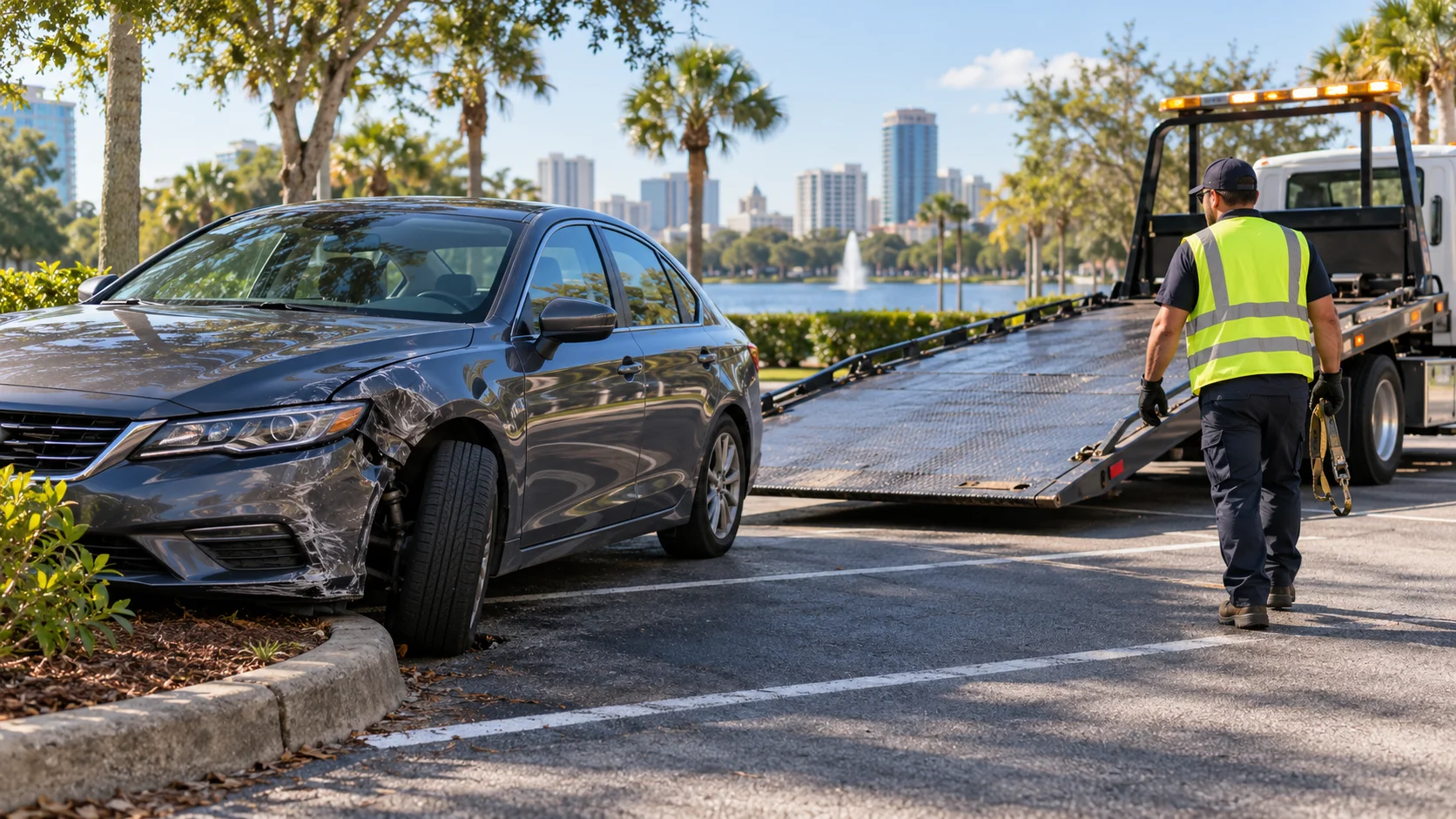
Your car clipped a curb, median, or parking barrier. Now a wheel looks wrong, and the car won’t roll normally. Stop trying to move it, get clear of traffic, and arrange a tow based on the vehicle’s visible condition and location.
A car that can’t roll needs more planning than a routine breakdown. The operator needs clear details before choosing a loading approach. You don’t need to identify the broken part yourself.
Stop trying to move the vehicle
Don’t keep pressing the accelerator when the car resists movement. Don’t force the steering wheel or repeatedly shift between drive and reverse. Continued attempts could change the vehicle’s position or make the scene harder to manage.
A wheel may be turned sharply, pushed against the body, or sitting at an unusual angle. The car might also drag, scrape, or stop after moving only slightly. Those observations matter, but they don’t confirm which component failed. Leave the diagnosis to a repair shop.
Turn off the engine once the car is stable. Set the parking brake if doing so doesn’t require leaving a safe position. Keep the keys with you and avoid crawling beneath the vehicle. Damage below the car can’t be assessed safely from the roadside.
If the impact happened in an Orlando parking lot, leave the car where it stopped unless someone with the right equipment moves it. The same applies after hitting a median near International Drive or a curb along a neighborhood street. A more convenient parking space isn’t worth another movement attempt.
Tell the towing contact that you need to tow a car that won’t roll. That phrase separates the request from a normal flat tire or no-start call. If the vehicle also left the pavement or became lodged against an object, accident recovery and winch-out service may be the relevant starting point.
The goal isn’t to prove what’s broken. It’s to preserve the current condition and give the referred operator an accurate picture.
Get yourself clear of traffic
Your first concern is where you and your passengers are standing. A disabled car beside moving traffic creates a different scene than one stopped inside a quiet parking area.
If you can exit away from traffic, move to a protected location. Keep children, passengers, and pets together. Don’t stand between the damaged car and an approaching vehicle. Avoid waiting beside the wheel that took the impact.
On roads such as I-4, SR 408, SR 417, SR 429, or the Turnpike, traffic may pass close to the stopped car. Don’t step into a travel lane to inspect damage or take photos. If the vehicle blocks traffic or anyone may be injured, contact emergency services. Follow instructions from responding law enforcement or road personnel.
Use the hazard lights if they’re working. At night, stay where you’re visible without entering the roadway. Don’t place yourself in traffic to wave vehicles around the car. The safest observation point may be well away from it.
A curb strike in Winter Park, Lake Nona, Kissimmee, or downtown Orlando can also leave the car partly inside a driveway or intersection. Tell the towing contact exactly where the vehicle rests. Mention whether any portion remains in a traffic lane, bike lane, driveway, or pedestrian route.
For a broader look at how collision scenes differ from routine breakdowns, read our guide to accident recovery towing in Orlando. It explains why the vehicle’s position and surroundings matter before recovery begins.
Once you’re clear, stay available by phone. The operator may need a better description of access before approaching the vehicle.
Describe the wheel position and visible damage
Give facts you can see without touching or moving the car. Start with which corner struck the curb. Say front or rear, then driver side or passenger side. If you aren’t certain, describe where the visible damage appears.
Useful observations include:
- The wheel points in a different direction from the others.
- The tire is pressed against the wheel opening.
- The wheel sits farther inward or outward than expected.
- The tire appears flat, torn, or separated from the rim.
- A panel or plastic liner touches the tire.
- Fluid or loose material is visible beneath the car.
- The vehicle rests against a curb, median, or parking barrier.
- The body sits noticeably lower at one corner.
These details help describe the condition. They don’t establish whether the problem involves the tire, wheel, steering, suspension, axle, or another part. Don’t label the failure unless a qualified repair facility has already inspected it.
Take photos from a safe standing position. Capture the whole vehicle, the damaged corner, and the space around it. Include nearby obstacles without stepping into traffic. A short video may also show the car’s position, but don’t ask anyone to operate the vehicle for the recording.
Tell the towing contact whether the steering wheel turns and whether the transmission selector moves normally. Report only what you’ve already observed from the driver’s seat. Don’t restart the engine or test the vehicle just to gather more information.
This situation differs from a confirmed component failure. Our article about how to tow a car with a broken axle covers cases where that condition is already known. After a curb impact, visible facts are more useful than roadside guesses.
Also mention loose bodywork, broken glass, or deployed airbags. That information helps the referred operator prepare for the scene without turning your description into a diagnosis.
Share the pickup surface and access
The damaged wheel is only part of the towing request. The operator also needs to know where the car sits and how it can be approached.
Describe the pickup surface first. It might be asphalt, concrete, gravel, grass, sand, or a sloped driveway. Say whether the ground appears level, soft, wet, or uneven. Orlando rain can change a shoulder or grassy edge quickly, so describe current conditions rather than how the area usually looks.
Next, explain the access route. Mention gates, parking arms, low garage ceilings, narrow drive aisles, tight turns, or parked cars surrounding the vehicle. If you’re inside an apartment complex, shopping center, hotel garage, or secured lot, say how the operator can enter. Arrange any permission needed from property staff before the vehicle is collected.
Give the vehicle’s position relative to solid objects. For example, say the front bumper faces a wall, the passenger side rests near a curb, or the rear is blocked by another car. Note whether there is open space in front, behind, or beside it. Don’t estimate measurements if you haven’t confirmed them. Photos can show the available room more clearly.
Share the vehicle’s year, make, model, and drivetrain if you know them. Also report whether you have the keys and whether the parking brake can be released normally. If you don’t know something, say so. An honest unknown is more useful than a guess.
A car with a wheel that doesn’t roll normally may require a different loading plan from an ordinary roadside pickup. Flatbed towing may be considered when the vehicle’s condition calls for keeping its wheels off the road. The referred operator should choose the method after reviewing the car, access, and destination.
Choose a destination that can inspect the car
Decide where the car should go before collection when possible. A curb impact needs inspection, not just a parking spot. Choose a repair facility that can evaluate the vehicle’s visible damage and the reason it won’t roll.
Call the destination before arranging the tow. Confirm that it accepts the vehicle, can receive it at the expected time, and has instructions for after-hours drop-off if needed. Those details can change, so get them directly from the facility.
Ask where a disabled vehicle should be placed. Some locations use a marked drop area. Others require contact before a car can be left. Don’t assume the entrance, gate, or service lane will remain accessible.
If insurance or a rental company is involved, ask whether it requires a specific destination or authorization process. Keep any claim information available, but don’t delay moving from a dangerous scene while sorting out routine paperwork. Safety directions from responding authorities take priority at the roadside.
Provide the exact destination name and address to the towing contact. If several locations share a business name, confirm the correct Orlando-area branch. A shop in Sanford isn’t interchangeable with one near Lake Nona, even when both use the same branding.
Remove essential belongings when it’s safe and permitted. Take your keys, identification, medication, work items, and anything needed that day. Don’t climb into an unstable vehicle or enter a traffic-facing side to retrieve something.
Quick Tow Orlando connects drivers with independent towing and roadside operators across the Orlando Metro. The request line takes calls 24/7. The details you provide help the local operator assess the pickup, loading conditions, and destination before handling the vehicle.
When to call us
Call when your car hit a curb and no longer rolls normally. This isn’t a good situation for improvised movement or roadside diagnosis. Quick Tow Orlando can connect you with a local operator for the damaged vehicle and its location. Call us at (321) 321-9797.