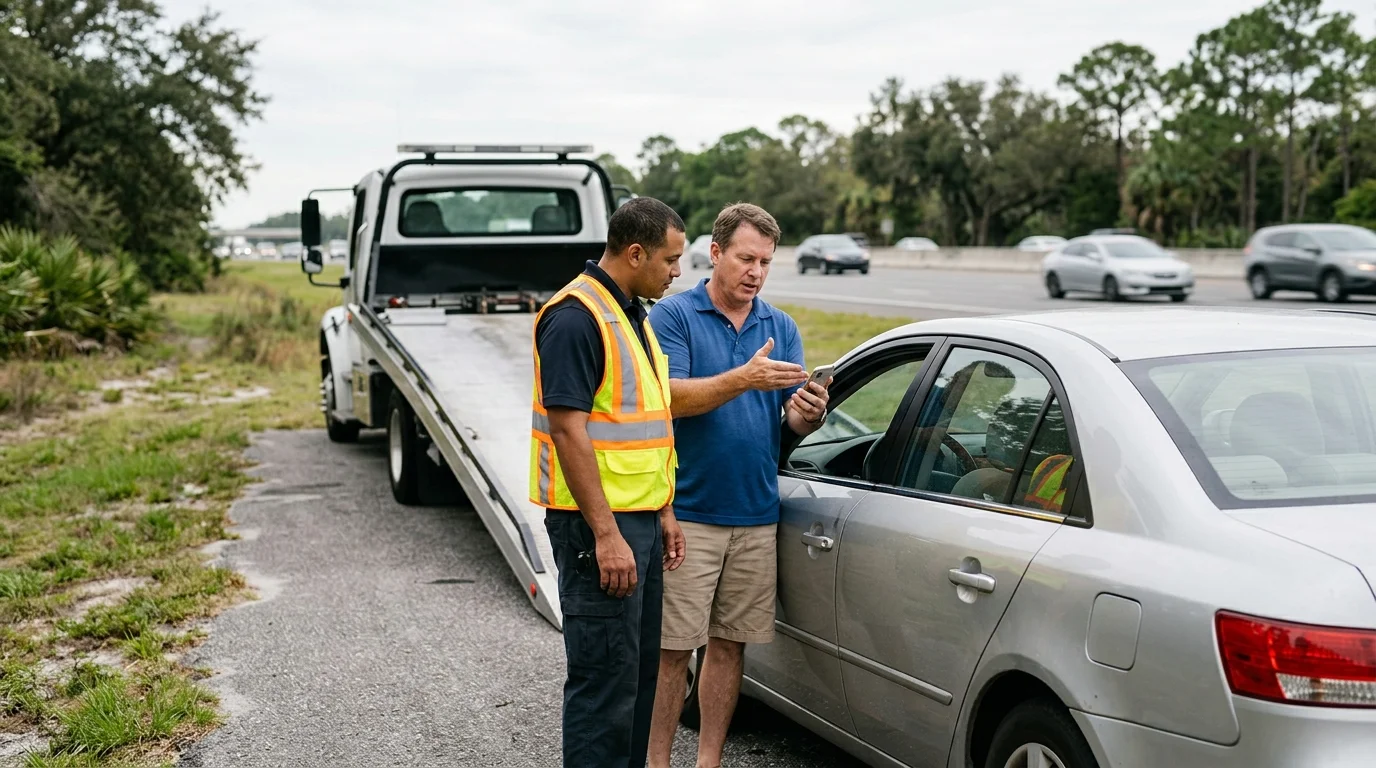
Cheap towing in Orlando starts with comparing the same complete job. A low opening figure means little when important details remain unanswered. Before choosing an operator, confirm the vehicle, route, service, and payment terms in writing.
That comparison matters when you’re stranded near I-4, SR 408, or International Drive. Stress can make the first available option sound like the only option. A short, specific conversation helps you compare offers without delaying the decision unnecessarily.
Start with the full scope of the tow
Give every operator the same job description. Otherwise, you may be comparing different services instead of different quotes. Start with the vehicle’s year, make, model, and current location.
Describe what happened without diagnosing the problem yourself. Say whether the engine starts, the wheels roll, and the steering works. Mention collision damage, a missing key, a locked transmission, or a flat tire. Tell the operator if the vehicle sits in mud, a garage, or a tight parking space.
Next, state where the vehicle needs to go. A repair shop in Winter Park creates a different route than a home in Lake Nona. Don’t settle for phrases such as “near downtown.” Give the exact pickup and destination addresses when you have them.
Ask what service the quote covers. It might involve a standard tow, a flatbed, a wheel-lift truck, or recovery work. If you aren’t sure what the car needs, describe its condition and let the operator identify the proposed method. Our guide to wheel-lift and flatbed towing explains the basic differences.
Before ending the call, repeat the complete scope:
- The exact pickup point
- The intended destination
- The vehicle and its condition
- The proposed towing method
- Any access problem at either location
- The accepted payment methods
- Every charge currently included
For more context about common billing components, read our guide to tow costs in Orlando. It doesn’t replace a job-specific quote, but it can help you ask clearer questions.
Ask what could change after vehicle inspection
A phone quote depends on the information available during the call. The vehicle may look different when the operator arrives. Ask which findings could change the quoted amount before anyone is sent.
Keep the question direct: “What could make this job cost more after inspection?” Then ask the operator to explain each possible change. Don’t accept an open-ended answer such as “extra work” without a description.
The operator may need to assess wheel movement, steering access, ground conditions, or visible damage. A vehicle resting against a curb isn’t the same as one centered in an open parking space. A car inside a low garage may also require a different approach than one beside an accessible road.
Describe the scene from a safe location. Photos may help if the operator accepts them. Include the vehicle, surrounding space, wheel position, and any visible obstruction. Don’t step into moving traffic to capture a better angle.
If the vehicle was involved in a crash, say so immediately. Don’t describe it as a simple breakdown to get a lower opening figure. Hidden damage can affect how the vehicle must be handled.
Ask whether the quoted scope includes these possibilities:
- A vehicle that won’t roll or steer
- Restricted access around the vehicle
- Recovery before the tow can begin
- A destination that refuses the vehicle
- A route or destination change
- Waiting requested by you or the receiving location
The goal isn’t to predict every complication. It’s to learn which conditions remain unresolved. An affordable tow truck in Orlando should still be compared through clear, matching job details.
Separate a requested tow from an impound bill
A customer-requested tow and an impound aren’t the same transaction. If you’re choosing an operator for your disabled car, you can compare the proposed service before authorizing it. If your vehicle was already removed without your consent, you’re dealing with the towing and storage operator holding it.
Don’t call several roadside operators expecting them to negotiate an existing impound bill. First, identify where the vehicle is stored. Then contact that operator directly and request an itemized total and retrieval instructions.
Florida’s private property towing statute sets rules for nonconsensual towing from private property. Those rules include required signage in many situations. They also address vehicle release, inspection, and storage-location limits.
For a private-property tow, the operator must release the vehicle within one hour of the owner’s request. The owner may inspect the vehicle before accepting it. The operator also can’t require a release or waiver as a condition of redemption.
Separate rules apply to storage charges under Florida’s wrecker lien law. Storage can’t be assessed when the vehicle has been held for fewer than six hours. These legal rules don’t establish a specific local bill that we can quote for your situation.
We couldn’t confirm a current Orlando or Orange County maximum rate schedule from the approved sources used for this guide. Request the current itemized charges from the storage operator, and ask where you can verify the applicable local maximum before you pay. Our guide to Florida towing fee regulation provides more background without guessing at local rates.
Check the pickup and destination before dispatch
Location details can separate a usable quote from an incomplete one. Orlando addresses may appear close on a map while involving different roads, entrances, or access conditions. Confirm both ends before you approve dispatch.
Start with the precise pickup point. A car on SR 417 needs different location details than one inside a Lake Nona shopping center. If you’re in a garage, share the level, entrance, and any posted clearance. In a large lot, name the nearest visible storefront or section.
For a roadside breakdown, say which road you’re on and your direction of travel. Include the nearest exit or cross street when you can verify it safely. Don’t cross traffic or walk along an active lane to inspect a sign.
The destination deserves the same attention. Confirm that the repair shop, dealer, residence, or parking facility will accept the vehicle. Ask about its open entrance and after-hours drop procedure directly. A locked gate can interrupt an otherwise straightforward tow.
If you haven’t selected a repair shop, say that before the operator is sent. Ask how a later destination change would affect the authorization. Don’t authorize a vague destination while assuming you can decide after the vehicle is loaded.
Drivers near Sanford, Kissimmee, Winter Park, and Orlando should also check whether the destination name has multiple locations. Give the street address, not just the business name. Confirm it with the receiving location when possible.
When comparing emergency towing options, use the same addresses for every conversation. If the destination changes, update your comparison. A quote for one route shouldn’t be treated as a quote for another.
Get the authorization in writing
Written authorization gives both sides a shared description of the requested job. Before dispatch, ask for a text or email showing the vehicle, pickup, destination, service type, and quoted charges.
Read the full message. Check that the destination is correct and the quoted scope matches your request. Look for conditions that could change the bill. If something is unclear, ask for revised wording before you approve it.
The written scope should identify who may authorize changes. If you’re not present, give the operator the name of the person meeting the truck. Don’t assume a repair shop, passenger, or parking attendant can change the job for you.
Keep screenshots of the quote and your approval. Save any later messages about changed conditions. If the operator finds a problem, ask for the revised scope before agreeing to added work. Pressure doesn’t remove the need for clarity.
Payment terms also belong in the written exchange. Ask which payment methods are accepted and when payment is due. If someone else will pay, confirm that arrangement before dispatch. Don’t assume the vehicle can be released to a shop or another person without instructions.
Quick Tow Orlando connects callers with local operators. We don’t control the operator’s final bill or the conditions found at the vehicle. Give us the same complete information you would use to compare towing quotes in Orlando. We’ll use those details when matching your request.
The cheapest opening figure isn’t always the clearest offer. Compare complete scopes, unresolved conditions, and written terms. That gives you a better basis for choosing under pressure.
When to call us
Call when your vehicle can’t be moved safely or needs transport to another location. Quick Tow Orlando can answer and connect you with a local tow operator serving the Orlando area. Call us at (321) 321-9797.