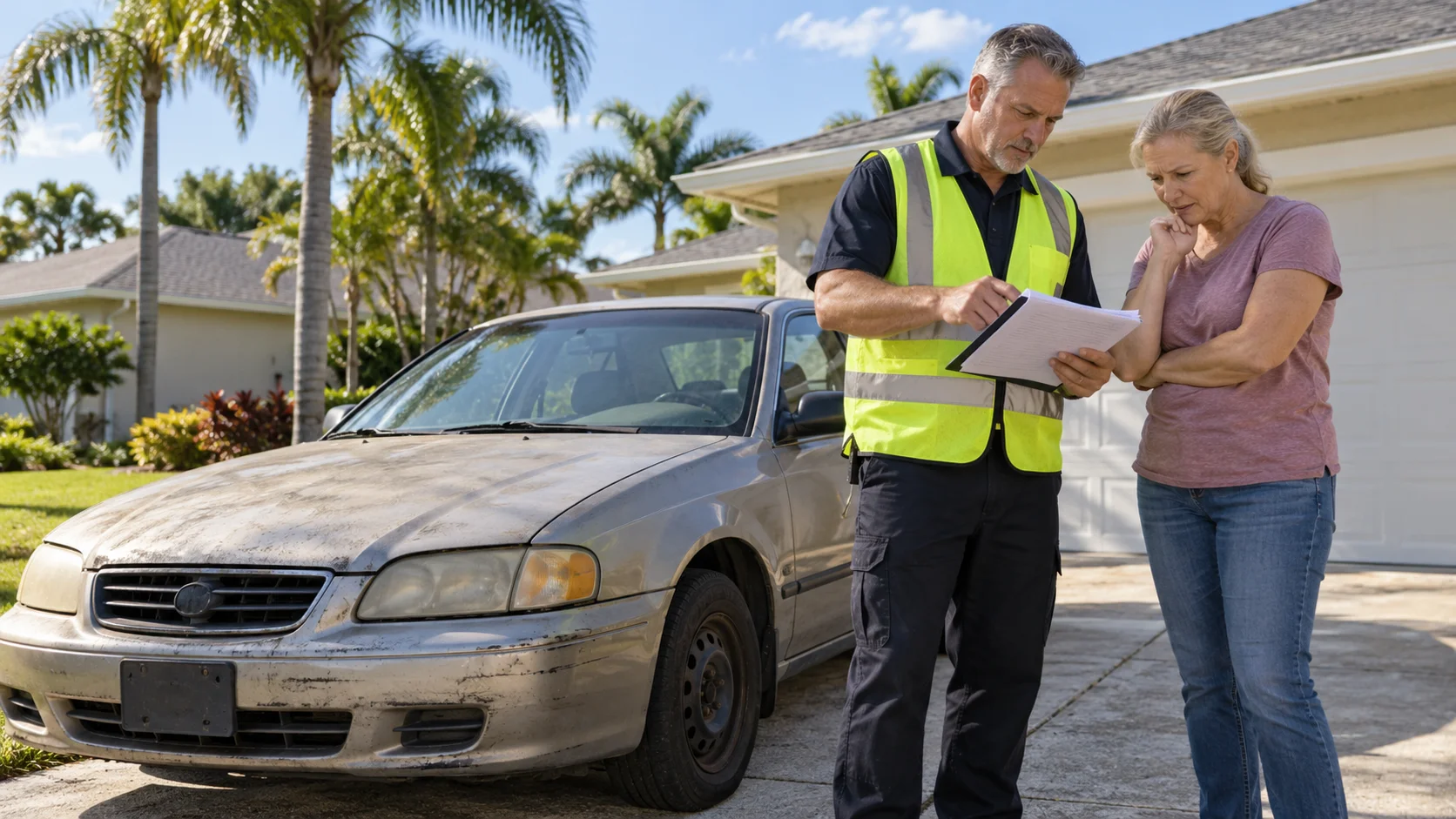
The approved sources don’t confirm whether Florida permits junk-car removal without a title. Confirm ownership and the current state process before anyone takes the vehicle.
Don’t accept a buyer’s promise that paperwork doesn’t matter. Start with the vehicle record, your connection to the car, and current FLHSMV guidance.
Confirm who owns the vehicle
First, determine whose name appears on the vehicle’s ownership record. A car sitting at your Orlando-area home isn’t necessarily yours to sell or scrap. Paying for repairs, storing it, or receiving the keys doesn’t settle ownership.
Look for any records already in your possession. These might include an old title, registration, purchase paperwork, financing records, or documents from an estate. These records can help identify the issue. They don’t necessarily replace whatever Florida currently requires for transfer.
Match the vehicle identification number on your records to the car. Don’t rely only on its color, model, or license plate. Photograph the vehicle and the identifying information you can safely access. Keep those images with your paperwork.
Several situations need extra care:
- The title was lost after you became the recorded owner.
- The seller never completed the earlier transfer.
- A relative died while still listed as owner.
- A business owns the vehicle.
- Another person remains connected to the ownership record.
- Financing paperwork suggests an unresolved lien.
- The car was simply left on your property.
Those aren’t interchangeable problems. A duplicate-title path may fit one situation but not another. We couldn’t confirm every current eligibility rule or accepted substitute document from the approved sources for this page.
Before arranging pickup, check the state’s current vehicles, tags, and titles guidance. Ask which process matches the record, not just the car’s condition. Our broader guide to Florida junk-car paperwork can help you organize the questions.
Separate a missing title from abandonment
A missing title means ownership paperwork isn’t available. An abandoned vehicle involves a different issue: the person seeking removal may not own the car or have authority to transfer it.
That difference matters at an apartment, rental home, inherited property, or commercial lot. For a vehicle left by a tenant, customer, former partner, or unknown driver, we couldn’t confirm ownership from the approved sources. Check who owns it and who may authorize its transfer.
Don’t sign paperwork claiming ownership unless that statement is accurate and supported. Don’t let a buyer treat possession of the keys as proof. The approved sources don’t confirm how towing affects ownership or dismantling authority. Verify both issues before the vehicle moves.
Start by writing down what you know:
- Who brought the vehicle onto the property
- Whether you know the recorded owner
- How you obtained the keys
- Which records came with the vehicle
- Whether the owner has given written instructions
- Whether the car appears connected to a loan or estate
If the vehicle isn’t yours, pause the sale discussion. Review when a vehicle may be considered abandoned in Florida and seek current instructions from the appropriate authority. We couldn’t confirm a single abandonment process that covers every Orlando Metro property and circumstance.
Private-property towing rules also aren’t a substitute for ownership. Florida’s verified rules for nonconsensual private-property towing address towing authorization, signs, storage, and release. They don’t turn the property owner into the vehicle owner.
Keep the two decisions separate: who may authorize movement, and who may transfer the vehicle for junking.
Gather the records you can verify
Once ownership appears clear, gather records before requesting removal. The goal isn’t to build a homemade substitute title. It’s to give FLHSMV, the tax collector, or the receiving business accurate information.
Start with the vehicle identification number. Copy it carefully from the vehicle and compare it with every record you have. A single incorrect character can point to another vehicle.
Then collect documents already tied to the car or owner. Useful records for asking questions may include:
- Any title copy, even if damaged or marked
- Current or expired registration records
- Purchase or transfer paperwork
- The recorded owner’s identification
- Lien-release records, when applicable
- Estate or court documents, when applicable
- Written authorization from an owner, if someone else is coordinating
- Photos showing the vehicle’s condition and location
This list isn’t a promise that Florida accepts every item as transfer authority. We couldn’t confirm all current document combinations from the approved ledger. Ask the receiving business what it needs, then verify that answer against current FLHSMV instructions.
Don’t alter a document to make names or vehicle details match. Don’t sign blank forms. Keep copies of anything you sign or hand over. Ask for written records identifying the vehicle and the parties involved.
Also separate the license plate from the title question. They’re different records and may require different steps. Before changing insurance or surrendering anything, review current FLHSMV insurance guidance and title instructions. We couldn’t confirm the correct sequence for every missing-title case.
If the vehicle may be destroyed rather than resold, read our explanation of a Florida certificate of destruction. Don’t assume severe damage automatically gives you authority to request one.
Check the current Florida transfer process
Florida’s exact path depends on the ownership record and why the title is missing. The approved claims ledger doesn’t confirm every current form, fee, deadline, exemption, or document accepted for a junk vehicle without its title.
That means the safest answer is specific: verify your case through current FLHSMV guidance before transferring the car.
Describe the situation precisely when seeking instructions:
- You’re the recorded owner, but the title is lost.
- You bought the vehicle, but the earlier transfer wasn’t completed.
- The recorded owner has died.
- The vehicle belongs to a business.
- A lien may still appear on the record.
- The car was abandoned and you aren’t the recorded owner.
- The title exists but is damaged or contains an error.
Ask whether you need a replacement title, an ownership correction, lien documentation, estate records, or another current state process. Also ask whether the vehicle’s condition changes the available path. Don’t rely on a recycler’s advertisement as proof of Florida requirements.
Some businesses market “no title needed” pickups. That phrase doesn’t explain who owns the vehicle, what documentation the buyer relies on, or whether the situation qualifies. Ask the business to identify the exact paperwork it expects. Then confirm that process through the official FLHSMV page or the appropriate local title office.
We can’t verify any current missing-title form number, processing fee, same-day option, vehicle-age exception, or value threshold from the approved sources supplied for this article. Those details can change and shouldn’t be guessed.
If state staff or current official guidance says the transfer can’t proceed yet, resolve that issue first. A non-running car in a driveway near Winter Park, Lake Nona, or Kissimmee still needs a clear authority path before owner-approved junk removal.
Arrange removal only after authority is clear
Once the paperwork path is confirmed, explain the vehicle’s condition and location to the removal operator. That helps the operator plan access without making assumptions about the car.
Mention whether the car rolls, steers, or has keys. Describe flat tires, missing wheels, collision damage, locked steering, or parts resting on the ground. Note narrow gates, soft yards, parking garages, steep driveways, and vehicles blocking access.
Orlando-area properties can present tight pickup conditions. A car behind a home may need a different approach than one beside a wide driveway. Vehicles stored near busy roads such as I-4, SR 408, or SR 417 also require careful location details. Don’t move a car into traffic or onto a public shoulder merely to simplify pickup.
Before the vehicle leaves, confirm the receiving business and destination. Review every document before signing. Keep copies showing the vehicle identification number, date, and parties involved. Remove personal belongings only after you have lawful access to the vehicle.
Don’t promise the vehicle to several buyers while resolving its title. Don’t accept instructions to hide missing ownership records. If the operator or receiving business changes the paperwork requirements at pickup, pause the transaction and verify the new request.
Quick Tow Orlando connects callers across the Orlando Metro with independent towing and roadside operators. The brand doesn’t decide ownership or approve a vehicle transfer. Our junk-car and abandoned-vehicle removal service can help coordinate movement after the person requesting it has confirmed authority.
Clear paperwork protects everyone involved. It also keeps a missing-title problem from becoming an ownership dispute after the car is gone.
When to call us
Call after you’ve confirmed ownership and the current Florida transfer path. We can connect you with a local operator when the junk car is ready for authorized removal. Call us at (321) 321-9797.