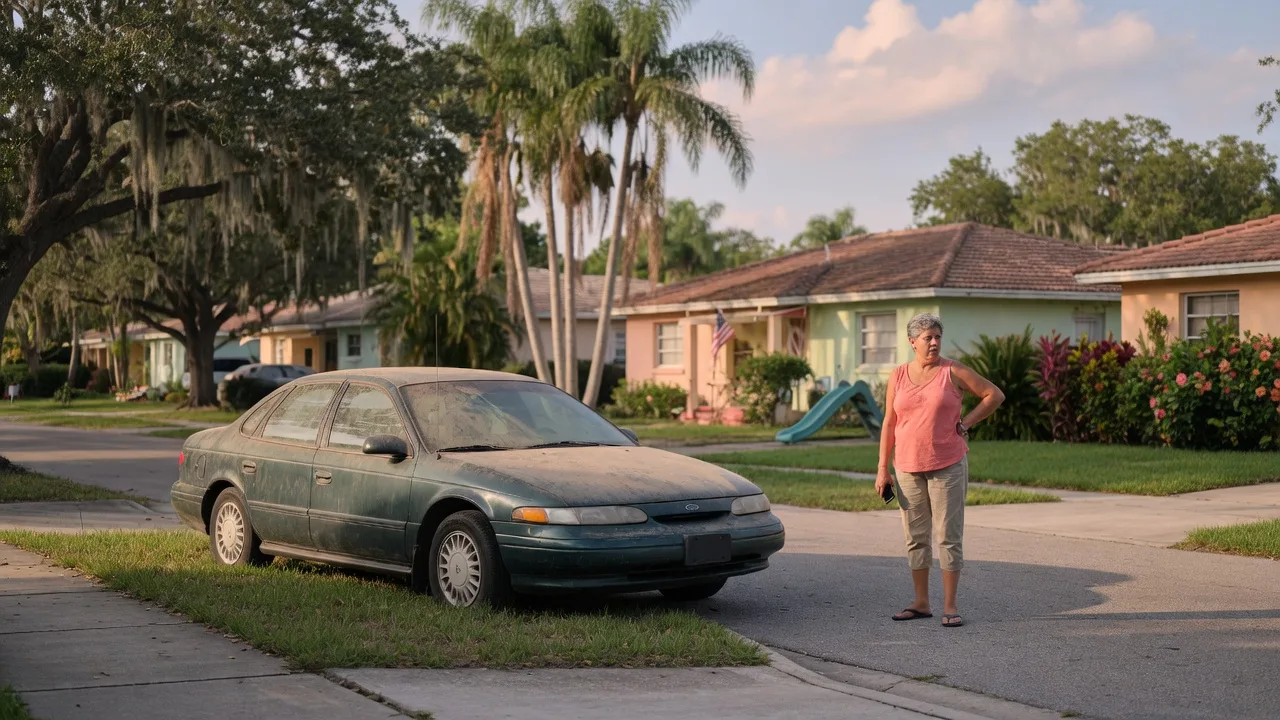
A vehicle is not “abandoned” in Florida under one statewide clock. The answer starts with where it sits: a public road, a private lot, or a public-use airport. Each setting uses a different statute, and none of those statutes give a neighbor, a landlord, or a referral line the power to declare the car abandoned.
Quick Tow Orlando connects owners and authorized property representatives with independent operators. We do not decide legal status, and we do not remove a car from public land on a private call.
If you already know it is abandoned and need the removal steps, use the Orlando abandoned-vehicle removal guide. This page answers the definition question first.
Start with where the vehicle is sitting
Look at the ground under the tires before you look up a statute.
A car on a public street, a county right-of-way, or a shoulder near SR 408 is a public-property problem. Law enforcement controls that call. Florida Statute 316.194 is the public-road removal rule. It is not a private-tow authorization.
A car inside an apartment lot, a shopping center, or a private driveway is usually a private-property towing problem under Florida Statute 715.07. That statute is about posted tow-away zones and owner consent. It does not use the word abandoned as its trigger.
A car left in airport parking at Orlando International is a third setting. Florida Statute 705.184 writes a separate definition for public-use airports. The MCO breakdown guide covers the stall. This page only covers when the airport statute treats the car as abandoned or derelict.
If you cannot tell public from private, stop. A grass strip along an Orlando curb can look like the lot and belong to the city. Check the parcel or ask the agency that owns the road before anyone hooks the car.
What Florida Statute 705.101 actually defines
People paste “abandoned vehicle” into a search and land on Chapter 705. Read the definition that is actually there.
Florida Statute 705.101 defines abandoned property, not a special class called abandoned motor vehicle, except later in the airport section. Abandoned property is tangible personal property disposed on public property in a wrecked, inoperative, or partially dismantled condition. It also covers property that has no identifiable owner and no apparent intrinsic value to the rightful owner.
That is a condition test on public property. It is not a 48-hour parking clock. It is not a private-lot rule. A dusty sedan that still has plates, an owner, and intact bodywork may be unwelcome on the street without meeting this definition.
Lost property is a different term in the same section. Lost property is property the owner unintentionally left and that the finder does not know how to return. A car with a current tag sitting in one space for a week is not automatically lost property either.
Florida Statute 705.103 then sets the public-property process after law enforcement takes jurisdiction. For property that cannot be easily removed, the statute requires a posted notice for five days before removal in the situations that section covers. That five-day posted notice is not a license for a neighbor to tow. It is a step in the public process.
Do not apply the Chapter 705 vessel timelines to a car. Those vessel windows are written for boats. A 21-day vessel figure does not become a car rule because someone blogged it that way.
Public roads use 316.194, not 705.101, for the waiting period
The public-road waiting period that people remember as “48 hours” lives in Florida Statute 316.194.
A vehicle parked or stored on the public right-of-way for more than 48 hours may be removed when it sits within 30 feet of the pavement edge. When it sits more than 30 feet from that edge, the waiting period is 10 days. A police officer or traffic accident investigation officer orders the removal. The costs become a lien against the vehicle.
That is why a neighbor cannot “call it abandoned” on an Orlando side street and order the truck. Report the location, the plate if you can read it from a safe place, and whether it blocks a lane, a sidewalk, or a driveway. Florida Statute 705.102 also says a person who finds abandoned property must report the description and location to a law enforcement officer.
Orange County, Seminole County, and Osceola County each run their own non-emergency and code channels. Use the official site for the exact city or unincorporated area. Orange County Sheriff non-emergency is (407) 836-4357. We could not confirm a single countywide abandoned-car hotline that replaces that report.
If the car blocks your driveway from the public right-of-way, that is a different problem than abandonment. See a car blocking your driveway in Orlando.
Private property is usually 715.07, not abandonment
A car left in a private Orlando lot is often a parking or trespass-tow question, not an abandoned-property case.
Florida Statute 715.07 requires specific tow-away signs in most non-residential settings before a vehicle can be towed without the owner’s consent. The signs need “Tow-away zone” lettering at least four inches high, light-reflective lettering, the towing company name and current telephone number, and a height between three and six feet. Signs generally must stand for at least 24 hours before a tow. Storage distance limits in Orange County, a county over 500,000 residents, start at a 10-mile radius.
That process is about the property’s posted rules and the operator’s paperwork. It is not a finding that the car has no owner. A tenant’s car with a flat tire can sit for weeks and still not be abandoned property under 705.101, because it is not on public property.
HOA and apartment questions have their own pages: can an HOA tow your car in Florida and apartment guest-car tows. Use those when the car belongs to a resident or a guest and the fight is over parking rules.
If you own the car and you want it gone, that is junk car removal, not an abandonment case. You still need title and identity documents. The Florida junk-car paperwork guide covers that path.
Airports use a 45-day idle rule plus a wrecked-car test
Public-use airports are carved out on purpose.
Florida Statute 705.184 defines an abandoned motor vehicle at a public-use airport as one that is wrecked, inoperative, or partially dismantled, or one that has been left in an airport parking facility for 45 consecutive calendar days. Derelict, in that section, means the vehicle is not drivable.
Greater Orlando Aviation Authority parking guidance matches the 45-day idle figure for MCO lots. Current parking contacts published by GOAA include [email protected] and (407) 825-3562, Monday through Friday, 8 a.m. to 4 p.m. Eastern, plus the parking operator at (407) 825-2104. Confirm those on parking.orlandoairports.net before you rely on them. They are airport contacts, not the Quick Tow Orlando line.
A car that died this afternoon in Terminal A garage is a breakdown. It is not abandoned at hour one. Do not leave it for 45 days hoping the definition will solve the parking bill.
What you can document before anyone acts
You can record facts. You cannot close the legal question yourself.
From a safe place, note:
- Public street, private lot, or airport property
- City or unincorporated area
- Nearest cross street
- Plate, VIN if visible without entering the car, make, color
- Whether it looks wrecked, on stands, stripped, or merely dusty
- How long you have personally seen it sit
- Whether it blocks a lane, hydrant, sidewalk, or driveway
Photograph the scene without opening doors or removing parts. Do not sell, dismantle, or hide the car. Florida treats unauthorized taking of a vehicle as a different crime than a tow you were allowed to order.
If you are the owner, say so on the call and have the title or registration in hand. If you are a property manager, have the lot’s current tow-away sign photos and the written authorization the operator will ask for.
When to call us
Call Quick Tow Orlando when you own the car, or you control the private property, and you need an independent operator for a lawful private removal. The line is (321) 321-9797. It is open 24/7.
Do not call us to declare a street car abandoned. Report that one to law enforcement first. We will not invent a statute, a deadline, or a fee to make the car disappear.