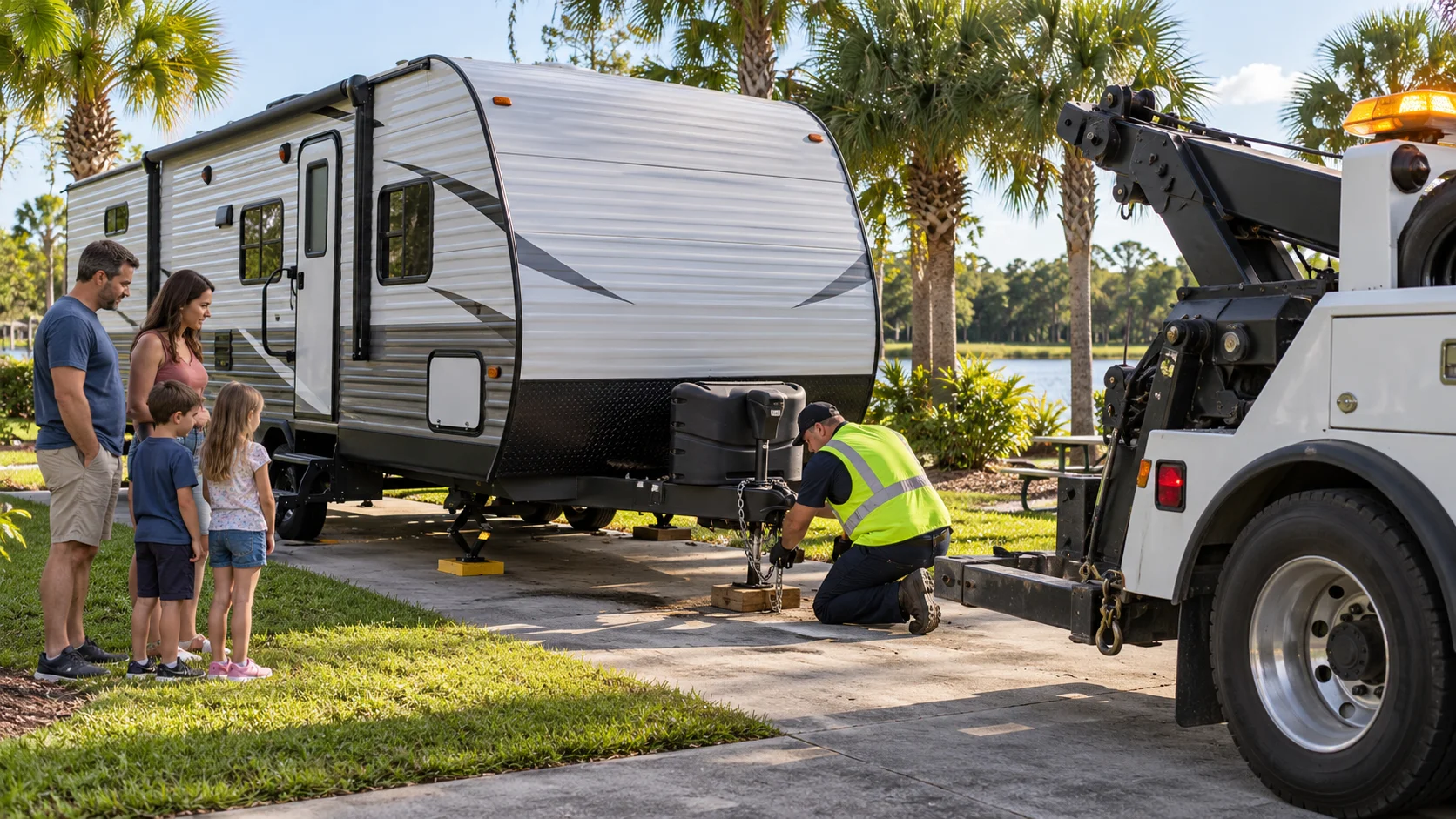
A travel trailer that can’t leave its campsite needs a planned recovery. The tow vehicle may be disabled, the ground may be soft, or wheel damage may prevent a normal departure. For travel trailer towing in Orlando, the operator first needs clear details about the trailer, access, damage, and destination.
Don’t hitch another vehicle or pull from an improvised attachment point. A trailer recovery can change quickly when the tires, axle, hitch, or ground can’t support movement. The operator referred through Quick Tow Orlando will choose the recovery or transport setup.
Keep people clear before moving anything
Start by creating space around the trailer. Keep children, pets, guests, and neighboring campers away from its path. Nobody should stand between the trailer and tow vehicle. People should also stay clear of the hitch, wheels, stabilizers, and recovery equipment.
Don’t attempt to push the trailer by hand. Don’t ask campground guests to pull it with another vehicle. Soft shoulders, wet grass, uneven pads, and narrow turns can create movement that nobody expects. A trailer may also shift when stabilizers or wheel restraints are changed.
If the trailer is leaning, partly off its pad, or near another campsite, leave it still. Tell the operator exactly what you see. Photos taken from a safe position can show the trailer’s angle and nearby obstacles. Include the front, both sides, wheels, hitch, and intended exit.
Ask campground staff to keep the lane clear. They may also need to manage parked cars, golf carts, entry gates, or other site traffic. Don’t move someone else’s property without permission.
If the tow vehicle has failed while still connected, shut down the travel party’s departure plan. Keep everyone in a safe waiting area chosen with campground staff. Don’t crawl beneath either vehicle or disconnect components under tension.
A trailer sitting normally on a firm pad may need transport planning. A trailer sunk into soft ground may need accident recovery and winch-out support. The operator makes that distinction after reviewing the conditions.
Describe the trailer, hitch, and tow vehicle
When you request help, identify the unit as a travel trailer. Don’t describe it only as an RV. Motorhomes, fifth wheels, travel trailers, and utility trailers need different planning.
Share the trailer’s manufacturer and model if you can read them safely. Give the operator any available paperwork showing its specifications. Don’t guess its weight, length, or loaded condition. An incorrect guess can send the wrong setup into a tight campground.
Describe the hitch as clearly as possible. Mention whether the trailer remains connected to its tow vehicle. Note visible hitch damage, bent parts, loose components, or anything resting against the ground. Don’t try to straighten, remove, or force damaged hardware.
The tow vehicle matters too. Tell the operator whether it starts, rolls, steers, and shifts normally. Explain whether the breakdown involves the engine, transmission, steering, wheel, suspension, or collision damage. If the vehicle can’t move, say whether it blocks access to the trailer’s hitch.
A disabled tow vehicle and a usable trailer may require separate arrangements. The operator might need to assess each unit before deciding what moves first. Quick Tow Orlando connects callers with independent operators for RV and trailer towing throughout the Orlando Metro.
If your trailer is usable but its original truck isn’t available, read our guide to moving a trailer without its tow vehicle. That situation differs from a trailer with damaged running gear or a unit stuck in soft ground.
Clear descriptions help the referred operator plan the job. They don’t replace an on-site inspection. The operator who arrives makes the final decision about safe movement.
Check the ground and campground access
Campground access can matter as much as the trailer’s condition. A wide trailer may be parked behind trees, landscaping, utility posts, parked vehicles, or a sharp internal turn. Resort-area properties near Lake Buena Vista may also have controlled entrances or busy guest lanes.
Tell the operator whether the trailer sits on pavement, gravel, packed soil, grass, or another surface. Mention standing water, deep ruts, loose material, or visibly sunken tires. Don’t test the ground by driving another vehicle across it.
Explain the route from the property entrance to the campsite. Note gates, arches, covered check-in areas, narrow lanes, tight corners, speed-control features, and low branches. If the recovery vehicle must enter through a different gate, ask campground staff to confirm that route.
Share the site number and the campground’s exact street address. A property name alone may not identify the correct entrance. This is especially important around Lake Buena Vista, International Drive, and Kissimmee, where visitors may be unfamiliar with the surrounding roads.
Ask staff what access they can authorize. Don’t assume a recovery vehicle can cross an empty campsite, grass area, maintenance lane, or closed section. The campground may need to open a gate or temporarily clear nearby parking. Any site-specific rule should be confirmed directly with property management.
Also describe the exit beyond the campground. Tell the operator if the planned route leads toward I-4, SR 417, SR 429, or another major road. Don’t start moving the trailer until the destination and route are settled.
The operator needs the full access picture before choosing equipment. A recovery setup that reaches an open roadside may not fit between campground sites.
Share wheel, axle, and cargo concerns
A trailer stuck at a campground isn’t always a traction problem. Wheel, tire, hub, axle, suspension, or brake damage may prevent safe movement. Report every visible concern, even if the trailer still appears level.
Look from a safe distance. Tell the operator if a tire is flat, missing, tilted, or pressed against the body. Mention a wheel sitting at an unusual angle. Report loose parts, leaking fluid, scraping, smoke, heat, or a burning smell. Don’t touch a hot wheel assembly or crawl underneath for a closer look.
If a tire failed before reaching the campsite, explain what happened afterward. The trailer may have been driven farther, pulled onto a pad, or parked while making noise. Our guide about a trailer tire blowout in Orlando covers that roadside situation separately.
Cargo also changes the recovery picture. Tell the operator whether the trailer contains personal belongings, tanks, batteries, recreational gear, or loose items. You don’t need to publish private details. You do need to disclose anything that may shift, leak, or affect movement.
Secure ordinary loose belongings only when the trailer is stable and campground staff allow access. Don’t enter a trailer that is leaning, unstable, collision-damaged, or partly unsupported. Let the operator evaluate it first.
Don’t move cargo merely to change the trailer’s balance. Don’t unload heavy items beside an active recovery area. The operator may ask for specific preparation after inspecting the unit.
Wheel damage, soft ground, and a failed tow vehicle can occur together. Share the complete picture during the first call. That helps the operator decide whether the job calls for extraction, trailer transport, tow-vehicle service, or a combination.
Confirm where the trailer should go
Choose a destination before movement begins. A campground exit isn’t a complete destination. The operator needs a specific address and a contact who can accept the trailer.
Your next stop might be another campsite, a repair facility, a storage property, or another approved location. Call that destination first. Confirm that it can receive the trailer in its current condition. Ask whether someone will be present and where the operator should place it.
Don’t assume an RV repair business handles every trailer problem. Describe the damaged system when requesting acceptance. A destination that handles body work may not handle an axle concern. A storage location may not accept a disabled unit.
If you’re moving between campgrounds, confirm the receiving site’s access. Share the assigned site, entrance instructions, surface, turns, and parking position with the operator. A destination can be reachable by car but unsuitable for the recovery setup.
Travelers also need a plan for the disabled tow vehicle. It may go somewhere different from the trailer. Keep both destination addresses available. Make sure the keys and necessary documents remain with the correct vehicle.
If the problem involves the living unit rather than campground access, our guide on what to do when an RV breaks down explains the broader planning process. This campground situation requires extra attention to the site, exit path, and receiving location.
Quick Tow Orlando’s request line is open 24/7. We connect callers with independent towing and roadside operators serving the Orlando Metro. The referred operator confirms whether the requested destination and access conditions work for the job.
When to call us
Call when a disabled tow vehicle, damaged wheel, soft campsite, or tight access prevents a normal departure. A local operator should assess the trailer before anyone attempts an improvised pull or extraction. Call us at (321) 321-9797.