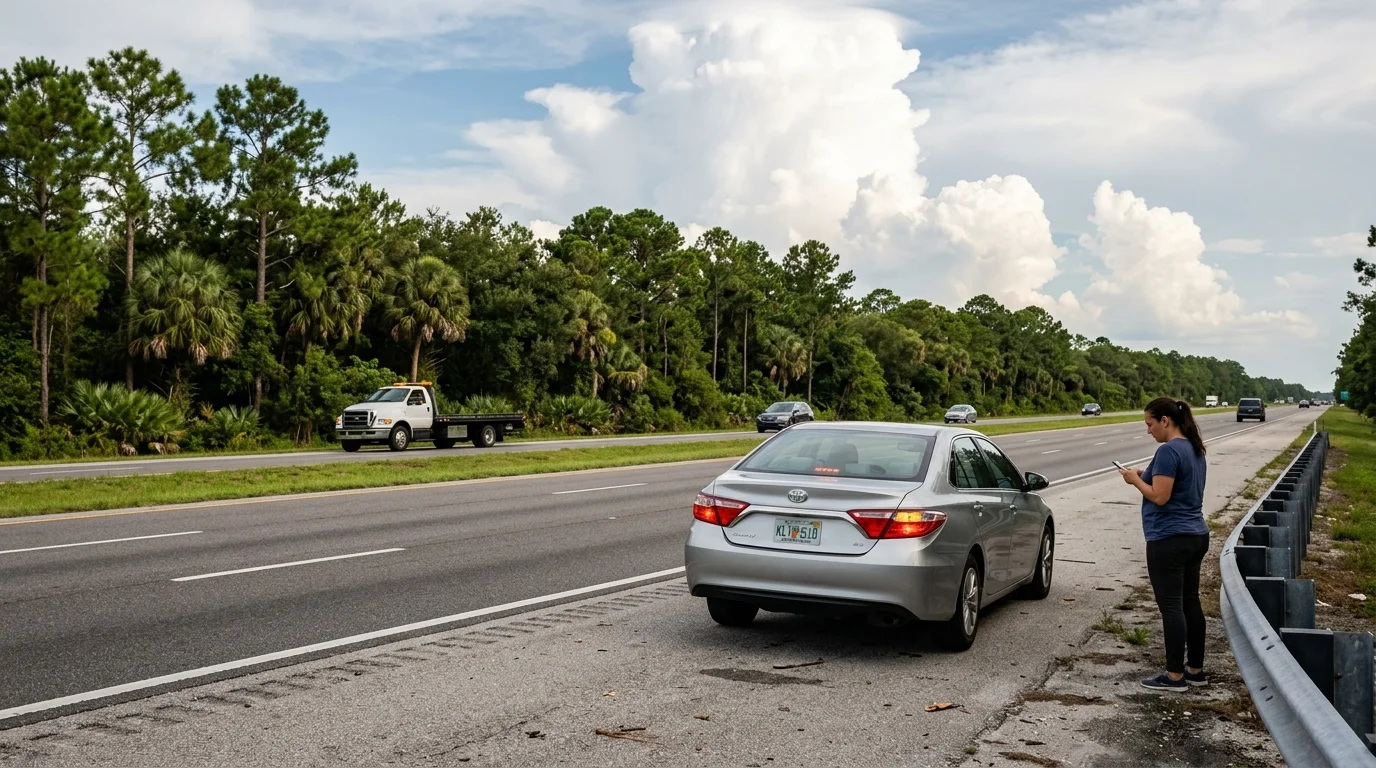
Cheap roadside assistance in Orlando often starts with free highway help. A membership makes sense when its limits match your driving. Otherwise, paying per call may give you more control.
What a roadside plan actually buys you
A roadside plan is a contract for specific services. It isn’t unlimited towing or a promise that every breakdown is covered. The value depends on the written terms, not the logo on the card.
Common service categories include battery jumps, tire changes, fuel delivery, lockout help, and towing. Those benefits vary between plans. Before buying, confirm which services are included and which trigger another charge.
Start with the towing terms. Check how far the covered tow goes. Find out whether distance is measured from the breakdown or another starting point. Ask what happens when your chosen repair shop sits beyond the covered area. A short towing allowance may work around Winter Park. It may be less useful during a longer drive between Sanford and Kissimmee.
Next, read the vehicle rules. Confirm that your car, motorcycle, trailer, or rental qualifies. Check whether coverage follows one named vehicle or an enrolled person. If other household members drive the car, make sure the plan addresses them.
Florida’s required personal injury protection doesn’t include towing or roadside assistance. Help through an auto policy comes from optional roadside coverage or policy-specific collision terms. Read the actual policy before assuming a roadside bill will be reimbursed.
The right service also depends on the breakdown. A healthy battery that needs a jump is a roadside job. Collision damage, steering trouble, or a car that can’t roll may require emergency towing. Our roadside assistance service can connect you with a local operator when the problem fits that kind of help.
The free help already patrolling Orlando’s highways
Orlando has a free roadside layer many drivers overlook. FHP Road Rangers patrol covered highways and help clear traffic incidents.
Their listed services include jump starts and radiator water. They can change a tire when your vehicle has a usable spare. They may provide up to two gallons of fuel. They also handle repairs that take less than 15 minutes and help move vehicles from travel lanes.
That last distinction matters. Road Rangers can relocate a disabled vehicle out of the travel lane. They don’t tow it to your home or repair shop. When a full tow is needed, FHP calls a private operator, and the motorist pays that operator.
Coverage also depends on the road and schedule. Near Orlando, the Turnpike program lists SR 408 from milepost 0 to milepost 1 as covered around the clock. Listed segments of SR 417, SR 429, and SR 570 operate from 6 a.m. to 10 p.m. Check the official Road Rangers page before treating that coverage as your complete roadside plan.
Use FL511 to review official traffic and incident information. It can help you see whether a crash or closure affects your route. Drivers dealing with a breakdown on Orlando’s busiest corridor can also follow our guide on what to do after breaking down on I-4.
Free patrol help is valuable, but it’s route-specific. It won’t replace coverage for a dead battery in a Lake Nona driveway, a locked car near International Drive, or a flat tire inside a Winter Park parking garage.
Membership plan or pay per call: how the math works here
There isn’t one cheapest choice for every Orlando driver. Compare the total obligation and the limits you receive. Don’t judge a plan only by its advertised membership fee.
For a membership, count the recurring fee plus anything excluded from the benefit. Review towing distance, service-call limits, covered vehicles, and reimbursement rules. A low fee loses value when the service you need falls outside those terms.
For pay-per-call help, the cost depends on the actual job. Vehicle type, tow distance, destination, condition, and access can affect what an operator charges. A car in an open driveway presents a different job from one stuck in a low-clearance garage.
City and county maximums don’t set the price for a tow you request yourself. Orlando’s city schedule and Orange County’s schedule apply within their stated nonconsensual towing scopes. They aren’t caps for a consensual roadside call. Our guide to Orlando towing costs explains that local distinction.
Membership often fits drivers who want predictable access to a defined service package. That may include frequent commuters using I-4, SR 408, or the Turnpike. Pay per call may fit someone who drives less, already has another roadside benefit, or wants to choose an operator for each event.
Avoid counting the same protection twice. Check your auto policy and any current vehicle benefits before buying another plan. Then compare what remains uncovered. The cheapest option is the one that covers your likely problem without making you pay twice for the same narrow benefit.
Dispatch runs Monday to Friday, 8 a.m. to 10 p.m. Leave the details and we connect drivers with local operators. The operator handles the roadside work or tow.
Where cheap roadside assistance stops covering you
No single exclusion appears in every roadside plan. The common problem is unclear fine print. Cheap coverage becomes expensive when the service you expected isn’t included.
Start with towing distance. A plan may include towing but restrict the covered destination or distance. Confirm whether you can choose your repair shop. If you regularly cross Orlando, a small service area may not match your routine.
Then check service limits. Read how the plan handles repeated calls, the same unresolved mechanical problem, or a newly activated membership. Don’t assume every call receives identical treatment. Ask whether you pay the operator directly or submit a reimbursement request later.
Tire service has another common catch: the spare. Road Rangers change a tire using the vehicle’s own spare. A missing, damaged, or underinflated spare can turn a tire change into a tow. Check the spare and its tools before hurricane-season travel or a long Turnpike drive.
Location can also change the job. Parking garages may have height restrictions. Apartment gates can limit access. A vehicle that won’t shift into neutral may need different equipment than a car parked in an open lot. Give the provider those details before an operator is matched.
Storm conditions deserve their own check. Central Florida’s summer storms can bring heavy rain, lightning, and flooded streets. Don’t assume a basic plan includes recovery from mud, standing water, or an off-road position. Look for written language covering winch-outs and accident recovery.
Finally, check what the plan doesn’t promise. Coverage eligibility and arrival are separate issues. A benefit card may confirm that a service qualifies without controlling traffic, weather, operator availability, or road access. Choose based on written coverage, not an unsupported arrival claim.
Picking one for how you actually drive
Begin with your real driving pattern. Review where you travel, who drives, and which vehicle creates the most concern. That produces a better choice than buying the first low-priced plan you see.
An I-4 commuter should examine highway coverage and towing distance. Road Rangers add useful support on covered routes, but they don’t tow vehicles away. Your backup still needs to address transportation from the roadside to a useful destination.
A driver making short trips around Winter Park or downtown Orlando may care more about battery, tire, and lockout service. Someone regularly traveling between Sanford, Lake Nona, and Kissimmee should study service boundaries and destination rules. Don’t assume a metro-wide advertisement means every trip receives the same benefit.
Vehicle condition matters too. If the car has a working spare but an aging battery, compare jump-start terms. If it lacks a usable spare, make sure the plan addresses towing after a flat. Owners of motorcycles, RVs, trailers, or heavier vehicles should confirm eligibility in writing.
Before enrolling, get clear answers to five points: covered services, towing distance, vehicle eligibility, service limits, and payment method. Save a copy of the terms you accepted. Also keep the provider’s current contact instructions somewhere accessible outside the car.
A cheap plan should solve the breakdowns you’re most likely to face. It shouldn’t merely produce another card for the glove box. If the exclusions leave your regular routes or vehicle uncovered, pay-per-call help may be the cleaner choice.
Keep a backup path either way. Free Road Rangers cover certain highways and tasks. A membership covers whatever its contract states. A local referral service can connect you with an operator when neither option fits the situation.
When to call us
Call when the car can’t be driven safely, there’s no usable spare, or basic roadside help hasn’t solved the problem. Quick Tow Orlando can connect you with a local operator for roadside help or towing. Call us at (321) 321-9797.