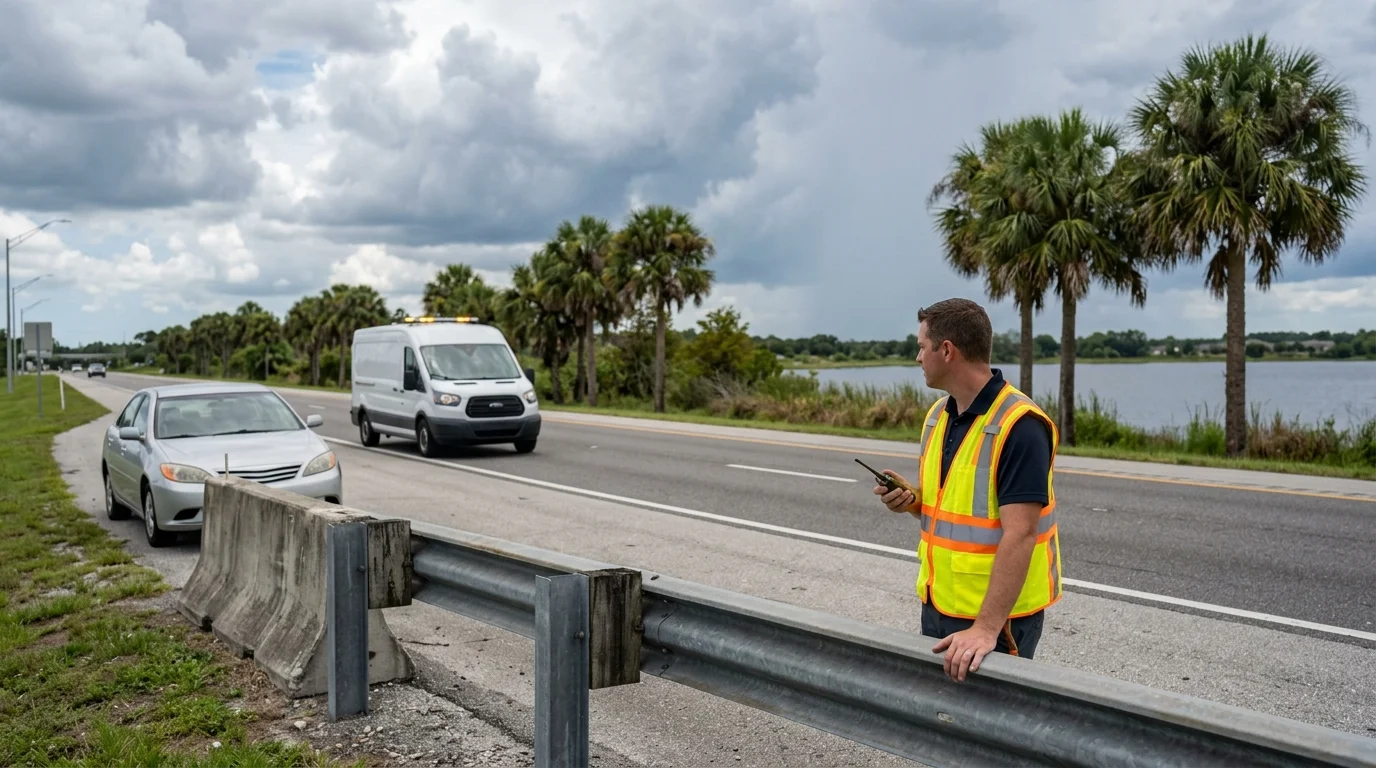
A stalled engine near Lake Nona turns a fuel problem into a safety decision. Request fuel delivery if the car is simply empty and safely accessible. If it won’t restart, has damage, or shows another problem, request a tow instead.
Quick Tow Orlando connects stranded drivers with independent roadside and towing operators. Start by protecting yourself, then give the operator an exact location.
Get behind a barrier or away from traffic
Your first task isn’t finding fuel. It’s reducing your exposure to passing traffic.
If the car still rolls safely, move as far from the travel lane as possible. Don’t force it across lanes to reach a preferred shoulder. Stop where you can without creating a second emergency, then turn on the hazard lights.
If a barrier offers a safe waiting area, use it only when you can exit without entering traffic. Leave through the side facing away from moving vehicles. Don’t stand beside the driver’s door, near a wheel, or between the car and a barrier.
Sometimes leaving the car creates more danger. Stay buckled inside when reaching the shoulder or barrier would expose you to traffic. Keep the doors locked while you arrange help. If the vehicle is stuck in an active lane, someone is injured, or you see smoke or fire, call 911.
Never walk along SR 417 or cross its lanes to find gasoline. A nearby map result doesn’t create a safe walking route. Fuel delivery or towing keeps you from entering highway traffic on foot.
Florida’s Move Over law covers disabled vehicles displaying hazard lights. On multilane highways, approaching drivers must leave the closest lane when it’s safe. Hazard lights help identify your stopped vehicle, but they don’t make the shoulder safe.
For another Orlando highway scenario, our I-4 breakdown guide explains how to organize the first few decisions. The same priority applies near Lake Nona: protect people before diagnosing the car.
Share your direction and nearest location marker
“Near Lake Nona” leaves too much road to search. Give the operator details that identify your side of SR 417 and your exact stopping point.
Start with your direction of travel. Say whether you were traveling northbound or southbound. Then identify whether you’re on the main roadway, an entrance ramp, an exit ramp, or a connecting road.
Look for the nearest visible location marker without walking toward it. Useful details include:
- The route number and travel direction
- A nearby exit name or number
- A mile marker visible from your position
- The name of a crossing road shown on your map
- Whether you stopped before or after a ramp
- Whether the vehicle is on the right or left side
- Your vehicle’s color, make, and model
A map pin can help, but describe the location aloud too. Open your phone’s map while you remain in a protected spot. Read the route label, direction, and nearest named road exactly as displayed. If available, share the pin or copied coordinates after the call.
Mention anything affecting access. Tell the operator if the shoulder is narrow, the car is close to a guardrail, or traffic blocks the safe side. Report whether all four wheels remain on pavement. Don’t step into the road to inspect the opposite side.
Keep your phone available after sharing the location. If you move for safety, update the operator with your new waiting spot. Don’t move away simply to meet an approaching vehicle. The operator needs the disabled car’s location first.
Clear location details help separate a straightforward roadside assistance request from a recovery that needs different equipment.
Separate fuel delivery from a towing problem
Fuel delivery may fit when you know the tank ran empty and the vehicle has no other visible problem. The operator can discuss whether roadside fuel help is appropriate at your SR 417 location.
Give the correct fuel type. Check the fuel-door label, owner’s manual, or information already saved for the vehicle. Don’t guess between gasoline and diesel. If you can’t confirm the fuel type, say that before an operator travels.
Also explain why you believe the car ran out of gas. Share the fuel-gauge reading and what happened before the engine stopped. Report whether the engine shut down while moving, whether it now cranks, and whether any warning appeared. These observations help the operator assess the request without treating your guess as a diagnosis.
Fuel delivery doesn’t mean the vehicle will restart. An empty-looking gauge can appear alongside a battery, starting, electrical, or engine problem. If fuel is added and the car still won’t run, continuing to attempt restarts may not solve the underlying fault. A tow may be the safer next step.
Access matters too. An operator must be able to reach the fuel door without standing in an exposed traffic lane. Explain which side contains the fuel door and how close that side is to traffic or a barrier. A simple fuel request can become a towing situation when safe roadside access isn’t available.
Don’t expect a specific fuel quantity, price, or arrival time without confirmation. Ask what the responding operator can provide and what terms apply before service begins. If you’re comparing payment options, memberships, or direct-pay help, read our guide to lower-cost roadside assistance in Orlando.
The right request is based on the vehicle’s condition, location, and access. It isn’t based only on the fuel gauge.
Explain any other warning signs before dispatch
Describe every warning sign before an operator heads toward SR 417. A detail that seems unrelated may change the service from fuel delivery to towing.
Report what you can observe from a safe position:
- A strong fuel smell or liquid beneath the vehicle
- Smoke, steam, sparks, or visible flames
- An unusual sound before the engine stopped
- A temperature, oil, battery, or engine warning
- Clicking, silence, or slow cranking during a restart attempt
- A damaged tire, wheel, bumper, or underside
- Contact with debris, a curb, another vehicle, or a barrier
Don’t crawl beneath the vehicle or open the hood beside moving traffic. Photos may help only when you can take them without leaving a protected area. A clear verbal description is better than moving closer to traffic for a picture.
If you smell fuel or see a possible leak, don’t add more fuel or keep trying the ignition. Move farther away when you can do so safely. Call 911 if there’s fire, an immediate danger, an injury, or a vehicle blocking active traffic.
Tell the operator about passengers as well. Mention children, older adults, mobility needs, or pets waiting with you. This doesn’t create an arrival promise, but it gives the operator a clearer picture of the roadside situation.
Avoid diagnosing the problem with a single label. “Out of gas” isn’t enough if the dashboard showed another warning or the car struck something. Say what you saw, heard, and smelled. The independent operator can then discuss whether fuel service remains suitable.
Quick Tow Orlando takes the details and connects you with a local operator. The operator who accepts the job decides what service and equipment fit the reported conditions.
Choose a safe destination if the car won’t restart
If fuel doesn’t restore normal operation, stop treating the incident as a simple empty tank. Request emergency towing and choose a destination that can receive the vehicle.
A repair shop may be the best destination when the cause is unknown. Before naming one, confirm that it works on your vehicle and can accept it. Ask the shop where the operator should leave the car if the building will be closed. Don’t assume an unlocked parking area means after-hours drop-off is allowed.
A dealership may make sense when the vehicle needs brand-specific service. Your home may work as a temporary destination when you have legal parking and a plan for later repairs. The right choice depends on who can accept the car, not which address appears closest on a map.
Have the full destination name and street address ready. Similar business names can lead to confusion across the Orlando Metro. Share a specific entrance or drop-off instruction only if the destination provided it to you.
Tell the operator about conditions that affect towing. These include locked wheels, missing keys, steering problems, collision damage, low clearance, or a vehicle positioned against a barrier. Don’t attempt to push the car along the shoulder or onto a ramp. Let the operator assess how it should be moved.
Remove essential personal items only when you can access the vehicle safely. Keep your identification, medication, phone charger, house keys, and anything needed after the tow. Don’t delay an urgent roadside move to reorganize the entire car.
Confirm the destination and service terms with the independent operator before the vehicle is moved. If the location becomes more dangerous while you wait, call 911 and follow emergency instructions.
When to call us
Call when the car can’t restart, fuel service isn’t safe, or another fault appears. Quick Tow Orlando takes calls at any hour, dispatches Monday to Friday from 8 a.m. to 10 p.m., and connects Orlando Metro drivers with independent towing and roadside operators. Call us at (321) 321-9797.