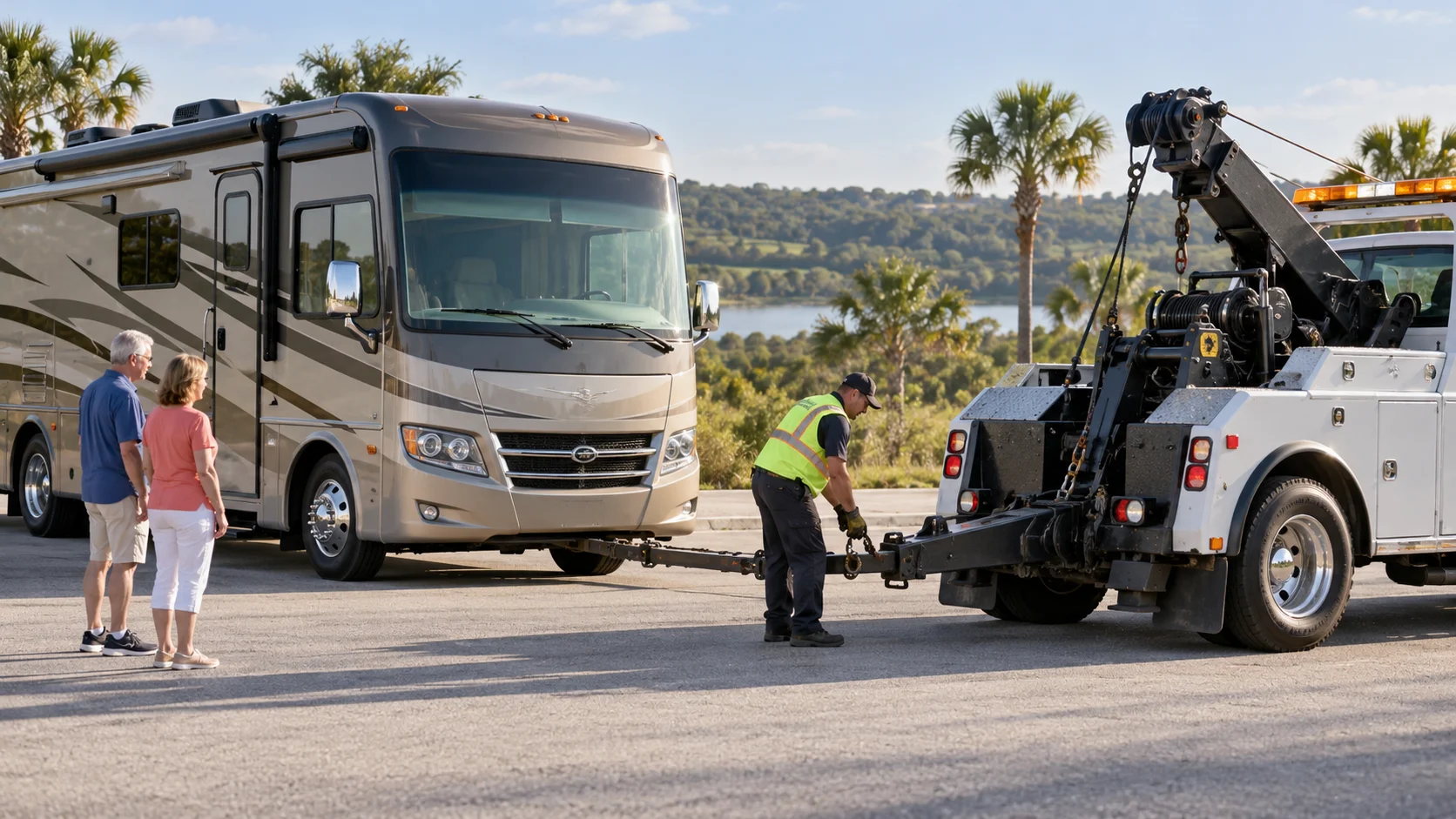
An RV failure near US 27 requires more planning than a passenger-car tow. Start by protecting everyone, then give the operator enough detail to choose a suitable recovery plan. For RV towing in Clermont, the rig’s configuration, position, road slope, and destination access all matter.
Protect passengers before checking the RV
Move passengers away from traffic before inspecting the RV. Choose the safest available waiting area, especially beside US 27 or SR 50. Don’t stand between the RV and passing vehicles.
If the RV can still move safely, look for a broad paved area. Don’t force it farther if steering, braking, wheels, or tires appear damaged. Continuing can make the vehicle harder to recover.
Turn on the hazard lights. Keep children and pets together. If anyone must exit, use the side farthest from traffic when possible. Don’t walk beside an active lane to examine a tire or look underneath the vehicle.
A towable RV creates another concern. The trailer and tow vehicle may not both be clear of traffic. Don’t disconnect them on a shoulder unless the referred operator directs you to do so. The slope, hitch condition, and trailer brakes can change what happens after separation.
Tell the call taker about smoke, leaking fluid, fire, injuries, or traffic exposure immediately. Those details affect the next step. If there’s an immediate threat to life, contact emergency services before arranging a tow.
Florida’s Move Over law covers tow trucks displaying amber lights. Drivers on multilane roads must leave the nearest lane when it’s safe. On two-lane roads, they must reduce speed as directed by Florida Statute 316.126. Even with that protection, passengers should remain clear while the operator works.
For a broader preparation list, read what to do when your RV breaks down.
Share the direction and nearest US 27 marker
“Somewhere on US 27” won’t narrow the location enough. State your travel direction first. Then share the nearest visible intersection, route sign, campground entrance, business entrance, or other fixed marker.
Mention whether you’re near SR 50, on US 27, or inside a campground. If you left the highway, explain each turn from the nearest main road. A dropped map pin can help, but include a plain-language description too.
Describe which side of the road you’re on. Say whether the RV is on a shoulder, in a travel lane, inside a parking area, or beyond the pavement. Note any median, divided roadway, gate, or restricted entrance between the operator and your position.
Look at the road ahead and behind you. Tell the call taker whether the operator can approach from either direction. If there’s no clear turnaround nearby, say that. Don’t assume a recovery vehicle can use the same path as a passenger car.
Campground locations need extra detail. Provide the campground entrance, your site or loop information, and the route from the gate. If access involves a code or staff approval, arrange that before the operator arrives. Confirm any current entry instructions directly with campground staff.
Clermont’s changing road grades also matter. Say whether the RV stopped uphill, downhill, or on level pavement. Mention if it’s near a crest, curve, or narrow shoulder. Don’t estimate the grade. A simple description gives the operator useful context without introducing a questionable number.
These details help the local operator assess access before choosing a transport or recovery setup.
Describe the RV, trailer, and visible condition
“RV” can mean several vehicle configurations. Start by saying whether you have a motorhome, travel trailer, fifth wheel, camper van, or another setup. For a towable unit, identify the tow vehicle as well.
Share the year, make, and model if you have them. Give the overall length and height only when those figures come from the vehicle’s paperwork or manufacturer label. Don’t guess. If you don’t know a measurement, say so.
For motorhome towing in Clermont, explain which wheels drive the vehicle if confirmed. Mention any attached car, trailer, cargo carrier, bike rack, or rear equipment. The operator needs the complete configuration, not only the main RV.
For a travel trailer, describe the hitch type and current connection. Say whether the trailer remains attached. Report any visible hitch damage, shifted load, dragging parts, or jack contact with the ground. Don’t crawl underneath to investigate.
Next, describe the failure. Useful observations include:
- The engine runs, but the RV won’t move
- A tire is flat, separated, or off the wheel
- A wheel appears out of position
- The steering doesn’t respond normally
- The RV is stuck in park
- The trailer leans or sits unevenly
- The hitch or landing gear looks damaged
- Fluid is visible on the pavement
Only report what you can see safely. Don’t diagnose the cause. A clear observation is more useful than an uncertain mechanical conclusion.
The referred operator chooses the recovery or transport method after reviewing the vehicle and scene. Some RV configurations may fall within heavy-duty towing, while others require a different setup. The vehicle details guide that decision.
Check access on Clermont’s graded roads
Road position can be as important as the breakdown itself. Clermont’s slopes may affect approach, staging, loading, and departure. Describe the ground under every part of the rig.
Start with the surface. Is the RV on pavement, compacted material, grass, sand, or soft ground? Note standing water, loose shoulders, deep ruts, or a sharp pavement edge. Don’t test soft ground by driving farther into it.
Next, look at the available space. Tell the call taker about nearby curves, traffic islands, parked vehicles, trees, low branches, fences, or campground structures. Mention whether another large vehicle could line up with the RV.
A motorhome facing downhill presents different access questions than one parked on level pavement. The same applies to a trailer angled across a campsite. Explain the RV’s orientation and whether its front and rear are both accessible.
If the unit is inside a campground, speak with staff about the planned exit path. Ask whether any gate, turn, bridge, overhead obstruction, or narrow internal road affects access. Don’t state that the route can accept a recovery vehicle unless campground staff confirms it.
Keep slide-outs, awnings, steps, leveling equipment, and exterior storage doors in mind. Retract or secure them only if the RV’s instructions allow it and the failure hasn’t made the action unsafe. Tell the operator if anything can’t be moved.
A trailer sunk into a site or blocked by campground geometry may need a different plan from a highway breakdown. Our guide to an Orlando campground travel-trailer problem explains why access details matter.
Choose a destination that can receive the vehicle
Don’t choose the destination based only on distance. Confirm that the location can accept your exact RV configuration and its current condition. A shop that handles passenger cars may not be prepared for a motorhome or attached trailer.
Call the destination before transport. Give them the RV type, make, model, approximate size, and reported problem. Tell them about any trailer, towed car, damaged wheel, or immobile component. Ask where the operator should enter and leave the vehicle.
Confirm these points directly:
- The facility accepts your type of RV
- It can receive the vehicle at the expected time
- Its entrance can accommodate the complete rig
- Staff can handle the reported mechanical issue
- There’s a designated place for an after-hours delivery
- Someone will provide current gate or access instructions
No answer should be treated as approval. If the shop can’t confirm receipt, choose another destination before transport begins. An RV left outside a closed or inaccessible facility can create another problem.
For campground returns, confirm that management will allow the disabled unit back onto the property. Ask where it may be placed and whether staff needs to meet the operator. Campground rules vary, so verify the current instructions with that property.
Remove essential medication, identification, keys, travel documents, and valuables before the RV leaves. Secure loose interior items when it’s safe. Tell the operator about pets, propane concerns, attached equipment, or anything that affects handling.
Quick Tow Orlando connects callers with independent local operators. The line takes calls 24/7, and the operator determines the suitable setup. Our RV and trailer towing service page explains what information to prepare.
When to call us
Call when the RV can’t move safely, the trailer is damaged, or the Clermont road grade complicates recovery. We’ll take the details and connect you with a local operator who can assess the vehicle, access, and destination. Call us at (321) 321-9797.